Commemorative Coins of the United States
Q. David Bowers
1937 Roanoke Half Dollar
The Lost Colony Commemorated
On June 24, 1936, an act of Congress was approved that authorized the coinage of no fewer than 25,000 silver half dollars "in commemoration of the three hundred and fiftieth anniversary of Sir Walter Raleigh's colony on Roanoke Island, North Carolina, known in history as the Lost Colony, and the birth of Virginia Dare, the first child of English parentage to be born on the American continent." The occasion was strictly a local celebration to be held at Old Fort Raleigh in August 1937.
Raleigh (1552?-1618; preferred original spelling: Ralegh), was a favorite in the court of Queen Elizabeth and, according to legend, spread his cloak on a puddle to prevent her majesty from being splashed by a passing coach. An accomplished writer, explorer, and soldier, Raleigh was given a patent to explore districts of America. In 1584 he sent two ships to the New World to find a place suitable for settlement. In 1585 seven additional ships, with 107 colonists aboard, were dispatched. Raleigh never visited America. Despite Raleigh's efforts no permanent colony was made until 1587, when he formed anew company, the City of Raleigh in Virginia, and gave the would-be settlers stock in the enterprise. A colony was formed on Roanoke Island, and on August 18, 1587, a child, Virginia, was born to Ananias Dare and Ellinor (also referred to as Eleanor or Elinor) White Dare. In 1590 John White, representing Raleigh in the governing of the colony, visited Roanoke Island, but his grand daughter Virginia Dare and the settlers were nowhere to be seen, although the word CROATAN, the name of a nearby island, was found carved on a tree. The fate of the settlers has never been determined. It has been conjectured that they may have been killed, or, perhaps more likely, they were absorbed into the community of nearby Indians, who had been friendly to the colonists.
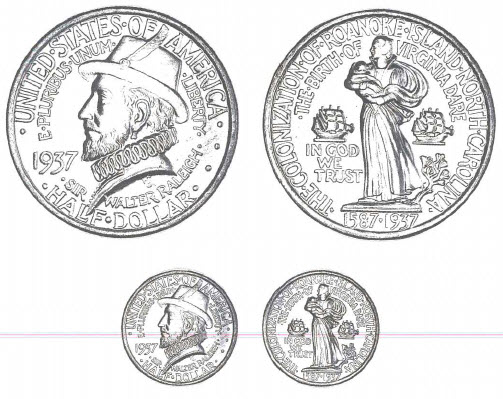
The Roanoke Colony Memorial Association enlisted Baltimore artist William Marks Simpson to prepare the designs. Portrayed on the obverse was a portrait with the inscription SIR WALTER RALEIGH below. "Sir Walter Raleigh resembles the movie actor Errol Flynn, who was specializing in Elizabethan dramatics at the time Simpson was creating this coin," Cornelius Vermeule noted in his 1971 work, Numismatic Art in America. Apparently, this is a fact, for the 1980 book by Anthony Swiatek and Walter Breen, The Encyclopedia of U.S. Silver & Gold Commemorative Coins, makes this unhesitating statement: "Obverse portrays Errol Flynn posing as Sir Walter Ralegh." (The present author has not been able to find any mention of Flynn in contemporary publicity released by the issuing commission.)
The reverse showed the standing figure of Ellinor Dare holding her child, Virginia. Many inscriptions surround. Simpson wanted to spell the explorer's name as Ralegh and cited examples that it was once spelled this way. In fact, no evidence at all could be found that it was ever Originally spelled as Raleigh. The Commission of Fine Arts denied the use of the correct spelling, informing the artist that "the models are satisfactorily designed, but the Commission disapproved of the spelling of Raleigh's name as Ralegh. In the opinion of the Commission the name should be spelled Raleigh as it is customary to do so in the United States and as it appears in the Act of Congress provided for this memorial coin. "Historical accuracy notwithstanding, Raleigh is how it finally appeared. The same spelling form is widely used today, not only in history, but in other connections, including as a brand of tobacco and as a city in North Carolina.
In January 1937, 25,015 Roanoke half dollars were struck at Philadelphia, followed by 25,015 more at the same mint in June. The congressional act specified no upper limit to the coinage, and at the time an unlimited quantity could have been made. Earlier, anticipating that the coins would be struck by the end of 1936, the Roanoke Colony Memorial Association of Manteo (located in Manteo, North Carolina) sent out an order acknowledgment card stating that shipment of the coins was expected to be on or about January 1, 1937.2 In Association correspondence the half dollars were often referred to as "Sir Walter Raleigh-Virginia Dare commemorative coins." The Association offered specimens for sale at $1.65 each. Collectors were urged to send an additional 55¢ for a copy of a booklet, A History of the Roanoke Island Settlement. The Roanoke half dollars were released too late to catch even a vestige of the wave of enthusiasm that characterized much of the market the year before, and only 29,000 were ever sold, many of these not until several years after the original offering. 21,000 coins went back to the Philadelphia Mint to be melted.
Collecting Roanoke Half Dollars Roanoke half dollars are readily available today. Among half dollars of this era, the Roanoke is one issue typically seen in middle to high degrees of Mint State, MS-63 to MS-65.
GRADING SUMMARY: Handled with care at the Mint, most coins are in high grades today. Check Raleigh's cheek and hat for marks and on the reverse the higher areas of the standing figure. Partially prooflike pieces are sometimes seen (and offered as "presentation pieces" or "prooflike presentation pieces"), although most are lustrous and frosty.