Commemorative Coins of the United States
Q. David Bowers
1924 Huguenot-Walloon Half Dollar
Illogical Portraits
In the year 1624 a group of Walloons (Lowlands Calvinists) sailed from Holland aboard the Nieuw Nederland to make a settlement in New York. Two years later the Dutch West India Company installed Peter Minuit as director of the American colony.
Sensing an opportunity three centuries later, an outfit known as the Huguenot-Walloon New Netherland Commission, chaired by Rev. Dr. John Baer Stoudt, associated with the Federal Council of Churches of Christ in America, advanced the idea of issuing commemorative coins as a fund raising venture in connection with the 300th anniversary of the early settlement.
Planning well in advance, the group assisted in the formulation of legislation that became a reality on February 26, 1923. Almost immediately, opponents pointed out that for the government to issue coins to raise funds for a church group was a violation of the First Amendment of the Constitution, which mandates the separation of church and state, and was therefore unconstitutional. However, such protests went unheeded in Washington.
The law provided for 300,000 silver 50-cent pieces to be issued in commemoration of the 300th anniversary "of the settling of New Netherland, the Middle States, in 1624, by Walloons, French and Belgian Huguenots, under the Dutch West India Company." In 1924, from May 17 through 22, Huguenot-Walloon Tercentenary celebrations were held in New York City. Among the activities paid for, at least in part, from the profit derived from the sale of the commemorative coins was the dedication of the National Huguenot Memorial Church at Huguenot Park, Staten Island, on the afternoon of May 18th.
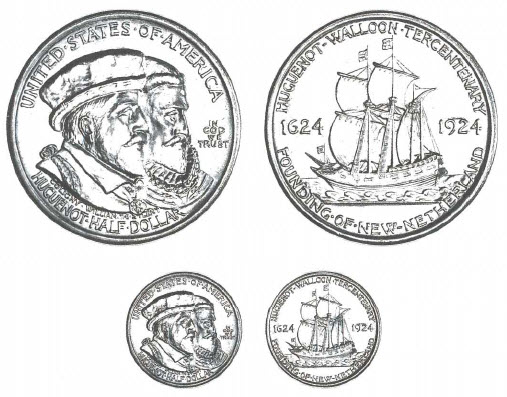
George T. Morgan, chief engraver of the Mint, used designs suggested by Dr. John Baer Stoudt and produced dies showing on the obverse portraits representing Admiral Gaspard de Coligny(1519-1572; who died 52 years before the settlement in question!) and William the Silent (1533-1584; first stadtholder of the Netherlands, who had also been dead for a long while by the time of the 1624 settlement). Both of these individuals were associated with Protestantism and the Calvinist church, a tenuous historical connection at best with the 1624 landing, although a brochure noted they were "champions of the Huguenots." Debate raged concerning the appropriateness of these portraits with the reasonable conclusion that they were irrelevant to the subject being commemorated. The reverse bore a depiction of the ship Nieuw Nederland. Morgan's models were subject to approval and modification by James Earle Fraser, and this was done. (See Taxay pp. 70'73, pages which also reprint an interesting letter from Fraser to Congressman Vestal, telling of the Mint's hostile posture toward outside artists.)
The Huguenot-Walloon design was mentioned by Stuart Mosher in his 1940 book, United States Commemorative Coins: "At the time the coin was issued, considerable controversy arose. It was claimed, and perhaps rightly so, that its issue was a shameful abuse of the coinage system. According to one critic in referring to the portraits of Coligny and William the Silent which are on the coin, 'both these men had absolutely nothing to do with the founding of New Netherland, as they had been assassinated several decades before there was a thought of a Dutch West India Company and of its colony of New Netherland. Coligny was slain at the massacre of St. Bartholomew, on August 24, 1572, and William the Silent on June 10, 1584.'"
Mintage and Distribution
To help sales, the proponents of the issue enlisted the person they considered to be the most prominent in numismatics at the time: Moritz Wormser, president of the American Numismatic Association. (Wormser served as ANA president 1921-1926, the longest term in ANA history (later terms were limited to just two years). In 1936 he founded the New Netherlands Coin Company, inadvertently adding an "s" to Netherland. Later his son Charles took over the business, adding John J. Ford, Jr. to the management in 1950, after which time the company became distinguished for its fine auction catalogues (see related commentary under the 1936 Long Island Tercentenary half dollar listing).)
Of the 142,080 Huguenot-Walloon half dollars struck at the Philadelphia Mint in February and April 1924, it is believed that 87,000 were sold for $1 each to the public, primarily through the Fifth National Bank of New York and by bulk sales to certain groups. A quantity of 55,000 pieces went back to the Treasury Department, which placed the coins into circulation. (Cf. p. 29 of Coinage of Commemorative 50-Cent Pieces OJ.S. Government Printing Office, 1936) and a letter from Secretary of the Treasury Andrew W. Mellon to Hon. Randolph Perkins, chairman of the House Committee on Coinage, Weights and Measures, January 31, 1930, which states that 55,000 were returned to the mint and then placed into circulation.) It seems unusual that relatively few worn pieces exist today. Perhaps most in the channels of commerce were immediately snapped up by alert citizens who realized their unusual nature. With relatively few exceptions, survivors seen today are in lower technical levels of Mint State.