Commemorative Coins of the United States
Q. David Bowers
1925 Lexington-Concord Sesquicentennial Half Dollar
An Important Anniversary
Few would question the appropriateness of issuing a commemorative half dollar to mark the sesquicentennial (150th anniversary) of the Battle of Lexington and Concord which took place in Massachusetts between American patriots and British soldiers on April 19, 1775, the day after Paul Revere's famous ride. Resentment against the British culminated in "the shot heard around the world," igniting the spark for American independence.
As the time for the 150th anniversary of the battle drew near, separate committees from Lexington and Concord endeavored in 1923 to have a commemorative coin made. Unknown to each other, both contacted Chester Beach to do the work. Beach agreed, and suggested that each town pay half of his $1,250 fee. The Concord group had charge of the obverse design and selected a Concord-related theme, whereas the reverse motif was the purview of the Lexington committee, which chose a Lexington landmark.
The United States Lexington-Concord Sesquicentennial Commission, as the combined group was subsequently designated, proposed legislation that was approved by Congress on January 14, 1925, and which provided for 300,000 silver half dollars to commemorate the anniversary, the same quantity authorized for the 1925 Fort Vancouver Centennial half dollars. Whereas the Fort Vancouver event was strictly of regional interest, the Lexington-Concord observation had national importance.
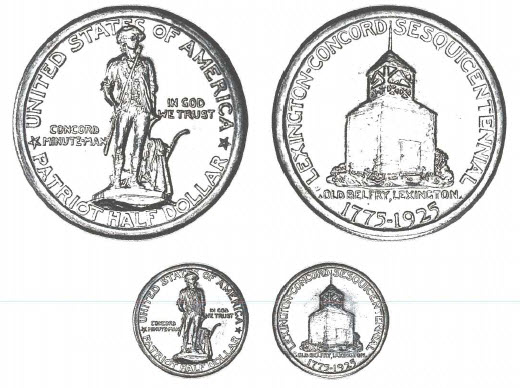
Chester Beach prepared the designs, which, after much discussion and the consideration of various ideas;' depicted the Minute Man statue (called CONCORD MINUTE-MAN in the inscription in the left field of the obverse). On the reverse was shown the Old Belfry (which alerted the Minute Men to action in 1775) at Lexington. The obverse was adapted from a sketch by Concord artist Philip Holden, who had forwarded his work to Beach. Edward C. Stone, a Lexington attorney, photographed a reproduction (the original had been destroyed in 1909) of the Old Belfry on Lexington Green and submitted the print to Beach for his use as part of the reverse motif. James Earle Fraser approved the designs on behalf of the Commission of Fine Arts but felt that better subjects could have been chosen.
The Minute Man statue was created by Daniel Chester French, a Concord resident who was 23 years of age. Modeled in clay during the winter of 1873-4, the statue was cast in plaster, then in bronze by the Ames Foundry in Chicopee, Massachusetts. A later art historian- described the work: "The young farmer is standing with one hand upon the plow and the other grasping a musket, his head alert, as if he were waiting for a summons, his body held ready to advance. Though a work of immaturity and giving little promise to the author's [French's] subsequent accomplishment, it yet has something of the sweet uplifting of sentiment that will reappear [in French's works] later with more assurance of conviction and with maturer technical expression."
The dedication scheduled to take place on April 19, 1875, the centennial date of the battle, was postponed for a day, for the 19th fell on a Sunday, and it was felt that the festivities would conflict with worship services. As President Ulysses S. Grant officiated at the ceremony, a crowd estimated at 100,000 looked on. French was in Italy and did not attend, but his father mailed a report that all had gone well.
Over the years the Minute Man statue became a familiar American icon and was reproduced many times in illustrations including on a five-cent commemorative stamp issued in connection with the 1925 Sesquicentennial. Years later, during World War II, the statue motif was used on savings stamps sold to school children to help finance the war effort.
In his 1971 book, Numismatic Art in America, Cornelius Vermeule commented as follows: "This coin, a true descendant of the Roman imperial products with statues and buildings on them, is almost reduced to the artistic level of a photograph, for little is left that is original on the part of Beach. Since the materials of the design are so wretched, artistically speaking, Beach can be forgiven for the excess of inscriptions. They were probably dictated to him. Nothing is more out of place than the religious motto. This was a commemorative half-dollar that ought to have been designed by a novice in the Mint. Although less irritating than his half dollar for the Monroe Doctrine Centennial, this coin does no credit to Beach's stature as a first-class artist. What the coin exudes in patriotism, it lacks in art."
Production and Distribution
During April and May 1925 162,099 Lexington-Concord Sesquicentennial half dollars were struck at the Philadelphia Mint, an amount representing slightly more than half of the authorization. The coins were shipped to Massachusetts, where they were encased in small wooden boxes with slide covers and distributed for $1 per coin by the Concord National Bank and the Lexington Trust Company.
The Sesquicentennial festivities were held from April 18th to the 20th, 1925, during which time approximately 60,000 half dollars were sold as souvenirs, with 39,000 finding buyers in Lexington and 21,000 in Concord. In addition, the coins were sold throughout New England and, to a lesser extent, in other areas of the United States. Most went to the general public rather than to numismatists. When all was said and done, virtually the entire coinage was sold. A paltry 86 coins were returned to the Mint for melting, and one suspects that these may have been defective pieces rather than unsold surplus, or they may have been Assay Commission coins.
Collecting Lexington-Concord
Half Dollars
For decades after 1925, Lexington-Concord half dollars were plentiful in the hands of the public in Massachusetts and other New England states, testimony to their wide distribution. Lexington-Concord half dollars were well received by numismatists, and no controversy ever arose concerning them. Many specimens exist in the AU-58 to MS-60 range, being coins which were sold to the public in 1925 and which later found their way to coin collectors and dealers. Today half dollars of this design are inexpensive enough that even a beginning collector can afford an attractive example.
GRADING SUMMARY: Today examples are readily obtained in all grades with the majority of pieces being in high AU or low Mint State categories. MS-65 coins are scarce in comparison to those in MS-60 through MS-64 levels. Look for friction on the legs of the Minute Man on the obverse and, in particular, on the corner of the Old Belfry on the reverse. Some specimens are deeply frosty and lustrous, whereas others have partially prooflike fields.