Commemorative Coins of the United States
Q. David Bowers
1938 New Rochelle Half Dollar
1936, 1937, or 1938?
The 1938 New Rochelle half dollar, commemorating a strictly local event of no national importance, is especially amusing for, although it is dated 1938 and no mention of any other contemporary date appears, the issue was struck in advance in 1937. Here we have a coin authorized in 1936, struck in1937, carrying the date 1938, certainly a perplexing situation!
The Westchester County Coin Club of New Rochelle, with numismatist Pitt M. Skipton in charge, planned the issue, which was carefully executed so that no sensibilities would be offended. New Rochelle resident Julius Guttag, who earlier was very active as a partner in the Guttag Brothers firm of numismatists and securities dealers, served as chairman of the sales committee. Guttag was remembered in later years as the founder in the 1920s of National Coin Week, sponsored by the American Numismatic Association. (It was Julius Guttag who allegedly purchased for 95¢ each the quantity of 7,500 1935 Hudson half dollars from a total mintage of 10,008, thus causing them to be scarce on the market from the time of issue.)
The enabling congressional legislation passed on May 5, 1936, stated that "in commemoration of the 250th anniversary of the founding of the settlement of the city of New Rochelle, New York, there shall be coined at a mint of the United States ... not to exceed 25,000 silver 50-cent pieces."
The bill further provided that the authorized coins shall bear the date 1938 irrespective of when they were minted. This provision, like others of its era, would seem to authorize restriking as well as prestriking the coins. Apparently, the striking of coins in the year in which the pieces were dated was no longer of concern to the government, although it certainly was important years earlier. For example, in 1899 when Lafayette dollars were struck, it was decided that the date 1900 would not be appropriate on coins struck during the preceding year, so the inscription was reworded to suggest that the date 1900 refer to a statue on the coin, not the coin itself. Apparently, by 1936 no one cared about such fine distinctions. (Nor would the government be concerned about such distinctions later. In the 19605 the various mints restruck Lincoln cents, in the 19705 the 1976-daterl bicentennial coins were struck before and after the year 1976, and in the 1905 a number of commemoratives were prestruck or restruck.)
The Design
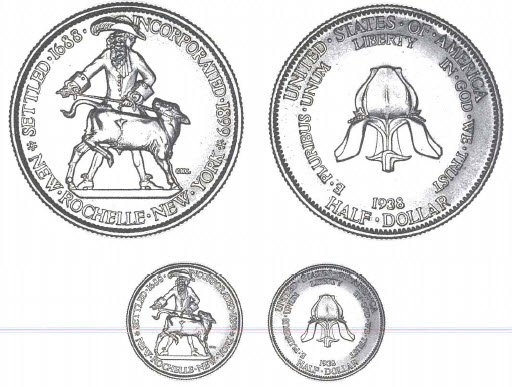
Gertrude K. Lathrop, who had created the design for the Albany, New York half dollar, was selected to create the motifs for the New Rochelle issue after the Commission of Fine Arts had criticized sketches made earlier by Lorillard Wise, who was characterized as being inexperienced in designing coins or medals. Lathrop created an obverse design depicting a fatted calf, facing to the right, with a rope around its neck. John Pell, early owner of the land upon which the city of New Rochelle is situated, was shown pulling on the rope, an acknowledgment of an early deed provision under which Pell sold his land in an agreement that provided a fat calf would be tendered in payment on June 24th every year thereafter (if demanded). (The calf used as a model on the coin was from the farm of Parker Coming, a New York representative in Congress at the time (reference: United States Commemorative Coinage, by Arlie Slabaugh, p. 148).) The reverse depicted an iris (the French fleur-delis) taken from the seal of the New York city and its French namesake, La Rochelle. On the coin the fields were unusually flat and open, providing a surface that sharply highlighted the motifs and lettering. The Commission of Fine Arts approved Lathrop's work in February 1937.
Writing in his 1937 monograph, The Commemorative Coins of the United States, B. Max Melh revealed that he was no fan of either New Rochelle or its forth-corning half dollar issue: "Having visited New Rochelle on two or three occasions, I don't quite comprehend why this town rates a commemorative coin to celebrate its 250th anniversary. The only claim to fame that this town may have is that it is only about "forty-five minutes from Broad-way." (The title of a song by George M. Cohan, copyrighted in 1905 and used in a 1906 Broadway play of the same name.) But apparently it must have, and it does have, some active collectors who apparently knew the art of string-pulling and got the bill for the coin through Congress for an issue of 25,000 coins which will be distributed at $2 per."
Stuart Mosher, in United States Commemorative Coins, 1940, took a more favorable view, at least of the design: "Miss Lathrop ... has produced in this one a most pleasing effect. The calf was modeled from life, and the colonial costume on the figure of Lord Pell has been accurately reproduced according to the style of that period. One of the handicaps belaboring every artist who attempts to design a coin for the United States government is the multiplicity of legends that must be used so as to comply with our coinage laws. In this instance the artist has arranged them in an orderly manner on the reverse, thus avoiding the cramped effect so often found on our coins when the designer attempts to crowd too many ideas into a small space. To illustrate this point we might point to the first type of our half dollar. While it may not be classed with the most artistic coins ever produced, it is pleasing and most of us like it. However, today our coins must bear two additional legends, 'In God We Trust,' and 'E Pluribus Unum.' (The first United States half dollars, minted in 1794, bore the inscription LIBERTY but not E PLURlBUS UNUM (first used on regular issue half dollars in 1801) or IN GOD WE TRUST (first used on regular issue half dollars in 1866).) Imagine, if you can, how this chaste design would appear if cluttered up with such unnecessary announcements."
In 1971 historian Cornelius Vermeule dismissed the design as "a simple, bold and absolutely tasteless coin .... It is small wonder that, on seeing a coin such as this, President Franklin Roosevelt urged a moratorium on their issue." (Numismatic Art in America, p. 203. Actually, Roosevelt made such a proposal long before he saw New Rochelle half dollars. On June 17, 1935, he wrote to Hon. Duncan U. Fetcher, chairman of the Committee on Banking and Currency, U.S. Senate, to state that "historical events could bevery suitably and properly commemorated through the striking by the government of medals in lieu of coins."