Commemorative Coins of the United States
Q. David Bowers
1936 Delaware Tercentenary Half Dollar
An Array of Dates
In March 1638 Swedish colonists, who had departed Goteborg aboard the Kalmar Nyckel and the Fogel Grip in 1637, arrived in Delaware Bay and anchored at Port Christina, the site of present-day Wilmington, Delaware, soon establishing a fur-trading outpost. Later the region fell under the control of first the Dutch, then the British, and in 1682, William Penn. In 1776 Delaware became one of the 13 original states and in 1787 became the first state to ratify the Constitution.
In 1938 it was desired to celebrate the 300th anniversary of the landing of the Swedes, but proponents of an appropriate commemorative half dollar for the event couldn't wait that long. Legislation approved on May 15, 1936, provided for no fewer than 25,000 silver half dollars to be struck at a single mint and of a single design. Authorized and dated 1936, the half dollars were actually struck in 1937 for an anniversary scheduled to take place in 1938, another reflection of the abuse of the commemorative half dollar coining privilege.
A leaflet published by the issuing commission gave this information: "The first permanent white settlement in Delaware was made by Swedish colonists in the year 1638 at 'The Rocks,' now within the city limits of Wilmington. This was not only the first settlement in Delaware, but in the entire Delaware River Valley, including the states of Pennsylvania, New Jersey, and Delaware, and the first settlement between the Dutch settlement at Manhattan on the north and the English settlements in Maryland and Virginia. The 300th anniversary will be celebrated in 1938 by the states of Delaware, Pennsylvania, and New Jersey, the national government and the Kingdom of Sweden, and the people of Swedish birth or descent now in this country."
Design and Distribution
The Delaware Swedish Tercentenary Commission staged a design competition with a $500 prize, which was won by Carl L. Schmitz, a French-born sculptor who had studied at the Beaux Arts Institute of Design in New York, whose entry was judged by Chief Engraver John R. Sinnock and noted sculptor Dr. Robert Tait MacKenzie. Lee Lawrie, a Commission member, did not know the contest winner nor was he familiar with his earlier artistic endeavors, but still he was moved to comment: "These models seem to me to be made by one who understands his business-they are excellent."
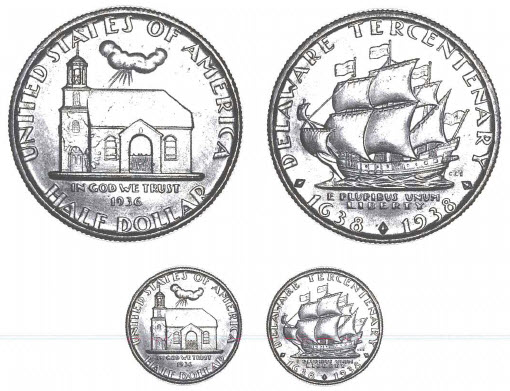
A descriptive leaflet noted: "On the obverse [sic] of the commemorative half dollar appears the Kalmar Nyckel, the ship in which the Swedish colonists arrived in this country. This design is made from a model made in Sweden, a copy of the authentic model of the ship now in the Swedish Naval Museum. The reverse shows the Old Swedes Church at Wilmington, dedicated in 1699 and still standing near 'The Rocks' in the city of Wilmington and in use. It is said to be the oldest Protestant church building in the United States still used for worship."
The issuing commission designated the ship side of the Delaware Tercentenary half dollar as the obverse; Mint records designated the church side as the obverse (today collectors agree with the Mint records).
Writing in 1971, Cornelius Vermeule praised the design." "Carl L. Schmitz produced the design for the Delaware Tercentenary in 1936 as the result of a competition. The rivalry must have run the gamut of amateurism .... Considering that two standard, even popular, and potentially difficult motifs are used, the design comes off with boldness and simplicity. Ships and architecture can offer more pitfalls than they do joys, but Schmitz, wisely, has presented plain solids and solid, yet unusual, lettering. Even the triad of standard mottoes are apportioned to both sides, to their exergues, in such a manner as to avoid irritation. Although offering nothing new, this coin speaks forcefully amid its contemporaries."
In March 1937, 25,017 Delaware half dollars were struck at the Philadelphia Mint. The Delaware Swedish Tercentenary Commission offered the coins for $1.75 each through the Equitable Trust Company of Wilmington, Delaware. All but 4,022 were sold. The undistributed coins were returned to the Mint to be melted. As was the case with several other 1936 issues, large quantities of this issue were common in numismatic circles for the next decade or two.
Collecting Delaware Half Dollars
Today the 1936 Delaware Tercentenary half dollar is popular with numismatists. Most examples seen are in the middle ranges of Mint State, MS-63 and MS-64 being typical, as the issue seems to have been handled with more care at the Mint than certain others were. MS-65 coins, while elusive, are not rare.
GRADING SUMMARY: On the church side marks will often be seen on the roof of the structure, with occasional marks in other areas as well. On the reverse the center sail on the ship often shows contact marks and also may show graininess from the original planchet. Most Delaware halves are very lustrous and frosty.