Commemorative Coins of the United States
Q. David Bowers
1921 Alabama Centennial Half Dollars
A Confusing Array of Dates
Adventurers from Spain may have traversed the area known as Alabama by 1528, more than a decade before Hernando DeSoto's 1540 visit. Settled by the French in 1702, the region later came under the dominion of Great Britain, which retained possession until the American Revolution. In 1798 the land became part of the Territory of Mississippi, of which it remained a part until Alabama became its own territory in 1817, followed by statehood on December 14, 1819.
The 1820 government census tallied 127,900 white residents of Alabama. Tuscaloosa served as capital of the state from 1826 to 1846; in the latter year it was relocated to Montgomery, a city which later served as capital of the Confederate States of America.
It seems reasonable to suggest that, if a 100th anniversary of statehood commemorative half dollar were to be created, 1919 would have been the logical year to do it. Indeed in 1919 many centennial celebrations were held throughout the state.
Now enters the element of greed. Early in the year 1920 the Alabama Centennial Commission devised the idea and promoted a piece of legislation in Congress to provide for a commemorative quarter dollar, which was amended on April 21, 1920, to be a half dollar. On May 10, 1920, a bill was passed providing for 100,000 silver 50-cent pieces to be produced "in commemoration of the 100th anniversary of the ad-mission of the State of Alabama into the Union," completely overlooking the fact that the centennial had already passed, and it was now the 101st anniversary.
Mrs. Marie Bankhead Owen, chairman of the Alabama Centennial Commission, wrote to Governor Thomas E. Kilby recommending a design that would include images of James Monroe and Woodrow Wilson, representing the American presidents in office at the time of the admission to the Union in 1819 and the anniversary in 1919. Numerous other suggestions were made including one in which the obverse would display the Alabama State Seal. Another idea was that, if no other suitable reverse could be found, a design identical to that used on regular issue 1819 United States half dollars (the Capped Bust design by John Reich) could be employed.
The situation dragged on, and finally on June 28, 1921, two years after the centennial, committee chairman Owen suggested a new design showing William Wyatt Bibb and Thomas E. Kilby, representing the governors in 1819 and 1919. This was the motif eventually adopted. The obverse and reverse were designed by Laura Gardin Fraser, wife of James Earle Fraser, utilizing Owen's ideas.
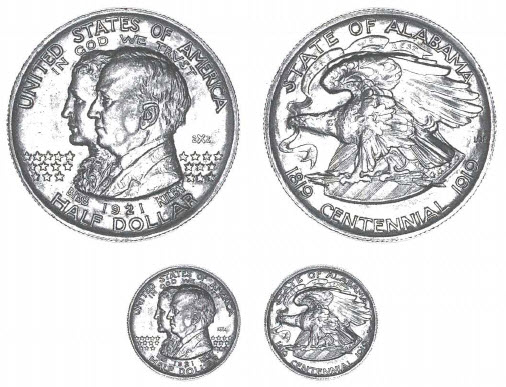
The obverse (designated as the reverse in certain contemporary correspondence) depicted the overlapping or accolated portraits of governors Bibb and Kilby, whereas the reverse showed the Alabama State Seal with an eagle holding arrows, perched on a horizontal shield. In the eagle's beak appeared a ribbon with the state motto, HERE WE REST.
The fact that Governor Thomas E. Kilby was a living individual caused much comment, for heretofore all legal tender coins had depicted dead persons. From George Washington onward enlightened public officials took the stance that living people should not be portrayed on coinage, although during the Civil War and immediately thereafter certain contemporary officials were depicted on paper money. The Act of April 7, 1866 expressly forbade the portrayal of living persons on coins. Later three other individuals-Calvin Coolidge, Carter Glass, and Joseph Robinson-were also depicted on "illegal" commemorative half dollars during their lifetimes.
The Alabama Centennial coins, authorized in 1920 to celebrate a 1919 anniversary, were not struck until 1921, and to reflect this the auxiliary date of 1921 was placed on the obverse in addition to the 1819-1919 dating on the reverse, a bewildering confusion of dates to the casual observer.
Two Varieties Created
The first examples of the Alabama half dollars were struck on October 21, 1921, and bore on the obverse a special notation, 2X2, representing the fact that Alabama was the 22nd state to enter the Union, the two digits being divided by a St. Andrew's cross taken from the Alabama state flag (the design of which inspired the Confederate flag). Some 6,006 pieces with 2X2 were struck in October 1921, after which the 2X2 inscription was removed from the master die; and a second variety, later known as the "plain" issue, was produced to the extent of 64,000 pieces (plus 38 for assay) at the Philadelphia Mint in December.
On the morning of October 26, 1921, the first pieces with 2X2 were put on sale in Birmingham during President Warren G. Harding's visit to the city. Later examples were distributed through banks for $1 each. In December 1921 a further 10,008 pieces with 2X2 were produced plus 54,030 of the "plain" type, giving a total mintage of 16,014 with 2X2 and 54,030 without that distinguishing feature.