Commemorative Coins of the United States
Q. David Bowers
1990 Eisenhower Centennial Silver Dollars
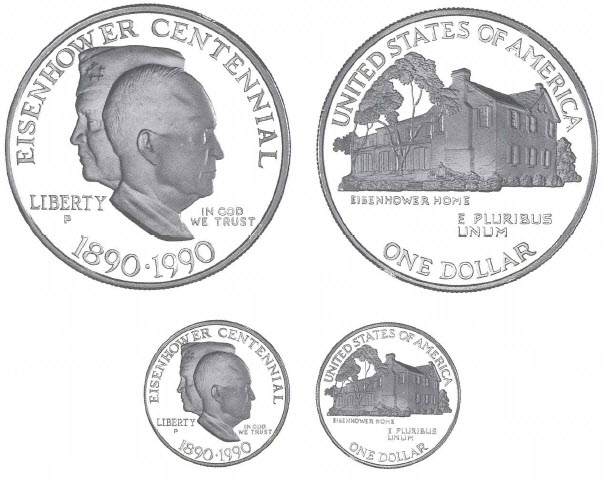
A President's Birth Commemorated
The 100th anniversary of the birth of Dwight David Eisenhower furnished the opportunity for the creation of a commemorative coin in 1990. Public Law 100-467, Signed by President Ronald Reagan on October 3,1988, provided for the production of up to four million Eisenhower Centennial silver dollars.
Eisenhower was best known as Supreme Commander of the Allied Forces in Europe during World War II and as the person who planned the D-Day invasion of Normandy, the largest in history. Later he served as president of Columbia University and still later was elected president of the United States for two terms, 1953-196l. During his presidency Eisenhower held the first summit with Soviet leaders, was the first chief executive to have a televised news conference, balanced the federal budget, and initiated the interstate highway program.
Dwight David Eisenhower was born on October 14, 1890. On the 1990 centennial date various celebrations were held around the United States including his birthplace in Dennison, Texas, his hometown of Abilene, Kansas, his retirement home in Gettysburg, Pennsylvania, and the Kennedy Center in Washington, D.C.
Mint Director Donna Pope was quoted as saying, "When we designed the Eisenhower Centennial coin we wanted to create a lasting symbol of the centennial and of the man whose life shaped the course of history. Ike helped create much of the world we know today. The coin is our way of recognizing all that he did simply put, our way of saying we still like Ike!"
The Design
In a letter to Mint Director Pope, January 4, 1989, J. Carter Brown, chairman of the Fine Arts Commission, wrote the following: "As there is ample time the Commission would like to suggest that the design for this important commemorative coin be obtained through an invited, compensated competition." Five outside artists as well as the artists on the Mint Engraving Department staff were invited to submit designs.
In August 1989 Secretary of the Treasury Nicholas F. Brady made the final selections in consultation with the Commission of Fine Arts and the Eisenhower family. John Mercanti of the United States Mint created the winning obverse motif, which featured a bust of President Dwight Eisenhower, an older man, facing right, superimposed on a younger bust as Eisenhower the five-star general, facing left. "With the two portraits on the same side of the coin, I tried to create something different, something unique," the artist noted. (Conversation with the author, April 22, 1991.)
The winning reverse by New Jersey artist Marcel Jovine, modeled by Mint sculptor-engraver Chester Y. Martin, showed Eisenhower's retirement home at Gettysburg, Pennsylvania (although no mention of the building's location appears on the coin).
A Controversial Competition
The design competition for the 1990 Eisenhower dollar really wasn't a competition in the usual sense of the word. On August 7, 1989, Secretary of the Treasury Nicholas F. Brady made preliminary selections of designs for the Eisenhower dollar, apparently without consulting with the Commission of Fine Arts until after the fact.
An account in Coin World gave details.("Ike Dollar Designs Get Approval," October 4, 1989, p.3.) "When the Commission met, only the Mercanti-Jovine designs in plaster form were presented. [Commission of Fine Arts member Diane] Wolf was critical of the fact that the Mint continues to bring designs for coins and medals after the design has been selected. 'If they had come to the Commission of Fine Arts earlier, we could have given them suggestions for improving these coin designs,' Miss Wolf stated. 'The designs were on the track but they are not as good as they could be. It is the difference between a masterpiece and something functional. We are here to help, but the Mint doesn't seem to understand that. They just want us to rubber-stamp whatever they bring over. And the way they do it, there's not much else we can do.'
"The Mint received seven obverse and six reverse designs from four outside artists and seven obverse and five reverse designs from five members of the U.S. Mint staff by the May 5/ deadline. The following outside artists submitted designs: Eugene Daub, Philadelphia (two obverse and two reverse designs); Jovine (one obverse and one reverse); Curtis Kauffmann of Springfield, Missouri (one obverse and one reverse); and Patricia Lewis Verani of Londonderry, New Hampshire (three obverse and two reverse). One of the five outside artists invited to participate, William Woodward, of Warrenton, Virginia, did not submit designs by the deadline.