Commemorative Coins of the United States
Q. David Bowers
1991 United Service Organizations
Silver Dollars
Honoring the USA
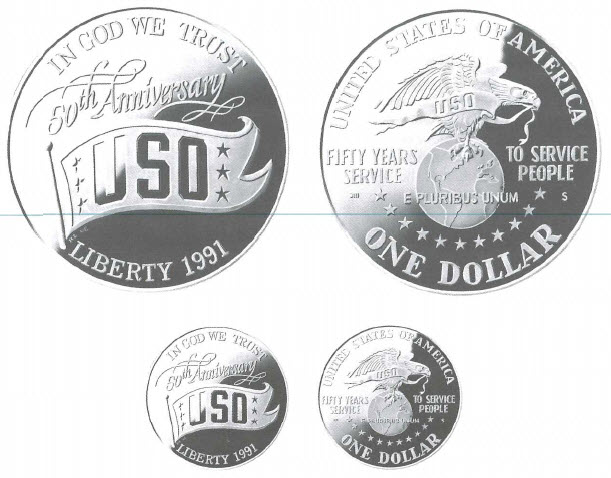
In 1991 a commemorative silver dollar was produced to observe the 50th anniversary of the United Service Organizations, which provides entertainment and other services to members of the United States armed forces. Coins were to be produced in both Uncirculated and Proof finishes and were intended to be ready by Flag Day on June 14, 1991. Profits from surcharges on the USO dollars were to be divided evenly between the USO and the United States Treasury. The enabling legislation, Public Law 101-404, was approved on October 2, 1990. The price of each coin included a $7 surcharge of which 50% went toward "the USO to fund programs, including airport centers, fleet centers, family and community centers, and celebrity entertainment," with the remaining 50% to be applied to the national debt.
Design Selection Controversy
The legislation stated: "The design of the coins shall... be emblematic of the services provided by the USO to military service personnel and families [and shall include the date 1991 and the regular statutory inscriptions]. The design for each coin authorized by this act [actually, only one coin was authorized] shall be selected by the secretary [of the Treasury] after consultation with the president of the USO and the Commission of Fine Arts."
Five artists from the private sector and artists from the Engraving Department of the Mint were invited to submit sketches. On January 17, 1991, the Commission of Fine Arts approved the designs. Later the motifs were approved by Secretary of the Treasury Nicholas F. Brady.
The USO, Korean War Anniversary, and Mount Rushmore designs were the topic of hot discussion at the Commission's meeting in January. (As reflected by a transcript of the minutes provided to the author by the Commission.) Member Robert Peck commented, "I think everything in design that the federal government does, whether it is as large as a building or as small as [a coin], should be of the highest quality we can get. These are not. I would hope in our letter reporting this, we would urge that something be done to improve the design quality of our coins .... "
Commission Chairman J. Carter Brown inquired of Mint representative Eugene Essner, "Who is the jury?" to which Essner replied: "A panel consisting of myself, the director of the Mint, the treasurer of the United States, and the deputy treasurer. We do the initial review and we make recommendations to the secretary of several designs, and then the secretary makes his approval."
Chairman Brown then commented: "In our advisory capacity, since we don't want to hold you up, we are presented with a fait accompli. If in some informal way there could be some point-you do all your prescreening, there are a lot of technical issues that can or cannot be [adapted to the minting process], but if you come up with three designs, if we can have a peek at those before they go to the secretary-and in this instance the secretary of the Treasury is a very sophisticated art collector. That is not one of the necessary qualifications for the job. But if we could then, without limiting his choice, be able to have some input at that point, then when you went to him for a signoff you could say we have to report to you in all honesty, 'We, the staff, like this one, but those characters over at the Fine Arts Commission are tilting toward this, and that is trouble because if we submit something and they turn it down, it will slow us down.' There could be some colloquy here."
Mr. Essner replied that in the past this had been done, and Chairman Brown acknowledged that indeed it had been in some cases. Essner related that Mint policy was that, if just one coin were being designed, they would invite ideas from five outside artists. Commission member George Hartman stated that he "couldn't name the top three or four leading coin designers in the world," but suggested that Brown could find out, to which Brown replied, "It is a field not overpopulated with geniuses."
Then followed a discussion in which Brown suggested that sculptors and others could possibly learn the techniques of the coinage medium. "Get them an NEA grant, bring them to Washington." Mr. Essner noted that the Mint had "recently hired a couple of very good sculptor-engravers and a couple that had experience with the Franklin Mint, but the personnel system is one of the problems .... Also, the pay scale that the government is authorized to pay is a problem."
Clearly, public and government commentaries concerning the designs used on 1991 commemorative coins dramatically indicate two things: (1) The Mint should be allowed by Congress to have more time to refine designs and should not be given unrealistic deadlines. (2) Given adequate time the Commission of Fine Arts and the Mint should work together more closely, and a wider selection of quality designs should be presented for consideration.
Significantly, numismatists, representing the majority of buyers of commemorative coins, have had no say in the design selection process or any other aspects of commemorative coinage, a situation which calls for remedy.