Commemorative Coins of the United States
Q. David Bowers
1920-1921 Pilgrim Tercentenary Half Dollars
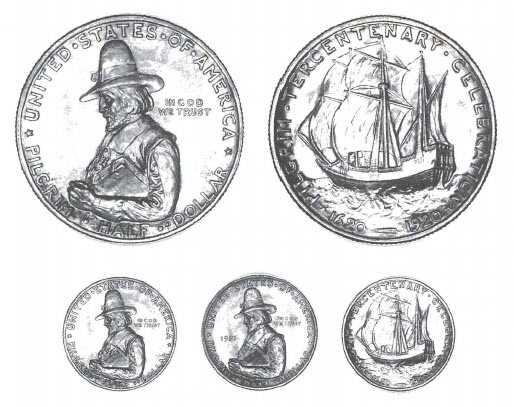
Pilgrim Coins Authorized and Designed
In 1920 the 300th anniversary of the landing of the Pilgrims at Plymouth furnished the opportunity for numerous celebrations throughout New England. On May 12, 1920, special legislation was passed which authorized the production of 300,000 (the bill originally stated 500,000 but was amended, apparently inadvertently) silver Pilgrim Tercentenary 50-cent pieces to commemorate the event. Nothing was said about issuing the coins for more than one year, but doing so was not in violation of the legislation, for neither was it prohibited.
The Pilgrim Tercentenary Commission suggested a design, which was modeled by Cyrus E. Dallin, a Boston sculptor who was known for Indian subjects. The obverse bore a stylized portrait of Governor William Bradford (1590-1657), who was said to represent a typical Pilgrim of the time. The Pilgrims were part of the Puritan movement whose members fled England during the reign of King James I when he threatened religious dissidents with expulsion or worse. Bradford was among the Pilgrims who came from England aboard the Mayflower, arriving in the New World late in the year 1620 to settle in what became known as Massachusetts. He served as elected governor of the Plymouth colony for 30 years and wrote a book, History of Plimoth Plantation, which told of life there. On the coin Bradford's left arm supports a Bible, representative of the Separatist religious movement of which the governor was a member, a group which endeavored to lead their lives in strict accordance with that book's teachings. Alternatively, Old Colony Memorial, published in 1920, states that the book supported by Bradford is his History of Plimoth Plantation (Michael Garofalo noted this in "The Celebration of the Pilgrims," an article in The Commemorative Trait; Winter 1989, pp. 43-46.)
Curiously, sculptor Dallin's initial D was shown incuse or recessed under Bradford's elbow on the coin-an unexplained departure from all other motifs, indicating it was probably added by the use of what seems to have been a D mintmark punch, possibly as an afterthought in the hub. On the original plaster model his initials C.E.D. appeared in relief.
The reverse showed a view of the Mayflower but with an error in the ship's rigging, for it showed a flying jib type of sail that had not been used at that early date; a square water-sail under the bowsprit should have been depicted. (As pointed out by David M. Bullowa in The Commemorative Coinage of the United States, p. 43.) The reverse displayed the date expressed as 1620-1920.
As the legislation authorizing this issue was not approved until May 12 and as during the summer of 1920 many celebrations were planned, the artist was urged to complete his work as quickly as possible.
James Earle Fraser was shown Cyrus E. Dallin's models by the Commission of Fine Arts and found the devices to be well done but the inscriptions crude, as noted in this letter to chairman of the Commission of Fine Arts Charles Moore, undated, but probably written toward the end of August:
"My Dear Mr. Moore:
"Altogether the design for the Pilgrim fifty-cent coin is good. The part that seems to me to need most attention if there is time is the lettering. The design would be greatly helped by good lettering. It is too bad that we can't make our suggestions in time to let the artist make a few changes if needed. As it is, the coins are to be minted within a month, which leaves no time for bettering the work and puts us in the position of accepting work which we are not altogether in favor of. Would it be possible to make a suggestion that the model should be shown to the Commission three months before the coin could be minted?
"Faithfully yours."
Dallin was not given the opportunity to redo the lettering.
Distribution of the Coins
In October 1920, 200, 112 Pilgrim Tercentenary half dollars were struck at the Philadelphia Mint. Except for the odd 112 pieces reserved for the Assay Commission, the production was shipped to the National Shawmut Bank in Boston, which put them on sale for $1 each beginning in November, with the profits going to the Pilgrim Tercentenary Commission. (Addison L. Winship. a vice president, was in charge of distribution for the Shawmut Bank. An offering brochure illustrated Dallin's models, without lettering, for the coin.) A Shawmut Bank brochure noted: "There will be no re-issue of Pilgrim half dollars, and all who desire these historic mementoes should take advantage of the present opportunity to secure them." Although by November the impetus of the 300th anniversary of the landing of the Pilgrims had been blunted and the situation was old news to many, sales proceeded at what was announced to be a satisfactory pace, although by the end of the year tens of thousands of unsold coins remained on hand.