Commemorative Coins of the United States
Q. David Bowers
1935-1936 San Diego Half Dollars
(California-Pacific Exposition Half Dollars)
Exposition Coins
The California-Pacific International Exposition held in San Diego saw the issuance of commemorative pieces popularly known today as San Diego half dollars. $20 million was spent to stage the event in Balboa Park in that city, but fewer than four million people eventually attended. Located in California about 10 miles from the Mexican border, San Diego, home of a large naval base, was and is a popular tourist attraction, shipping port, and commercial area. The Exposition sought to popularize the advantages of the seaport city. A brochure advised visitors to the Exposition that "living costs are low in San Diego. More than 200 hotels. Rates range from $1.00 per day."
Legislation approved May 3, 1935, provided for the coinage of not more than a quarter million silver half dollars for sale in connection with "the fulfillment of ideals and purposes" of the Exposition, one such purpose being profit. To stimulate interest on the part of collectors, coinage was to be accomplished at two different mints (interestingly enough, not including Philadelphia).
Design and Mintage
Robert Aitken, who had been associated with certain earlier commemorative series(most notably the Panama-Pacific $50 gold coins), prepared the designs for the San Diego half dollar, which were translated into dies by the Medallic Art Company in New York.
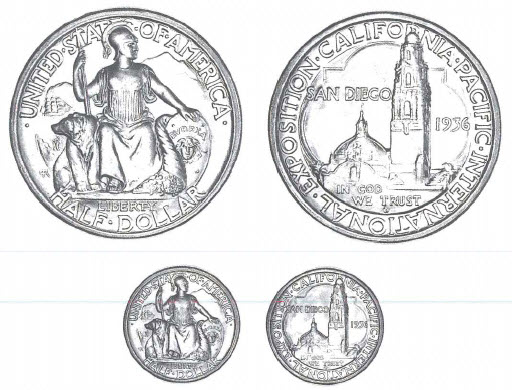
The obverse depicted elements of the California State Seal, with Minerva seated, wearing a helmet, with her right handholding a staff and her left resting on a shield inscribed EUREKA. A cornucopia is between the shield and goddess Minerva, and to her right (observer's left) is a grizzly bear. In the distance, faintly, are a sailing ship and a gold miner, set against hills of the Sierra Nevada. The reverse showed parts of two buildings, the Chapel of St. Francis and the California Tower, at the California-Pacific International Exposition.
The total coinage came about in an interesting way. The original authorization provided for not more than 250,000 pieces without any specific date given, except it was noted that the Exposition would beheld in 1935 and 1936. During August 1935 the San Francisco Mint produced the entire authorization of 250,132 pieces (the odd 132 being for assay), which were sent to the Exposition and offered for sale for $1 each. The large production figure was not attractive to collectors, especially in view of only 10,000 having been made for the highly sought-after Hudson issue of recent notoriety, and interest was not strong, despite an extensive campaign involving news releases and advertising.
Melting and Recoining
The Exposition petitioned Congress to pass additional legislation, which was accomplished on May 6, 1936, providing that "the director of the Mint is authorized to receive from the California-Pacific International Exposition Company, or its duly authorized agents, not to exceed 180,000 silver 50-cent pieces heretofore coined under authority of an Act of Congress approved May 3,1935, and recoin the same [the unsold 1935-S pieces] under the same terms and conditions as contained in said Act: Provided that the coins herein authorized shall be of the same design, shall bear the date 1936 irrespective of the year in which they were minted or issued, and shall be coined at one of the mints of the United States .... "
This curious recoinage proposal was implemented, and Denver was selected as the site for coinage of 180,092 pieces dated 1936. Earlier the Exposition petitioned Congress to authorize the production of 1936 coins at all three mints, but the request was denied."
Offered at $1.50 each, the sales of 1936-D San Diego half dollars were even less satisfactory than seen for 1935-S, and eventually a huge quantity amounting to 150,000 pieces went back to the Treasury for melting, leaving a net distribution of just one-sixth of the 180,000 coinage, which coins, it must be remembered, in turn were made from silver taken from unsold coins of the 1935-S issue. All of this activity certainly kept Mint employees busy, but whether it was productive for anyone else is a matter for debate.
The 1935-S San Diego half dollars were placed on sale at the Exposition grounds on August 12, 1935, and were offered for $1 each plus shipping charges for those who ordered by mail. Emil Klicka, treasurer of the Exposition, tried his best to sell the pieces, but the high published mintages were his undoing. A number of pieces were retained by the Exposition, apart from those returned for melting, and were subsequently offered in 1937 at $ 3 each, as if raising the price would make them seem "rare" and do something for the sales effort.
Klicka's advertising (A veritable blizzard of direct mail form letters was directed to the collector market circa 1935-1938. Much of Klicka's text consisted of incomplete sentences and thoughts that were hard to follow.) noted enthusiastically: "Do not be surprised if coins sell at $5.00 each before 1938!! If [the] price of [a typical] coin [rises to] only $6.00 in 10 years, [this] would make average 10% per year increase on present price, $3.00!! Due to the constantly increasing number of collectors these coins will advance steadily in price .... The [half dollar] promises to become an exceedingly valuable specimen. The coins, as an investment, will increase in value in years to come .... Probably your last chance to buy Uncirculated San Diego commemorative coins.... Our coins are selling rapidly-we urge you to order at once! Price $ 3.00 each for either 1935 San Francisco Mint or 1936 Denver Mint-THIS PRICE GOOD ONLY TO JUNE 1st 1937 .... Coin collectors from all parts of the world buying up coins before supply is exhausted."
However, in 1938 Emil Klicka sent a form letter to collectors offering 1936-D coins for the "real bargain" price of just $1 each, limit 10 coins per buyer. 1935-S coins were offered in 1938 for $2 each. The unsold supply of coins was stored in the Bank of America, San Diego.