Commemorative Coins of the United States
Q. David Bowers
1987 Constitution Bicentennial Silver Dollars
The Constitution Commemorated
The next occasion for issuing commemorative coins was provided by the 200th anniversary of the United States Constitution, observed in 1987. Through the efforts of Representative Frank Annunzio, a bill known as the Act of October 29, 1986 (public Law 99-582), was passed, which authorized the production of up to 10 million silver dollars and one million $5 gold pieces in combinations of Uncirculated and Proof finish. Surcharges of $7 for the dollars and $35 for the $5 pieces were to go toward reduction of the national debt, seemingly a bottomless pit, a vast deficit which was not likely to inspire any sense of patriotism in the heart of the average coin purchaser.
When distribution ended, nearly four million coins had been sold, yielding $52 million toward the debt. The allowable minting period extended to and included June 30, 1988 (technically, issues made in 1988 were restrikes).
This was not the first time that coins were proposed to commemorate this historic document. On April 23, 1936 there was introduced into the House of Representatives a bill CH.R. 12443) to authorize the coinage of half dollars to observe the 150th anniversary of the adoption of the Constitution of the United States. It was proposed that these commemoratives be "coined in an unlimited number during the year 1937 only" and that "as a further means of [observing the occasion] the director of the Mint shall suspend and cease the coinage of the usual or regular 50-cent silver pieces during the ca1endaryear 1937." Nothing came of the idea.
The Design
J. Carter Brown, chairman of the Commission of Fine Arts, wrote to Mint Director Donna Pope on November 4, 1986, to express the Commission's belief that "this is a great opportunity to tap the creative ability of our distinguished sculptors and invite them to participate in the design of these coins. I can think of no more fitting opportunity to demonstrate the federal government's commitment to the highest quality in its art. Anything we can do to support such an endeavor would be a welcome task. It is our hope that these coins can be truly representative of our very best efforts as a people. The occasion they will celebrate deserves no less."(As quoted in "More New U.S. Coins," by Ed Reiter. Coinage, February 1987, p.104.)
Secretary of the Treasury James A. Baker III announced that a competition would be held in which 11 outside sculptors would be invited to compete with six on the staff of the Engraving Department of the Mint. (The following outside artists were invited to compete: Robert A. Weinman, Merlin Szosz, Don Everhart, Marika H. Somogyi, Mico Kaufman, Eugene Daub, Karen Worth. Patricia Lewis Verani, Charles Perry, Marcel Iovine, and Leonard Baskin.) Each artist was requested to submit four sketches in return for a payment of $ 2,000, whether or not the designs were used. (The two artists whose designs were chosen each earned "about $3,000 in supplemental fees by working with the Mint technical staff," according to Eugene Essner (of the Mint Headquarters staff) as quoted in an article, "The Mint Holds an Official Design Contest," by Ed Reiter, Coinage, March 1988, p.43.) On March 31, 1987, Baker revealed that New Hampshire artist Patricia Lewis Verani's motif for the dollar was chosen. The Mint Engraving Department reduced the models and prepared the dies.
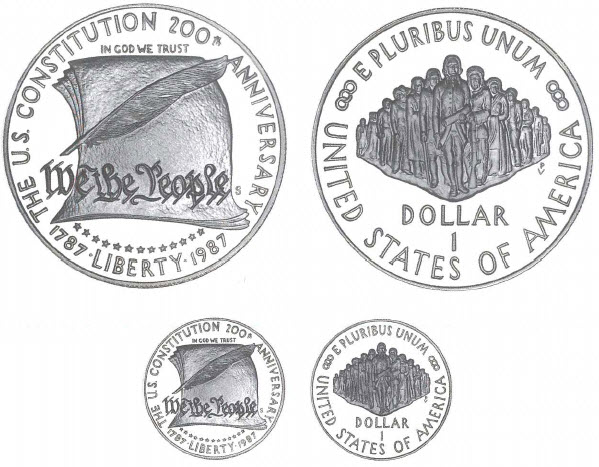
An official Mint description noted: "The obverse displays a quill pen laid across a sheaf of parchments and reads 'We the People.' The reverse depicts a cross-section of Americans from past and present in a dramatic parade through history. (Annual Report of the Director of the Mint, 1987, p. 11)
Minutes of a meeting of the Commission of Fine Arts reflect the reaction of its members. (Minutes of the Commission meeting, April 16, 1987, p. 2.) "The design of the one-dollar silver coin, by Patricia Lewis Verani, was not of the same high quality [as Marcel Jovine's design for the $5 gold] and [the members] recommended that if the secretary of the Treasury was not particularly attracted to the design, the Commission would like to study the other entries. Barring that, they thought the present selection ought to have the same style lettering as the five dollar coin and that 'DOLLAR l' was not as appropriate as 'ONE DOLLAR' on the reverse."
Mrs. Verani and the Dollar
Burnett Anderson, Washington correspondent for Numismatic News, filed this story on April 7, 1987: "Patricia Lewis Verani, designer of the Constitution Bicentennial silver dollar to be issued later this year, drew on a background of varied sculpture ranging from the monumental to the miniature in the creation of her winning design. Mrs. Verani, who entered a total of six submissions in the competition embracing 11 outside artists and U.S. Mint sculptor-engravers, described herself as thrilled, surprised, and honored by the selection of her work for the 1987 silver coin.
"Her first monumental bronze work was the Fighting Black Bear of the University of Maine, eight feet high at the shoulder, she said, a prominent and familiar sight at the University's campus in Orono. 'He's really monumental, Mrs. Verani continued, 'in a sort of half crouch and about eight feet wide as well.' She described the work as 'somewhat stylized, not stark realism, but not abstract either. You don't have any doubt that you're looking at a big black bear.'
"Mrs. Verani' s design for the silver dollar features a quill pen with some papers on the obverse, with the phrase 'We the People' superimposed across the coin in a script similar to that used in the original copy of the Constitution. The main feature of the reverse is a group of men in colonial dress, the foremost one with a roll of papers, reminiscent of paintings of the Founding Fathers.
"Asked how she generated the ideas for her designs, Mrs. Verani said that 'apparently everyone thought of the quill pen and papers,' and the quill appears on both the obverse and reverse of the gold coin designed by Marcel Jovine as well as on her obverse. 'But I was thinking of the people, of the whole country, as with the way so many people could identify with the Statue of Liberty, and I wanted people,' she said. The superimposition of the phrase 'We the People' was also her independent idea, but in the process of moving through the Treasury it was moved from the reverse to the obverse, she said ...."