Commemorative Coins of the United States
Q. David Bowers
1920 Maine Centenial Half Dollar
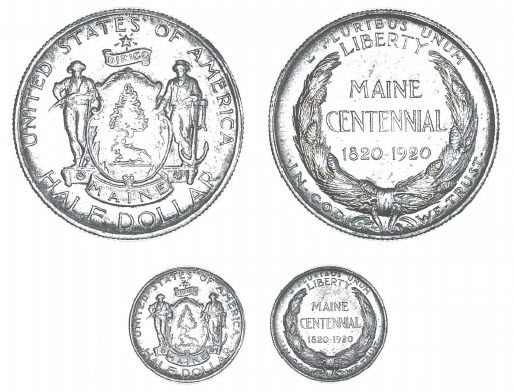
To Celebrate a Centennial
To celebrate the 100th anniversary of the admission of the state of Maine to the Union in 1820, the governor and Council of the state of Maine requested that the State Treasury Department issue a commemorative half dollar. On April 21, 1920, John A. Peters, a delegate to the House of Representatives from Maine, sought to promote his bill for a centennial half dollar by noting that the pieces were intended to "simply go into circulation with the special design upon them." It was felt that if the pieces passed from hand to hand in pocket change they would help publicize the centennial observation.
Maine, the largest of the New England states, had been settled on a transient basis by the French as early as 1604 and by the English shortly thereafter. By about 1623 permanent villages had been established by both countries. Although the district had its own British royal charter earlier, by 1658 it had come under the control of Massachusetts, which at the time claimed boundaries ranging far from the limits we know today. The citizens of the area wanted independence, and on March 15, 1820, Maine became the 23rd state in the Union in a trade-off in Congress in which under the Missouri Compromise, Maine entered as a free state whereas Missouri in 1821 entered as a slave-holding state.
Legislation providing for the Maine commemorative half dollar was approved on May 10, 1920, well into the centennial year, and was similar in wording to that authorizing the 1918 Illinois issue. The amount of pieces to be coined was 100,000, and expenses of die preparation were to be borne by the state issuing authority. By this time it had been decided to sell the coins at a premium to the public rather than release them into circulation for face value.
The Design Controversy
Four days after the bill authorizing the Maine Centennial half dollar passed, Secretary of the Treasury David F. Houston wrote to the chairman of the Commission of Fine Arts, Charles Moore, enclosing a sketch submitted by Representative Peters on behalf of the officials in charge of the centennial observation. Moore was asked for his opinion as to the merits of the proposed design. Moore forwarded the sketch to Commission member James Earle Fraser, a talented sculptor who had designed the 1913 Indian-buffalo nickel among other things.
Fraser did not like the motifs and said so in this communication: "Mistake to accept design for coin in form of drawing. Model should be made by medallic sculptor of note. Our coins have reached a high grade of perfection because this method is used. Designs proposed ... very ordinary. Should not be used .... "
Chairman Moore then contacted the secretary of the Treasury, stating that if accepted the design "would result in a coin far below the standard set by the new fifty-cent piece" (a reference to the highly-acclaimed Walking Liberty design by Adolph A. Weinman for regular issue half dollars in use in circulation since 1916).
"The design proposed is positively bad, and would bring humiliation to the people of Maine if it should be executed," Moore continued. "The Treasury Department and the Mint also would be made to suffer criticisms from the people who have now been aroused to a feeling and demand for an artistic coinage" (again a reference to the new silver coinage of 1916).
Further allusions were made by Moore to other coin designs of earlier times, probably Charles E. Barber's dime, quarter, and half dollar motifs of1892-1916, which had been widely criticized from nearly the first day they were produced: "We should not return to the low standards that have formerly prevailed. This is especially true in the present instance, where the coin goes ultimately to collectors and becomes a permanent memorial of the state of Maine."
The Maine Centennial Commission remained adamant. No change was wanted. The sketch was given to sculptor Anthony DeFrancisci, whose credentials were excellent, who did the best he could to create acceptable models from the design provided. (In 1921 DeFrancisci would create the design for the Peace silver dollar, a regular issue.) At the Philadelphia Mint the Engraving Department translated the models into coin dies. The result was a motif that few lauded for its beauty. The obverse was taken from the arms of the State of Maine and depicted a farmer, sailor, pine tree on a shield, moose, and other elements, whereas the reverse Simply bore inscriptions and a heavy wreath of pine in keeping with the Pine Tree State nickname given to Maine.