Commemorative Coins of the United States
Q. David Bowers
1935 Connecticut Tercentenary Half Dollar
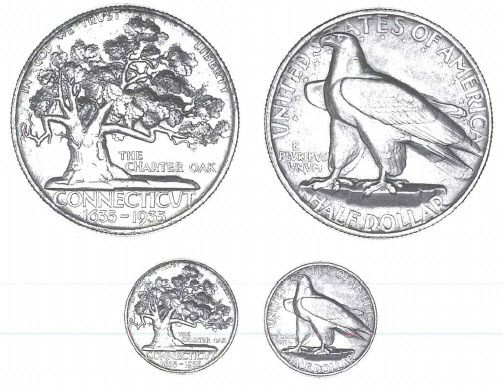
A Commemorative for Connecticut
The year 1935 was the proper date to observe the 300th anniversary of the founding of the colony of Connecticut, and, to the credit of the issuers of this commemorative half dollar, the Connecticut Tercentenary Commission did not start the celebration early, nor did they end it late.
To provide for an issue dated 1935, on June 21, 1934, President Franklin D. Roosevelt approved an act of Congress providing for 25,000 silver half dollars of appropriate design. Sculptor Henry G. Kreis was selected to prepare the models under the supervision of Paul Manship, a prominent medalist of the era.
The obverse design was adapted from an 1855 painting by Charles DeWolf Brownell owned by the Connecticut Historical Society that depicted the Charter Oak, the most prominent icon in Connecticut history, a tree in which early colonists secreted their royal charter when agents of King James II desired to confiscate it. The reverse depicted an eagle of starkly modernistic form (somewhat similar to the eagle motifs used in Germany at the time), perched, with appropriate legends surrounding. Artist Kreis later used a related eagle motif when he designed the reverse of the 1936 Bridgeport half dollar.
Correspondence surviving from communications between two members of the Commission of Fine Arts reveals that a number of criticisms were levied concerning the design. A particular complaint was that the leaves on the Charter Oak were made much larger than appropriate for the scale of the image and the size of the tree trunk. Apparently, this was artistic license.
For a number of years numismatists were divided as to which side should be called the obverse and which the reverse with David M. Bullowa designating the eagle side as the obverse, following notations in Mint records. Today the preference is that the oak tree side is the obverse.
In his 1940 book, United States Commemorative Coins, Stuart Mosher wrote: "This half dollar is among the most handsome of the entire series. The very simplicity with which the artist has portrayed the massive oak is pleasing to the most critical. The tree stood upon the northern slope of the Wyllys Hill, in Hartford. The trunk was 25 feet in circumference near the roots. A large cavity about two feet from the ground was the place of concealment of the Charter. On August 21st, 1856, a heavy gale uprooted the tree. The Wyllys Hill has been graded to a terrace, called Charter Oak Place, fronting on old Charter Oak Street, running east from Main Street, and now called Charter Oak Avenue. On the terrace, a few feet from the entrance to Charter Oak Place, a white marble slab marks the exact spot where the famous tree stood. The famous charter is now in the possession of the Connecticut Historical Society. The copy of it, which was retained in England until given to the colony by William III, is on exhibit in the assembly hall of the State Library. These interesting relics are seen by thousands of visitors each year."
Cornelius Vermeule had this to say about the design: (Numismatic Art in America, page 187.) "Henry G. Kreis ... used the great oak as a most effective composition on the obverse, and a massive eagle, thrusting like a rocket, on the reverse. Pleased no doubt with the novelty of this mighty bird, the following year Kreis reversed it, and tilted the head upward and the tips of the wings down to create the eagle on the reverse of Bridgeport's Centennial half dollar in 1936. All elements of the Connecticut Tercentenary coin blend superbly, the mottoes and aphorisms disappearing amid the leafy clusters on the obverse and the balance of the opposite side as successful as the eagle of 1907. (A reference to Augustus Saint-Gaudens' regular issue $10 of 1907.) Kreis inherited Saint-Gaudens' feeling for relief, space, lettering, surfaces, and edging. He was to continue the sharp, elongated, angular style of his eagles into the next decade, when he produced a startling medal of Five Wise and Five Foolish Virgins for the thirty-sixth issue of the Society of Medalists."
Interestingly, although the legislation specifically stated that "The United States shall not be subject to the expense of making the models for master dies or other preparations for this coinage," the law was violated, for the government financed Kreis's design and models as part of a Public Works Administration project. Apparently, no complaint was voiced concerning this unauthorized use of government money.
Production and Distribution
During April and May 1935 the full authorized coinage of 25,000 pieces, plus 18 coins for the Assay Commission, was produced at the Philadelphia Mint. The Connecticut Tercentenary Commission encased the coins in small cardboard boxes and distributed them through banks in the state as well as by mail to collectors. The vast majority went to Connecticut citizens, for by mid-1935 the commemorative boom had not yet begun, and interest in numismatic circles was sufficient to absorb only a few thousand pieces.
On July 8, 1935, Herbert L. Crapo, executive secretary of the Tercentenary Commission, wrote to coin dealer L.W. Hoffecker, stating: "We have disposed of our entire original allotment of 25,000, and are having some difficulty in reserving a few which we want to present as gifts to dignitaries." Apparently, even these few reserved pieces were gone by September. There was never any problem concerning profiteering, exploitation, or anything else connected with this issue, except perhaps the unauthorized use of Public Works Administration funds, a minor situation.
Collecting Connecticut Half Dollars
Today collectors prize Connecticut Tercentenary half dollars, and they are avidly desired for inclusion in commemorative sets. Most examples survive in grades in the high AU and low Mint State levels. Higher grade coins such as MS-65 are elusive.
GRADING SUMMARY: Friction and/or marks are often obvious at the ground or baseline of the oak tree on the obverse and, in particular, on the broad expanse of wing on the reverse. Turn the coin at several angles to the light to check for hairlines on the wing, and if they are there you will see them (the 1936 Bridgeport half dollar by the same designer is similar in characteristics of the reverse). Specimens that are otherwise lustrous, frosty, and very attractive often have friction on the wing.