Commemorative Coins of the United States
Q. David Bowers
1984 Olympic Silver Dollars
Another Olympic Dollar Issue
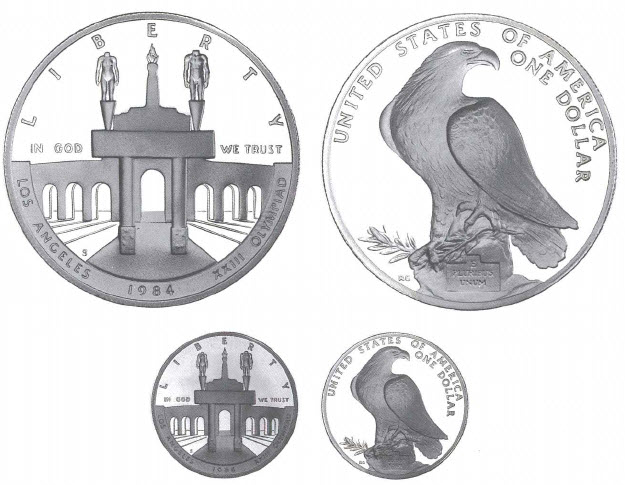
Robert Graham, who created the bronze sculptures placed at the gateway to the Los Angeles Coliseum, designed the 1984 Olympic silver dollar coin made of the same fineness as the 1983 issues. His obverse depicted two headless figures on a lintel supported by two columns with an Olympic flame between the figures and an outline of the Coliseum below. The reverse illustrated a perched eagle with its head turned over its left shoulder, an attractive and quite bold representation of the national bird, with an olive branch but lacking the customary arrows (for war or defense).
The obverse of the 1984 Olympic silver dollar received criticisms from viewers, and the Fine Arts Commission stated the design was without question a "loser," but the coin became a reality and was included as part of the Olympic Games marketing program. An unnamed spokesman of the Engraving Department of the United States
Mint, quoted by Walter Breen, apparently disliked the design and stated that the employees of the department were "just doing our job" when the Mint reduced Graham's models to coin size and to dies. (The Encyclopedia of u.s. Silver & Gold Commemorative Coins, 1990 reo print edition, p. 364.)
Opinions of the Fine Arts Commission
The Commission of Fine Arts had this opinion of the preliminary motifs. (Letter from J. Carter Brown to Francis B. (Barry) Frere, October 27, 1982.) "Obverse: Design is confusing, making Coliseum to be wings attached to sculpture in front of it. Suggest eliminating Coliseum, or sculpture, or using different design. Reverse: Approved."
In congressional testimony J. Carter Brown, chairman of the Commission of Fine Arts, commented. (Oversight on 1984 Olympic Commemorative Designs, Hearing Before the Subcommittee on Consumer Affairs and Coinage .... December 1, 1982, Serial No. 97-98, p. 19. J. Carter Brown is director of the National Gallery of Art, Washington, D.C.) "Unfortunately ... my experience ...is to have seen ... the difficulties that artists get into if they have not been that experienced in what happens when you reduce a design and when you have to make it producible by the technology of either a stamp or a coin. What has happened, it seems to me, with the obverse of the 1984 silver dollar, is that too much got crammed into too little, and you lost legibility, and you just can't tell what on earth that thing is trying to be. If it were blown up on a big screen you would probably say, 'There is a coliseum, and there is a sculptured archway, and whether you like it or not, you could understand what it was trying to be. So, we have a real problem of visual communication here .... "
The 1984 dollar was reviewed again at the Commission of Fine Arts meeting held on May 10, 1983, at which time revised designs were shown: "Like the previous design submitted, it showed the 1984 Olympic gateway with the Los Angeles Coliseum in the background. While some changes had been made, the members did not consider it an improvement because the roof line of the Coliseum coincided exactly with the horizontal member of the gate, still giving the impression that the building was an appendage to the gateway. It was unanimously disapproved, with the suggestion that the building be moved down so that it would appear entirely separated from the gate. (Minutes of the meeting, p. 14.)
Recollections of Mint Director Pope
In an interview with the author. (February 11, 1991, with follow-up commentary on March 14, 1991.) Mint Director Donna Pope told of the design: "The torsos gave us fits. The artist was an outside artist used at the insistence of the Olympic Committee. The Mint staff had to work with Bob Graham, who submitted his design in plaster, not in the usual sketch form. So, when we asked him to redo something, he would have to work on the plasters instead of sketches, taking a lot more time. At one time there were arms on his torsos, and the next time there were none. The nudes were too explicit for us, and we asked Bob Graham to tone them down. He did something, and the 20-year-old (?) torso of the woman first shown, suddenly looked like a 60-year-old's top torso. The male torso got more explicit instead of less explicit. I was very nervous about having nudes explicit.
"We finally got the lady's upper torso correct, but I was still concerned about the male's lower torso. I called Bill Smith [head of production at the Philadelphia Mint, where dies are made] one day, secretly, and said if anybody asks about it, say it was an order by the director, but only say this if asked, don't offer it. I told him in rather specific terms 'to lower the relief on a certain portion of the male torso.' The coin turned out nowhere near as explicit as the plaster. The coin we all dreaded didn't look that terrible. This coin sold better than the 1983 silver dollar. We were all afraid it would be a big bomb. Bob Graham was interested in doing the coin design because he was the sculptor for the sculpture actually used at the main Olympic stadium."