Commemorative Coins of the United States
Q. David Bowers
1922 Grant Memorial Half Dollars
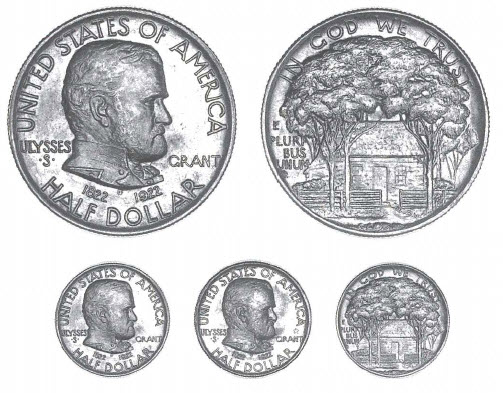
Ulysses S. Grant
The race was on to create unusual varieties for collectors, and the next entry in the field consisted of the 1922 Grant Memorial half dollars, made in two varieties, and accompanying gold dollars, likewise made in two versions. The occasion was the 100th anniversary of the birth of President Ulysses S. Grant. It developed that the general public greeted the silver and gold issues with a big yawn, and the main market (or what there was of it) was with numismatists and speculators.
Grant was born in Point Pleasant, Ohio on April 27, 1822. In his second year he moved with his family to Georgetown in the same state, where he spent his boyhood. In 1839 he entered West Point, from which institution he graduated in 1843, going on to serve in the army under Gen. Zachary Taylor and Gen. Winfield Scott during the Mexican War, 1845-1848. Grant resigned from the army in 1854 and worked as a farmer and real estate agent in St. Louis, moving to Galena, Illinois in 1860. When the Civil War erupted, he offered his services and was appointed colonel of the 21st Illinois Volunteers, later advancing to the rank of brigadier general. He captured Fort Henry and Fort Donelson (after which he was elevated to major general), saw action at Shiloh, and took charge of the decisive capture of Vicksburg. Following Grant's victory at Chattanooga, President Lincoln named him General of the American Armies. It was Grant who accepted Lee's surrender at Appomattox in April 1865.
Grant was elected president of the United States on the Republican ticket in 1868 and was re-elected in 1872. He did not serve with distinction, and his terms are remembered as corrupt and graft-ridden. Following his presidency he took a trip around the world. In 1884 he lost much of his fortune when a New York City bank failed. Devoting his time to writing his memoirs, Grant finished them four days before his death. The book earned about $450,000, a precursor of what many later presidents would do; telling about the administration was more lucrative than the office itself. Grant died on July 23, 1885, at Mt. McGregor, New York, and was buried dare I say it?-in Grant's Tomb in New York City.
Special Coinage
To commemorate all of this, the Ulysses S. Grant Centenary Memorial Association was incorporated in 1921 and soon announced ambitious plans, including anniversary celebrations in Clermont County, Ohio, the erection of memorial "community buildings" in Georgetown (where Grant lived as a boy) and Bethel, Ohio (where he lived for a short time after his graduation from West Point). The laying of a highway five miles in length from New Richmond to Point Pleasant was also specified in the congressional bill.
The enabling act, approved by Congress on February 2, 1922, provided that 10,000 gold dollars and 250,000 half dollars were to be coined to official Mint standards and that the profits were to go to the construction of memorial sites in Ohio. In keeping with similar legislation of the era, the committee ordering the coins was responsible for the expense of preparing the models and creating the dies.
The committee originally desired 200,000 gold dollars and no half dollars, but this was changed to 10,000 gold dollars and 250,000 silver half dollars, as noted.
Laura Gardin Fraser prepared the designs and models. Depicted on the obverse was the bust of Ulysses S. Grant in military uniform, facing right, adapted from a photograph by Mathew Brady. Shown on the reverse was the fenced clapboard house where Grant lived as a boy. (In the Annual Report of the Director of the Mint, 1922, p. 9, the clapboard-sided building was described erroneously as "the historic log cabin in which he was born. The log cabin terminology error found its way into many later references.) The Centenary Memorial Association was aware of the extra profit reaped by the distributors of Alabama and Missouri half dollars, so they too desired to have a special mark on their coins, but, not being able to devise anything significant in the way of an emblem, they came up with the idea of putting an otherwise meaningless star on the obverse of about half the issue of gold dollars.
Apparently, by error or inadvertence, a star was added to the obverse of a number of half dollars as well. It seems to have been the case that the committee desired the star to be added only to the gold dollar but not to the half dollar, for historian Don Taxay relates that in addition to making 5,000 starred gold dollars it struck a similar quantity of starred half dollars, "a bonus which greatly surprised the committee."
The Numismatist, May 1922, printed the following concerning the design of the new Grant issues:
"The head of Grant on the coins is in profile and shows him as he probably appeared in the later years of his life, with closely cropped beard, notwithstanding he is wearing a military coat. This head is, not as suitable or life-like for a coin portrait as the head on the small medalet issued for the occasion, if it was the intention to show him as he appeared during the days of the Civil War, when he was under 45. On the reverse of the coins is shown his cabin birthplace, on each side of which are trees of such a height that the cabin appears dwarfed. The surroundings of the cabin at the time of his birth may have been such as are pictured on the coins, but for the sake of better effect, a little of the realism might have been sacrificed without detracting from historic interest.
"The Grant coins differ from other commemorative coins heretofore issued in that there is no inscription on them telling of their nature or object-no reference to a Grant Memorial-the designs alone telling the story. In design and execution they are the equal of any of our recent commemorative issues, all of which have proved exceedingly popular with collectors."