Commemorative Coins of the United States
Q. David Bowers
1951-1954 Carver-Washington Half Dollars
If At First You Don't Succeed
Dr. S.J. Phillips of the Booker T. Washington Birthplace Memorial Association endeavored to continue the distribution of commemorative half dollars. Although vast quantities of unsold Booker T. Washington pieces remained on hand by the summer of 1951, he was able to persuade Congress to pass a new bill (which was approved by President Harry S Truman on September 21, 1951) providing for the melting of all unsold pieces in the hands of the Commission plus those retained by the Treasury and not called for by the Commission, with the resultant metal to be recoined into pieces of an entirely new design featuring black leaders Dr. George Washington Carver and Booker T. Washington.
The profits from the new coins were to go to "oppose the spread of Communism among Negroes in the interest of the national defense." These were the days of McCarthyism, and many citizens felt that Communist agents were lurking on every street corner. There was little objection to the proposal, for few questioned that blacks (and others) should be kept away from the Communist influence.
In addition to the metal available from melting down earlier-dated Booker T. Washington half dollars, an unused authorization remained for earlier pieces that had not been struck, and this could be applied to the new Carver-Washington issues as well, giving a maximum authorization of 3,415,631 pieces. Anyone who studied the situation in 1951 would have realized that this was far beyond the probable potential market. Phillips relocated, so to speak, and now headed the Carver-Washington Coin Commission, headquartered at Booker Washington Birthplace, Virginia, which, according to the Carver-Washington letterhead, was "acting for [the] George Washington Carver National Monument Foundation [and the] Booker T. Washington Birthplace Memorial Commission."
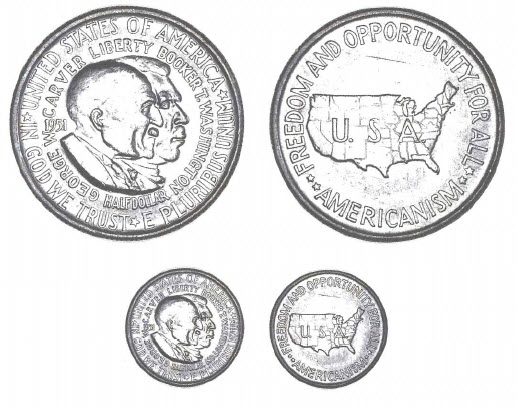
Two subjects were to be honored on the new coin: Dr. George Washington Carver and Booker T. Washington (the life of the latter is described earlier in this text). Born circa 1864 in Diamond, Missouri, the son of a slave, George Carver (his Washington middle name was added later in life) worked diligently, gained a college education, and went on to distinguish himself in the fields of agriculture and botany. At one time he assembled a collection of 20,000 mushroom specimens. Later he joined the Tuskegee Institute and set up an agricultural research facility there, discovering new and profitable uses for soybeans, peanuts, sweet potatoes, and other crops. Peanuts in particular were a specialty, and Dr. Carver astonished his contemporaries by discovering over 300 commercial uses for this hitherto unappreciated crop. Dr. Carver's death occurred on January 5, 1943.
The Design
Isaac Scott Hathaway, who created the Booker T. Washington half dollar motif, was tapped to prepare the designs of the new Carver-Washington issue. (Nomenclature note: It has been popular to designate these coins as Washington-Carver issues, but this is not correct. The issuer was specifically named the Carver-Washington Coin Commission, and George Washington Carver's portrait appears more prominently than and overlaps that of Booker T. Washington. The historically incorrect Washington-Carver term seems to have originated when A Guide Book of U.S. Coins added "Washington-Carver" issues to the end of its regular BookerT. Washington listings without a separate photograph or description of the new design. Also see the Minard letter quoted in the text, which states that Booker T. Washington coins had been produced for eight years and which does not sharply distinguish between the two design types. It is noted at the time of issue R. Green, Bebee Stamp & Coin Company, and others referred to the coins as Carver-Washington issues; that An Illustrated History of U.S. Commemorative Coinage, by Don Taxay, 1967, also referred to these coins correctly as Carver-Washington issues; and that beginning with the 1992 edition, the Guide Book designated these coins correctly as Carver-Washington pieces.) Sketches were complete by October 5, 1951, when they were submitted to the Commission of Fine Arts. At the Commission's meeting on October 25, the design was criticized, and the insignia of the American Legion pro-posed for the reverse was felt to be unsatisfactory. Hathaway made changes, and on November 9, 1951, David E. Finley, chair-man, advised Dr. S.J. Phillips that the revised design was appropriate, "However, the second head should also be modeled in clear profile and not only in three quarters. The spacing of the letters should also be improved, allowing some space between the heads and the lettering .... The reverse side is acceptable." Additional revisions were made, and on November 15, 1951, Felix W. deWeldon, sculptor member of the Commission, advised Phillips that the models for the coin had been approved.
On December 17, 1951, Acting Director of the Mint Leland Howard wrote to Chairman Finley of the Commission to complain of the procedure under which the Commission had given its blessing to the new design without checking with the Mint, and further noted that: "The engraver [Gilroy Roberts] stated that the designs were unsuitable for coinage, especially the reverse side. The center part of the design, the map of the United States, was too high in relief and was much higher than the border of the design. If a coin had been made using this design, it would have 'rocked' on the map of the United States and would not have stacked properly, in-as much as a coin should rest on its outer rim. He said that the lettering was terrible and could not be reproduced. Also, with the United States in high relief on one side and the heads of Booker T. Washington and George Washington Carver in high relief on the other side, it would be impossible to coin such a piece, as the metal could not flow into the center of the die and still leave a uniform surface on the remainder of the coin ....
"In the future, in order to produce coins technically as well as artistically meritorious, it is suggested that we in the Mint first have the opportunity to pass upon a model before it is approved by your Commission."
Chief Engraver Gilroy Roberts was commanded to alter the designs appropriately and make them ready for coinage. The result was a coin design which historian Donald Taxay has designated as "particularly ugly." (An Illustrated History of Commemorative Coinage, p, 253.)