Commemorative Coins of the United States
Q. David Bowers
1986 Statue of Liberty Half Dollars (Immigrant Half Dollars)
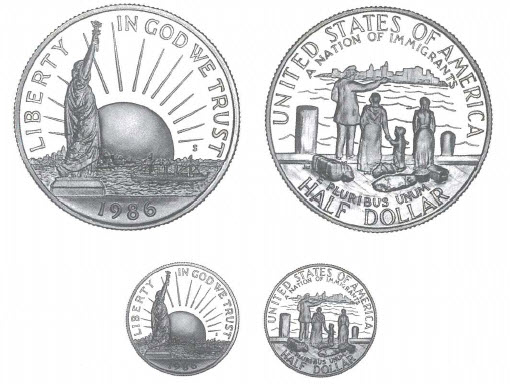
A Set of Three Denominations
The 100th anniversary of the dedication of the Statue of Liberty in New York City Harbor in 1886 furnished the occasion for the issuance of commemorative coins in 1986. The statue, officially known as Liberty Enlightening the World, was the work of French sculptor Frederic Auguste Bartholdi and had been presented to the United States by the government of France. Since that time it has been America's most visible symbol of freedom.
Conceived by Bartholdi in 1865, the statue was planned to be ready for the 1776-1876 centennial anniversary of the United States. However, by that time only a small part of the work had been completed, and Bartholdi had to be content with exhibiting just the hand and torch of Miss Liberty at the 1876 Centennial Exhibition in Philadelphia. This element of the statue proved to be a sufficient attraction that it stayed in America drawing visitors until its return to France four years later. In 1884 the statue was completed in Paris, after which it was dismantled and shipped to the United States in 214 numbered crates. Erection work commenced on Bedloe's Island in New York Harbor and was completed by October 28, 1886, when the Statue of Liberty was dedicated by President Grover Cleveland. In 1924 it was designated as a national monument.
By the early 1980s it was realized that the statue was in serious need of restoration. Beginning in 1982 plans were made to do the necessary work as well as to restore the vacant buildings on nearby Ellis Island, which had been used to process the immigration of millions of Europeans and others who sailed past Lady Liberty, some of whom may have known the concluding words to Emma Lazarus's poem, The New Colossus: "Give me your tired, your poor; Your huddled masses yearning to breathe free; The wretched refuse of your teeming shore; Send these, the homeless, tempest-tost to me; I lift my lamp beside the golden door!"
Rep. Frank Annunzio sponsored a bill which, after emendation, became law on July 9, 1985, authorizing the production of commemorative coins to assist in fund raising for restoration of the Statue of Liberty and the structures on Ellis Island. In 1982 President Ronald Reagan had appointed Lee A. Iacocca, chairman of the board of the Chrysler Corporation, to head the project. At the time Iacocca was heralded in the public and financial press as the savior of the third largest United States auto maker, a firm which had fallen on hard times and which survived only because of a financial bailout by Congress. Under Iacocca's leadership Chrysler prospered, the loan was eventually repaid, and Iacocca became a folk hero.
David L. Ganz, numismatic attorney and writer, told of his involvement with the coins: (Letter to the author dated January 17, 1991.) "The role that I had with the Statue of Liberty commemorative coin program came as a result of the retention of my firm by the privately run commission. Up until the time that the Statue of Liberty coinage proposal was introduced, we had never had a low-denomination clad commemorative coin. I made a private bet with Steven Brigandi, executive director of the Commission, that if a copper-nickel half dollar was included it would become the best selling of the issues. With 7.8 million combined, Proof and Uncirculated, this certainly proved to be the case. It also proved to be a successful experiment-so successful that subsequent programs have followed it. I do claim the language in the bill as my own, though of course, it was introduced by Mr. Annunzio at the request of the Statue of Liberty Centennial Commission."
Three different coin denominations were produced in connection with the observation: the Statue of Liberty half dollar (made in copper-nickel clad alloy; the first commemorative in this format), the Statue of Liberty-Ellis Island silver dollar, and the Statue of Liberty $5 gold piece, under provisions of the Act of July 9, 1985, which provided for the coinage of up to 25,000,000 half dollars, 10,000,000 silver dollars, and 500,000 $5 gold coins. The official sale period was from November 1, 1985, through December 31, 1986.
Public contributions to the restoration project exceeded expectations even before the commemoratives became a reality. Funds raised by coin sales were the icing on the cake. Over $83 million (double the original goal) was raised in coin surcharges for the Statue of Liberty-Ellis Island Foundation. "It was the most successful commemorative coin program in the history of the Mint. More than 15 million gold, silver, and half dollar Liberty coins were sold," a Treasury Department news release observed.
Mint Director Pope's Observations
In an interview with the author; Mint Director Donna Pope told of the 1986 commemoratives: "The Statue of Liberty program was extremely successful and was wonderful to work on. People related to it. People in America feel the Statue of Liberty is theirs. People around the world feel it is theirs also. This was the first time the Mint did its own international marketing. It was a wonderful experience finding people around the world who loved the Statue of Liberty.
"Without hesitation all of our distributors thought the Statue of Liberty coins would be excellent sellers. In Europe when they think of America, they think of two things: cowboys and the Statue of Liberty. For the Mint the John Wayne medal was the best-selling medal of all time, which shows how interested people are in this theme. When I was in Germany during the Statue of Liberty program, I noticed that the stores that had displays always had a Statue of Liberty and a cowboy when they wanted to represent the United States.
"In addition, Lee Iacocca was wonderful as head of the organization. He was doing all sorts of things, one event after another. There was constant publicity so that everybody knew of the celebration. It was basically because of the Foundation's publicity that we were already playing to a knowledgeable audience. We were notified of all of the events, and we were usually represented, or at least Lee Iacocca would mention the coin program. That is the key. If the organization scheduled to get the money from the sale of the coins ties the coins in with the rest of its program, it makes all of the difference in the world. The Olympic Committee did not do this in 1983 and 1984. We were not really happy about it. The program was successful because it was the first big commemorative program, and we were hosts of the games, and there was so much publicity, but not because of anything the Committee specifically did on our behalf."