Commemorative Coins of the United States
Q. David Bowers
1936 Lynchburg Sesquicentennial Half Dollar
A Local Event Commemorated
Lynchburg, Virginia celebrated in 1936 the sesquicentennial of the 1786 city charter, an event hardly of statewide importance, let alone national significance. Be that as it may, the congressional Act of May 28, 1936, authorized the production of a quantity of Lynchburg Sesquicentennial coins not to exceed 20,000 silver half dollars to be coined of a single design at a single mint.
Lynchburg was proud of her living citizens in 1936, and a brochure noted that they included such personalities as Senator Carter Glass, Lady Nancy Astor, Mrs. Charles Dana Gibson (wife of the artist), Douglas S. Freeman, Samuel Untermyer, Robert L. Owen, Col. Edwin Halsey, S.S. Van Dyne (nom de plume of William Huntington Wright, mystery writer), and the Warner brothers (of motion picture fame). (Fame is fleeting, and Lynchburg's famous citizens of yesteryear are virtually unknown there today. In February 1991 the author wrote to the City of Lynchburg to inquire about the biographies of these individuals and their past connection with the city and was referred to the city library, which informed me that these people were not known to those in charge and that research could be conducted for $10 per hour.)
The Design
The Lynchburg Sesqui-Centennial (sic) Association contacted the Commission of Fine Arts, which throughout the decade acted as a talent booking agency. The Association had considered Charles Keck and John D. Brcin (John David Brcin (born in Yugoslavia in 1899), earlier a student of Albin Polasek, maintained a studio in Chicago and was known as a sculptor and teacher in that city.) as potential designers. On the recommendation of Charles Moore of the Commission of Fine Arts, Keck was the one chosen. Earlier Keck had designed the 1915-S Panama-Pacific gold dollar and the 1927 Vermont half dollar.
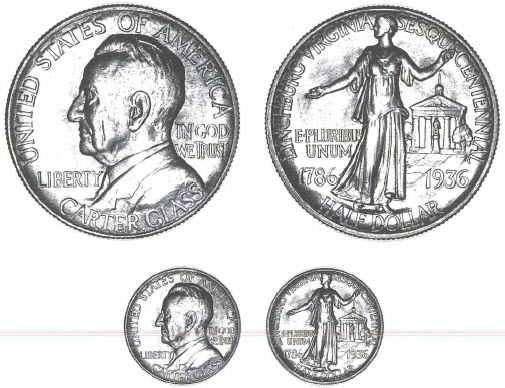
Although it was considered appropriate that John Lynch, after whom the city was named, be featured on the obverse, no likeness of Lynch existed. After due consideration the Association selected Senator Carter Glass, a living individual, honorary president of the Sesqui-Centennial Association and the most influential citizen of Lynchburg at the time. Glass raised a token protest over the use of his image, but it was approved anyway. Glass, born in Lynchburg on January 4, 1858, entered the newspaper business and then politics, becoming a state senator in 1899. From 1903 to 1918 he was a U.S. congressman. In the latter year he resigned to accept an appointment as secretary of the Treasury under President Woodrow Wilson, a position he filled until 1920. Later in his life, until his death in 1946, Glass was a Virginia state senator.
1936 Lynchburg Sesquicentennial Half Dollar
SUMMARY OF CHARACTERISTICS
Commemorating: 150th anniversary of the charter of Lynchburg, Virginia
Obverse motif: Portrait of Carter Glass
Reverse motif: Standing figure of Miss Liberty
Authorization date: May 28, 1936
Dates on coins: 1936 (also 1786)
Date when coins were actually minted: 1936
Mint used: Philadelphia
Maximum quantity authorized: 20,000
Total quantity minted (including assay coins): 20,013
Assay coins (included in above): 13
Quantity melted: None
Net number distributed (including assay coins): 20,013
Issued by: Lynchburg Sesqui-Centennial Association, (Officers: Judge Don P. Halsey, president; R.T. Watts, Jr., vice president; Mrs. John H. Lewis, vice president; John W. Craddock, vice president; Thomas W. Gilliam, treasurer; Fred W. McWane, secretary; Carter Glass, honorary president.) P.O. Box 731, Lynchburg, Virginia Standard original packaging: Cardboard coin holder with spaces to accommodate five coins, with imprinted cover, made by J.N. Spies Mfg. Co.
Official sale price: $1 plus 25¢ per order (for example: 1 coin, $1.25, 2 coins $2.25, etc.) Designer of obverse and reverse: Charles Keck
Interesting fact: Depicted on the obverse was Carter Glass, who was living at the time.
MARKET INDEX
(average market prices)
1940 MS-63 to 64 $2
1945 MS-63 to 64 $2.75
1950 MS-63 to 64 $3
1955 MS-63 to 64 $10
1960 MS-63 $18
1965 MS-63 $45
1970 MS-63 $40
1975 MS-63 $95
1980 MS-63 $550
1985 MS-63 $375
1986 MS-60 $235, MS-63 $325, MS-64 $600, MS-65 $1,350
1990 (spring) MS-60 $225, MS-63 $245, MS-64 $450, MS-65 $1,450
1990 (December) MS-60 $195, MS-63 $235, MS-64 $290, MS-65 $725