Walter Breen's Encyclopedia of Early United States Cents
Walter Breen
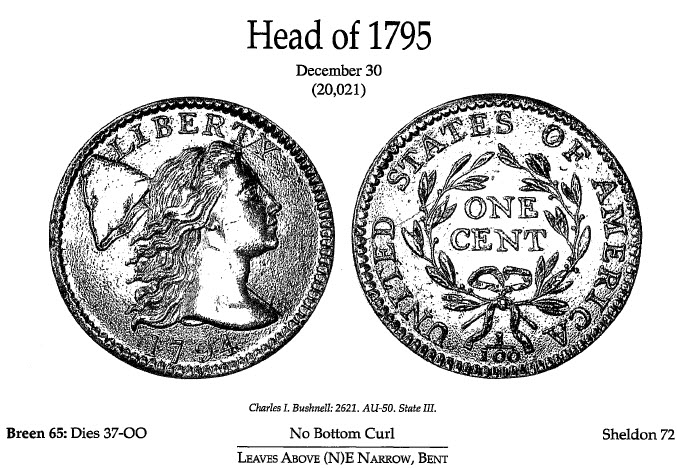
Obverse 37. The device punch is identical to that used in 1795. The lowest lock is short and points down with-out forming a curl. TY is low. The date is wide with 94 closer than the other digits and 4 high.
Reverse 00.
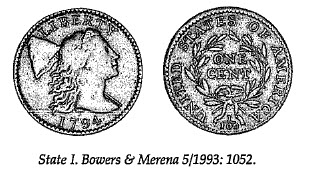
Die states: I. No cracks. Extremely rare.
II. Cracked from the rim through top of Y, base of T, and junction of forelock and brow. Later, this crack extends across the hair to the cap, although very faint. (State II may show traces of the reverse crack described in state III.)
III. The obverse crack is heavier, eventually with a lump between the hair and T. Reverse cracked from the rim through D to the wreath stem.
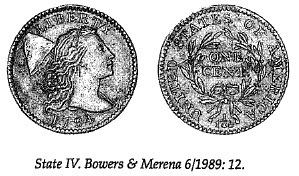
IV. Clash marks on both sides.
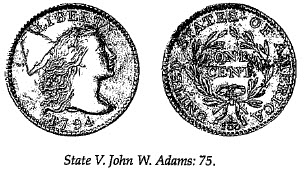
V. Two more cracks from the left field into the cap.
Equivalents: Maris 39, "'95 Head." Frossard 27. Doughty 59. Hays 56. McGirk 4L. Ross 35-KK. Chapman 59. Sheldon 72. EAC 63. Encyclopedia 1670.
High Rarity 2.
Remarks: The position of the 4 suggests that the date was first entered without the final digit, in case the die would not be ready for press before the end of the year. However, the obverses used in October 1795 differ enough in layout from the present die to suggest that they were made well after this.
One has been seen with the edge blundered ONE HUNDRED A DOLLAR. (Stack's, Halpern sale, 3/1988: 106.) Dan Trollan reported an example with the letter D in HUNDRED over the R of the same word. This is in the March Wells collection, from Superior Galleries sale of 2/1992, lot 741. (Letter to Mark Borckardt, August 17, 1997.)
Delivered December 30. Compare with variety 64.