Walter Breen's Encyclopedia of Early United States Cents
Walter Breen
Collectors have cherished the cents of 1794 for their extreme diversity. Yet this very diversity has proven a major source of difficulty, for dealers, for cataloguers, and perhaps most of all for cherrypickers. There are too many variables to remember, especially if one has to decide in a hurry whether an unattributed coin is overpriced or is a variety in enough demand to make it worthwhile.
Varieties instantly recognizable even by nonspecialists have always commanded a premium beyond their actual rarity level. The classic instance is clearly the "Starred Reverse" variety, number 38, with those 94 tiny five-pointed stars between dentils-and the smallest letters in the series. Nearly as famous are the Missing Fraction Bar, number 50, and the Fallen 4, number 37.
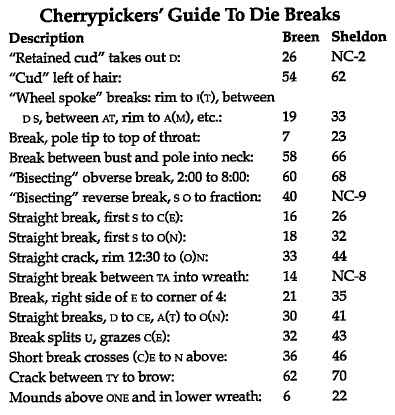
Some varieties have bizarre or extreme die breaks, enabling recognition "across the room." A list of these follows:
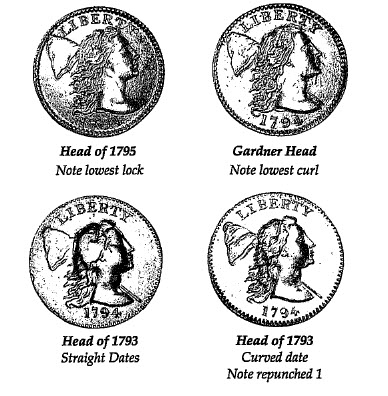
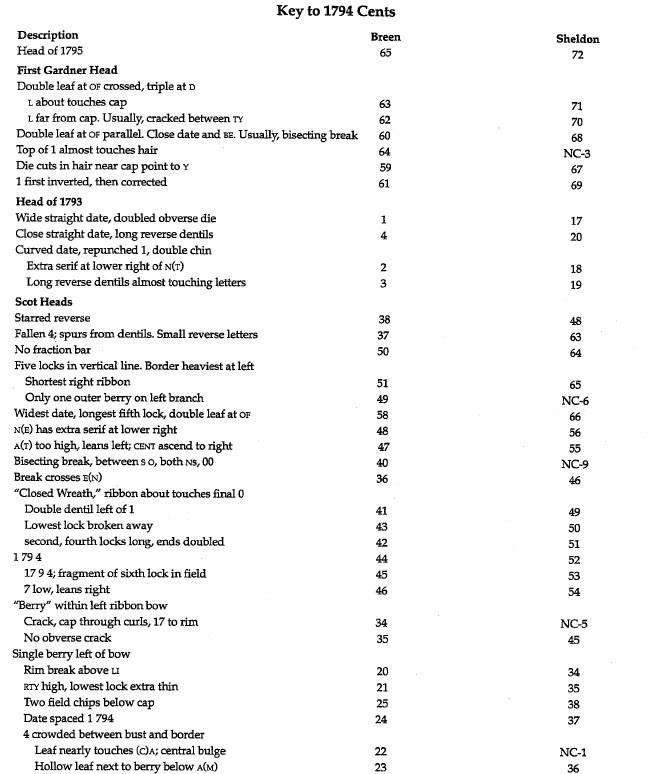
Some of these varieties also come without their die breaks and most other varieties are not so obviously marked. Accordingly, a tabular key to the varieties of this date is essential; but to use it effectively requires recognition of the three most distinctive heads, those least affected by Scot's handiwork. These are the Head of 1795, the Gardner Head, and the Head of 1793. In deciding if an unattributed 1794 belongs to one of these three groups, first check the head against the immediately following illustrations, ignoring the positions of letters and date. Recognition here has to be, for the moment, not the left-brain type which focuses on positional elements, but the right-brain type which enables you to pick out a friend in a crowd.