Walter Breen's Encyclopedia of Early United States Cents
Walter Breen
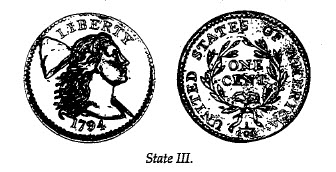
III. Faint obverse crack from the rim to base of 9. Reverse crack extends through the final 5 and faintly into the field.
IV. Additional heavier clash marks. Obverse cracked from the rim to 9 and the bust, and from the rim into the field about 4:00. Second reverse crack from the rim to the left foot of final A and the wreath.
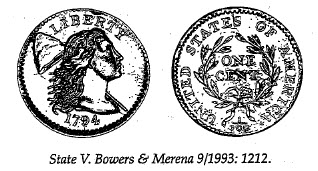
V. Third obverse crack from the rim to bust point.
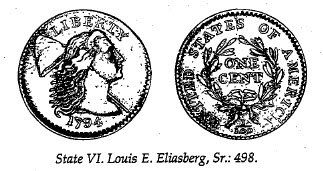
VI. Fourth obverse crack from the rim to lower point of the cap. First reverse crack shows a lump between the final 5 and top of the leaf. The crack through the final A later extends through bows and into the field left of CE, eventually reaching the leaf left of O(N). Faint crack from rim above A through the tops of TE.
VII. Fifth obverse crack from the rim through 1 slanting up to the hair. The first and second obverse cracks join. First reverse crack is plainer and extends to the wreath.
VIII. A branch comes off the first crack below STATES.
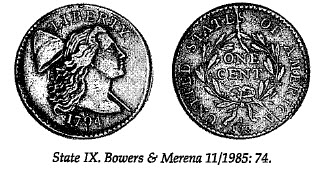
IX. First reverse crack extends to (N)E and (N)T and its upper part becomes heavy. An additional lump is betweenthe two topmost leaves. The entire reverse is eventually covered with tiny parallel cracks, as the die degenerates.
Equivalents: Maris 32, "Shielded Hair." Frossard 19.1.
Doughty 52. Hays 45. McGirk 5C. Ross 28-EE. Chapman 49. Sheldon 65. EAC 55. Encyclopedia 1668.
Rarity 1.
Remarks: Dies were misaligned both offset and vertically (axially), so that the obverse border is always broad and deep at the left, weak and often blurred at the right. This put extra stress on the left side of the obverse die so that it is not surprising that the die cracked below the date and left, only that it lasted long enough to create the most common 1794 variety.
Henceforth, coins of almost all varieties come with what many collectors (beginning with Dr. Charles L. Ruby)have called large and small edge letters, alias Edge of 1794 and Edge of 1795. On the latter, OF A DOLLAR are smaller, but the spacing and letter forms do not differ. Some coins, more recently examined, are apparently intermediate, difficult to assign to large or small. The size variation is real but unexplained. In the present study I make no attempt to call these edges sub-varieties.
Believed to comprise part, or all, of the deliveries of July 9 through August 14: over 150,000 in all.
The ANS has one with the edge blundered ONE HUNDRED A DOLLAR. (Dan Trollan, Penny-Wise, no. 184, 1/15/1998, p. 11.)
Condition Census:
MS-60 With light planchet roughness in the left obverse field. Laird More • C. E. Bullowa (Coinhunter) 10/1975: 709 $2,100 • Dr. Robert J. Shalowitz, 3/1977 • R. E. Naftzger, Jr. Obverse and reverse illustrated in Noyes.
AU-55 With light planchet roughness in the lower left obverse field. Col. James W. Ellsworth, 3/1923 • Wayte Raymond • Charles E. Clapp, Sr., 12/1924 • George H. Clapp • ANS • Dr. William H. Sheldon, 4/19 /1972 • R. E. Naftzger, Jr. • New Netherlands Coin Co. 11/1973: 385 $1,900. State VIII. Reverse illustrated in Early American Cents and in Penny Whimsy.