Walter Breen's Encyclopedia of Early United States Cents
Walter Breen
VF-30 Sharpness of EF-40 but edge dent and scratch. John P. Lyman • S. H. Chapman 11/1913: 399 $17 • S. H. Chapman • Henry C. Hines • Howard R. Newcomb • J. C. Morgenthau & Co. #458, 2/1945: 35 $62.50 • Dr. William H. Sheldon. Dorothy Paschal, 11/1977 • Myles Z. Gerson. John W. Adams • Bowers and Ruddy Galleries FPL,1982: 13 $2,500 • Bertram Cohen • Early American Numismatics (Dana Linett) "Buy or Bid" Sale #2, 1985: 525 $3,950 • Bertram Cohen, 4/4/1992 • James H. Goudge. State V.
VF-25 W. W. Hays, 1900 • Chas. Steigerwalt, 1906 • Charles G. Zug • Lyman H. Low 3/1907: 18 $3 • A. C. Gies Stack's FPL#14, 1/1942: 46 $125 • George H. Oapp • ANS. State V. Obverse and reverse illustrated in FrossardHays and in Chapman. Obverse illustrated in Early American Cents.
VF-25 Consignment Derby • Coin Galleries 11/1981: 1356 $1,050 •Del Bland • Dr. Robert J. Shalowitz • Dr. C. R. Chambers • Donald H. Petersen • Superior Galleries 2/1992: 662 $2,860 • Thomas D. Reynolds.
VF-25 Joseph H. Rose • Harmer Rooke Numismatists, Ltd. 3/1990: 17 $4,125 • Tom Morley • Superior Galleries 5/1992: 170 $1,650 • Thomas D. Reynolds.
VF-20 Leonard Kusterer • Benjamin H. Levin, 8/15/1983 • Denis W. Loring • Richard V. Punchard • Denis W. Loring • Stuart ''Mac'' MacDonald • Heritage Numismatic Auctions 9/1997: 5056 $3,450 • Chris Victor McCawley (CVM).
VF-20 Sharpness of VF-30 but obverse burnished. Alfred Bonard • Henry J. Berube (New England Coin Co.), 1/ 28/1966 • Philip Van Cleave • Kagin's Numismatic Auctions #340, 1/1986: 5027 $2,970 • Robert E. Matthews • Superior Galleries 5/1989: 151 $2,640 • Robert E. Matthews • Chris Victor-McCawley (CVM), 9/1/1989 • Robinson S. Brown, Jr. • Superior Stamp & Coin Co. 1/1996: 34 $2,970 • Walter Husak.
VF-20 Henry C. Hines • Barney Bluestone • Dr. Charles L. Ruby, 12/1972 • Superior Stamp & Coin Co. • Superior Galleries 2/1974: 351 $280 • Denis W. Loring, 5/1974. Dr. Robert J. Shalowitz, 8/1974 • Del Bland, 5/1975. Denis W. Loring, 1/1979 • George E. Ewing, Jr. • Bertram Cohen • Wes A. Rasmussen.
VF-20 Thomas J. Wass III, 2/1972 • Dr. Dane B. Nielsen • Tom Morley • Ed Kucia (Libertas Americana Galleries) • George E. Ewing, Jr. • Del Bland • Jack H. Robinson, 7/ 1983 • G. Lee Kuntz • Superior Galleries 10/1991: 30 $935 • Thomas D. Reynolds • Phillip W. Gover.
VF-20 A. H. Baldwin & Sons, Ltd. (London) • Eric P. Newman, 7/16/1985 • Eric P. Newman Numismatic Education Foundation.
VF-20 Carl Wurtzbach • Virgil M. Brand • New Netherlands Coin Co. #34, 10/1951: 587 $25 • M. L. Kaplan.
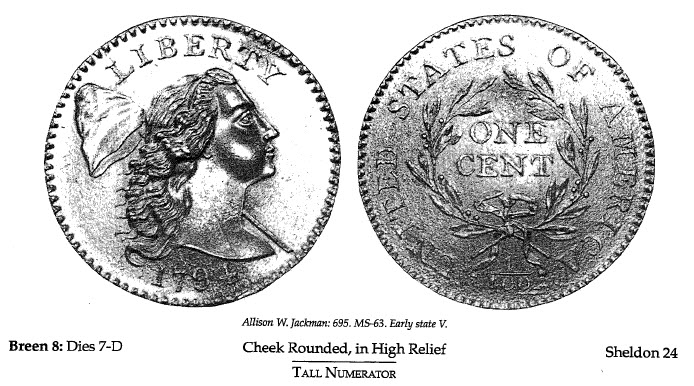
Obverse 7. Hair ends in seven locks, all with sharp points, the lowest unusually so. No shoulder loop. Cheek is in rounded high relief. Top of pole does not enter cap and the base is cut on the bias. Overpolishing of the die after completion of hair has left a large ear-shaped hollow just left of the neck.
Reverse D. Reground, now with berries smaller. Repunching still shows on ENT in early states. Later states with die buckling advanced, weakens these letters, the repunching faint or not discernible. NI are normally strong. Traces of central bulge at NT are not always noticeable.
Die states: 1. No obverse crack and no dash marks. II. Faint reverse dash marks plainest above the fraction. No cracks.
III. Faint crack from the rim through upright of L to the head. Central buckling at ENT stronger.
IV. Light crack from the rim, right of 4, to the lower neck. No die rust.
V. Traces of rust on the neck and lower field. Cracks of states III and IV are heavier. Reverse central buckling advanced, plainest at ENT. A faint flaw joins RI with another through final A at the crossbar. Wavy defects below and right of 100.
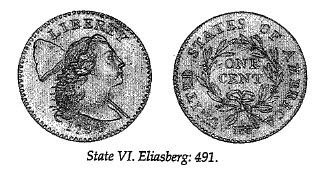
VI. The two obverse cracks join and become increasingly heavy. Rust advances. Reverse bulge eventually obliterates ONE CENT. The majority of survivors are in this state.
Equivalents: Maris 12, "Scarred Head." Frossard 8. Doughty 32. Hays 17. McGirk 4B. Ross 11-K. Chapman 8. Sheldon 24. EAC 8. Encyclopedia 1657.
Rarity 1.
Remarks: Sheldon's father called this the "Apple Cheek variety;" the name has become popular.
Evidently Scot deepened the cheek more than usual, and engraved the hair to match. Coins so made would look worn even when new, with ONE CENT weak or even illegible. The only answer: grind down and repolish the obverse. This explains the delicacy of the lowest lock, the fine sharp points on the rest, and the ear-shaped hollow in the hair.
Any hypothetical example struck before the die was ground down might be mistaken for number 7, state I.