Walter Breen's Encyclopedia of Early United States Cents
Walter Breen
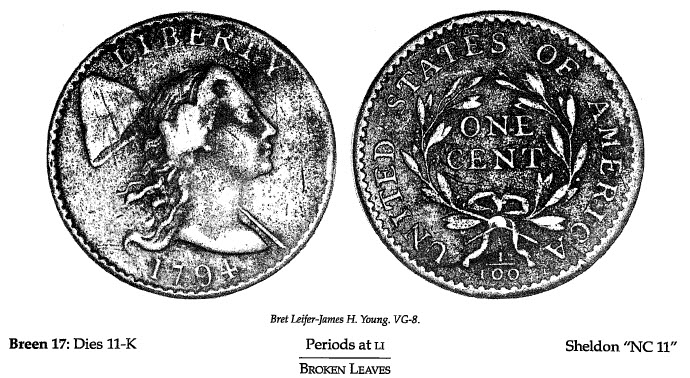
Obverse 11.
Reverse K. The ribbon knot is large. Broken or incomplete leaves are below TA, above O(N) and (N)E, and below RI. The inner leaf nearest (N)T is narrow, the left leaf below that T is weak at left, and later looks as though something has taken a bite out of its left edge. Six berries on each branch with that right of (N)E minute, its stem faint and incomplete. Fraction bar is nearer the numerator, which is above the right curves of the first O. u is low and its base is heavy.
Die states: Obverse displays extensive die polishing with detached points to hair curls. Large hollow area in hair, between third and fourth curls, above 17. The dots at bases of tr, heavy on earlier states of this obverse, are still visible on the unique example of this marriage. Reverse is perfect without cracks, clash marks, or polishing.
Equivalents: Not in Sheldon, later called "NC 11."
Included in Encyclopedia 1658.
Rarity 8. Two known.
Remarks: Discovered by James H. Young in 1995. A second example was located by James Young, Jr. (these two not related) in 1997. This is the second post-Sheldon variety, along with number 14, to share this obverse die.
This die marriage connects two previously separate groups of cents in the emission sequence. Probably among many varieties delivered March 28.
Condition Census:
VG-8 Sharpness of VF-20 but porous with scratches and edge dents. Acquired from an unknown individual circa 1950, by Harry Leifer in his grocery store in Ossining, N.Y., for payment of goods and kept until his death in 1991 when it was inherited by his son, Bret Leifer, who, after having it attributed on 3/20/1995 by James H. Young, sold it on 9/21/1995 to Robinson S. Brown, Jr. • Superior Stamp & Coin Co. 1/1996: 37 $23,100 • Daniel W. Holmes, Jr.
AG-3 Sharpness of G-5 but a punch mark on each side and some small edge dents. Purchased unattributed on 11/30/ 1997 by James Young, Jr.
No other examples have been reported.
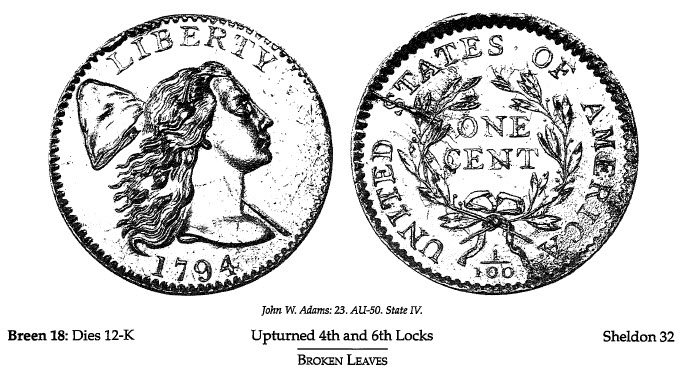
Obverse 12. Counting from the bottom, the fifth lock is double and the fourth and sixth turn up at their ends. Two hollow areas in the hair right of them. Part of the cap and adjacent hair incomplete nearest top of pole. Exposed inner part of the cap shows odd wrinkling not found on other dies.
Reverse K. Usually recognized by diagnostic die breaks (state II below). To aid in identification of the unfamiliar early state, refer to the reverse description at number 17, above. In the common broken die states, the berry next to c(E) is minute and easily missed among clash marks while the berry below ST is obliterated by the straight break through the first s. Fraction bar is nearer to numerator, which is above the right curves of the first O. u is low and its base is heavy.