Walter Breen's Encyclopedia of Early United States Cents
Walter Breen
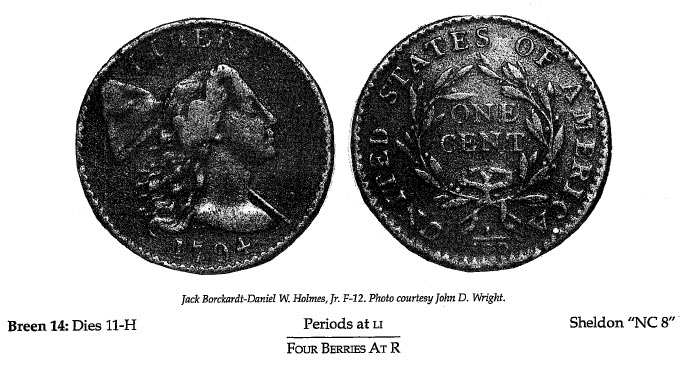
Obverse 11. Very wide date, spaced 1794 with the 9 and 4 tipped to the left. Hair ends in seven thin sharp locks. Most are longer than usual, the bottom is shorter than usual, and the top two are unusually far apart. Pole does not enter the cap. Shallow shoulder loop. Dentils at the left and top are joined for much of their length. Narrow extra dentil between two wider ones opposite the base of the cap. LIBERTY is unusually close to the border with LI and ER closer together than other letters. Heavy period between the bases of LI and another at the base of I.
Reverse H. Six berries left and eight right. Group of four berries at R, two inside and two outside with one impaled on a leaf stem. Upper leaf of the pair above O(NE) is extremely faint and easily missed. E of STATES leans right.
Die states: I. Heavy straight crack from the rim through right pendant of (S)T and left base of adjacent A to the wreath. Obverse without the clash marks found in its later combinations.
Equivalents: Not in Sheldon, later called "NC-8."
EAC 9. Encyclopedia 1658.
Rarity 8. Three known.
Remarks: Discovered by W. C. Blaisdell, December 1965, in a cent collection he bought in September 1965.
Probably struck March 26. The die must have lasted a very short time.
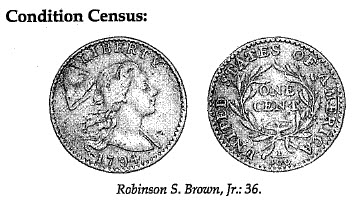
F-15 Discovered in 12/1965 in a collection of large cents purchased in September of that year by Willard C. Blaisdell, 5/25/1975 • R. E. Naftzger, Jr., 2/23/1992. Eric Streiner, 11/19/1992 • Robinson S. Brown, Jr. • Superior Stamp & Coin Co. 1/1996: 36 $20,900 • Thomas D. Reynolds. Obverse and reverse illustrated in Noyes. Discovered by Willard Blaisdell to be a new variety in December 1965.
F-12 Purchased unattributed in 7/1987 by Jack Borckardt (The Collector's Cabinet) • Daniel W. Holmes, Jr.
VG-7 Sharpness of VF-20 but some obverse pitting and some reverse porous spots. Purchased unattributed from The Coinery in 10/1981 by Richard Snow, 9/1982 as "S-25" • Harry Rescigno (American Rose Rare Coins), 9/ 1982. Herbert A. Silberman, 10/1982 • Denis W. Loring, 5/7/1983. Jack H Robinson. McLaughlin & Robinson #4369, 2/1988: 47 not sold • Jack H Robinson, 4/ 16/1988 • Frank H Stillinger.
No other examples have been reported.
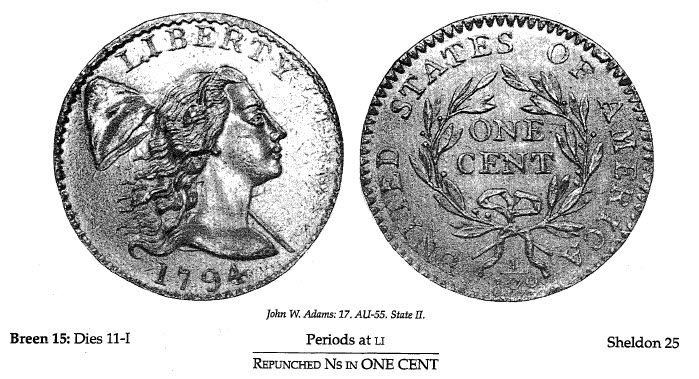
Obverse 11.
Reverse I. Center dot protrudes from the left upright of N(T), just below its diagonal. NS in ONE CENT both show recutting above diagonals. Short fraction bar is closer to the numerator than to 100 and begins beyond 1 of the denominator. Eight berries left and seven right. Attached to stem of the top leaf on the left branch, below AT, are two minute berries, far smaller than any others. T is below adjacent A-E.
Die states: I. Perfect dies without clash marks.
II. Single obverse and reverse clash marks, no cracks.
III. Double obverse and reverse clash marks.
IV. Triple obverse and reverse clash marks.
V. Crack from rim through D to the leaves. Usually weak on the upper right obverse and lower right reverse, the dies were axially misaligned.