Walter Breen's Encyclopedia of Early United States Cents
Walter Breen
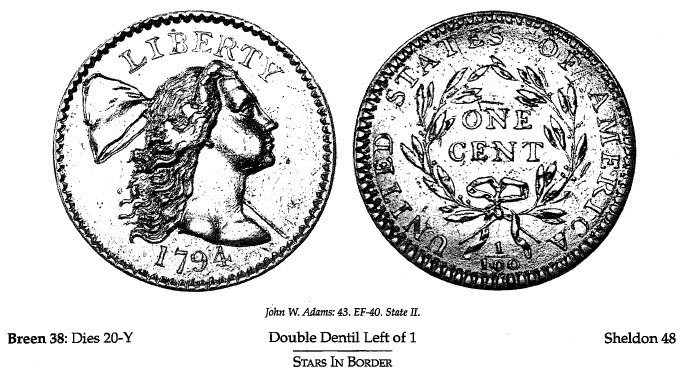
Obverse 20. Short bust without a shoulder loop. The shoulder forms a right angle just below its junction with the hair (above 7). Some strands are coarse, similar to the preceding, but made with the same needle pointed burin. The top two locks end abruptly and the one just below them has a severed end in the field. LIBERTY is close to the device, within especially close. LI is repunched and E is slightly high. Date is spaced 1794 with a double dentil left of the base of 1.
Reverse Y. 94 tiny stars at the border, some partly overlapped by dentils. Eight berries on each branch with the eighth on the right outside the main berry below M. The outer berry below ST is stemless and isolated with two more added below AT and two additional berries within the right branch. Lowest right leaf is now normal with the leaf below I(C) and outer leaf of the triplet now edgewise. Several other leaves are fragmented with a spine at the leaf tip below ic, Part of an extra tip is on the point of the leaf below ST with an extra fragment of the ribbon above and left of the knot. Left ribbon end is hollow and the right end is narrow. Fraction bar is short and well away from the ribbon ends. The left stem is lengthened.
Die states: 1. Faint obverse clash marks (Smith state A).
II. Polished to remove clashmarks, possibly a heavier set Repunching on u fades (Smith state B). Reverse buckling: first at 0 CE and RI only and. extremely faint (Smith state C), later from EN to RI and rim, still faint (Smith state D).
III. Reverse buckle extends in a straight line from EN through ON to (A)T and upper rim (Smith state E).
IV. Massive die failure right of bulge (Smith state F). Equivalents: Maris 51. Doughty 24. Hays 8. McGirk 2D. Ross 5-E. Chapman 30. Sheldon 48. EAC 36. Encyclopedia 1663.
Rarity 5.
Remarks: Believed among the varieties delivered June 24. According to S. H. Chapman, his brother Henry discovered the Starred Reverse in 1877; Henry Chapman said 1876. (See Chapman, Cents 0/1794, p. 20; also, Henry Chapman 6/1908: 18.) The two brothers were examining a lot of 1794s with Dr. Maris standing between them; Henry said "Here is a die with minute stars around the reverse," and Dr. Maris confirmed the discovery with the line "It was previously unknown." According to John W. Adams, this discovery coin went to the Samuel Bispham collection. (S. H. & H. Chapman 2/1880: 162)
Lyman Low, at lot 8 of his March 17, 1907 catalogue, said "This number, although unknown to Maris and the general public until about 1887, was possessed and commented upon by A. J. Gilbert (brother of Ebenezer Gilbert), residing at Catskill prior to 1850." No documentation of this claim has surfaced; possibly Ebenezer Gilbert told him in person. Sheldon (Early American Cents, p.113) repeated the story without naming his source, changing the man's name to American Numismatic Society has one, ex Baldwin, A. T. Gilbert. In Penny Whimsy he dropped the reference and said instead "Collectors mention it with religious awe." Doubtless that was more often true then than now despite the recent cheapening of the word "awesome" in and out of the San Fernando Valley.
Pete Smith, in 1986, published The Story of the Starred Reverse Cent, a depth study of this variety, with more extensive pedigree data than herein. His die state desig-nations are quoted above and his pedigree numbers, below.
Usually in low grades, occasionally on defective planchets, and seldom showing all 94 stars, the border often being weak at upper right. The description in Frossard-Hays and Elder-Hays specifies only 87; Chapman gave the correct number, from a higher grade speci-men. Dr. Maris had conjectured that the number of stars was meant to allude to the Signers of the Declaration of Independence. Robert Coulton Davis connected it with the Mint Cabinet's 1792 experimental copper coin today known as Joseph Wright's pattern quarter dollar (Judd 12, Pollock 14, Encyclopedia 1365), which has 87 stars in the reverse border. However, the stars on the 1792 pat-tern are larger and differently shaped, withone point broken.' Ebenezer Locke Mason, Jr, published the Davis account in Mason's Numismatic Visitor for the summer of 1880 and, on page 6, concluded "This fact leads to the conclusion that some of the planchets [for the quarter dollar pattern] bearing only the stars, were used when the Mint authorities were coining the 1794 cents."
The isolated extra berry at M may have been Scot's secret mark identifying reverses whose border dentils had been altered. Compare this to the other dies on which it appears (B of numbers 3-4 and F of number 11).
Usually in low grades, occasionally on defective planchets, and seldom showing all 94 stars, the border often being weak at upper right. The description in Frossard-Hays and Elder-Hays specifies only 87; Chapman gave the correct number, from a higher grade specimen. Dr. Maris had conjectured that the number of stars was meant to allude to the Signers of the Declaration of Independence. Robert Coulton Davis connected it with the Mint Cabinet's 1792 experimental copper coin today known as Joseph Wright's pattern quarter dollar (Judd 12, Pollock 14, Encyclopedia 1365), which has 87 stars in the reverse border. However, the stars on the 1792 pattern are larger and differently shaped, with one point broken.' Ebenezer Locke Mason, Jr, published the Davis account in Mason's Numismatic Visitor for the summer of 1880 and, on page 6, concluded "This fact leads to the conclusion that some of the planchets [for the quarter dollar pattern] bearing only the stars, were used when the Mint authorities were coining the 1794 cents."
The isolated extra berry at M may have been Scot's secret mark identifying reverses whose border dentils had been altered. Compare this to the other dies on which it appears (B of numbers 3-4 and F of number 11).
Sheldon placed this variety after his number 47 (39), claiming that the obverse was "retooled. The double cutting of L and has been removed." This could only mean that the obverse had been ground down to remove clash marks, as on S-49 (41). When he wrote Early American Cents, he had not seen any of the high-grade specimens and based his description on his own piece (ex Jackman, Hines) and the Miller, American Numismatic Society coin, both VF, as compared with the Mint State American Numismatic Society specimen of his number 47. The best Starred Reverse coins I have examined show there punching, and must have preceded at least some of Sheldon 47; for a notable example see the full page illustration in the Adams catalogue. I have not yet seen a specimen with clash marks heavy enough to justify grinding down; probably the repairs promptly followed the accident.