Walter Breen's Encyclopedia of Early United States Cents
Walter Breen
Scot's First Head
(286,300)
Over 60 years ago, Samuel Hudson Chapman grouped these varieties together on the basis of style. Chapman's "Style I" comprised the Heads of 1793. The present group, his "Style 2," begins with a variety sharing the reverse of number 4, and all these obverses have the same date punches (shorter 7 and flat top 4), unlike later varieties. He could not explain why all were of a Single style, especially as the hair is very differently treated on some of them. The true explanation was only discovered on June 2, 1984, (See "The How and Why and Who" chapter for specific details.) Caps, busts, and facial features are identical except for occasional touching up of lips or deepening relief of cheek. All contours of device are the same except for pole and details of hair. All these heads were made from a single device punch, the hair on each being reworked by hand.
Order of emission of the varieties has proved a more difficult problem. Aside from number 5, the "Flat Pole:" which comes first because of its leftover reverse, there IS a single isolated variety (sharing a die with no other); one isolated pair of varieties; one isolated group of five; while the remaining 15 form a long connected sequence whose order is clear from die break progression. In which order did the three isolated groups come, before or after the long sequence? Chipping or breakage and replacement of letter or numeral punches could provide an answer. Unfortunately, the only deviant punches noticed in 1794 apparently represent numerals or letters from other denominations, not replacements of broken punches. There is neither any marked resemblance between the isolated obverses and others, nor any unambiguous stylistic progression.
The four varieties here numbered 5, 6, 7, and 8 show enough resemblance in treatment of the hair to belong together. Numbers7 and 8 have a tall numerator, unlike numbers 1 through 6.
As Robert Hilt (Robert Hilt, Die Varieties of Early United States Coins, Omaha, Nebraska: RTS Publishing Co., 1980) pointed out, Scot most likely made dies for a given denomination in batches, keeping a certain number of pairs in reserve to minimize interruption of coining. This way, when dies clashed, whichever one looked worse for the encounter (or even both) could be temporarily replaced for repolishing; whenever either or both dies broke at press, they could be replaced at once. Many of what Sheldon calls "freak mules" or "coins ... struck in an idle hour (I), as the result of a coiner's whim" (Penny Whimsy, p.72.) are more readily explainable as products of temporary replacement in just such emergencies. If the dies were grouped by denomination on shelves in the coiner's vault, there is no guaranteethat they were arranged in chronological order of manufacture, or that the pressman would grab the one at the left rather than the right end of the row.
Planchets for this group mostly came from the first Taylor & Bailey shipments, described at the beginning of this year. Numbers 5 through 8 and some later ones on smooth flans free of defects are probably on blanks cut from the British sheet copper. Occasional later varieties on defective planchets (numbers 18 through 25) may have been struck onblanks from one of the domestic purchases.
Edge II continues as on 1b, 2b, 3b, and 4b.
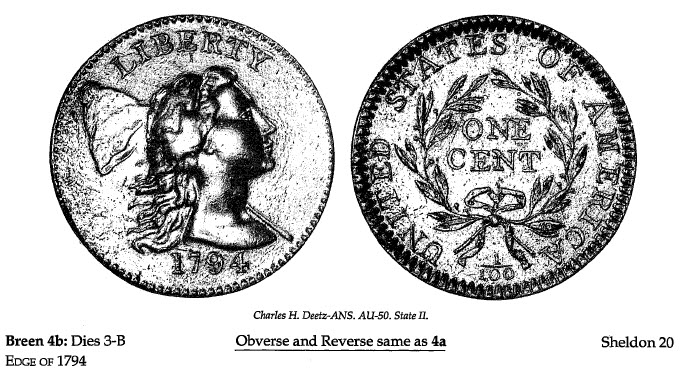
Obverse 4. Pole recut and broadening toward its end; "The Flat Pole." The shoulder loop is narrow and shallow. The nose is a little more pointed than on later dies. Hair ends in eight locks. L is repunched, ER are closer than other letters, and TY are slightly low. 17 is closer than 794. Border is usually weak and incomplete.
Reverse B. Rusted as in number 4b. Die states: 1. Without obverse cracks.
II. Crack from the rim through upper serif of Band between IB to the cap. Rust in wreath at ONE and adjacent leaves.
III. Clash marks from hair in the wreath.
IV. An additional crack through top of the cap to L and another from B to the forelock eventually join. Branched cracks behind the cap to rim. Reverse has additional clash marks in the center and the rust marks are extended.
V. Cracked from rim to second curl point from the bottom. Advanced rust in wreath and a crack from base of N(T) to bow.
Equivalents: Maris 3, "Sans Milling." Frossard 22.
Doughty 21. Hays 5. McGirk 8e. Ross 4-A. Chapman 5. Sheldon 21. EAC 5. Encyclopedia 1656. Rarity 3.
Remarks: Probably comprised the 8,800 delivered January 17.
Diameters on this and many of the following varieties are normally 18/16" to 18.5 /16" (28.5-29.4 millimeters).
Dick Young has one with the edge blundered ONE HUNDRED A DOLLAR. The Jack H, Robinson collection sale (lot 30) offered an example with a clip at K-5. John S. Ashby had a double struck example with the first strike 25% off-center at K-9. See "Oops!" chapter below.
Condition Census:
MS-61 Henry C. Colvin • French's #80 10/1962: 25 $1,050 • Louis Helfenstein • Lester Merkin 8/1964: 2 $2,100 • Dr. Herbert 1. Ketterman • James A. Hayes. Lester Merkin, privately 1/1977 • Dr. Robert J. Shalowitz, 3/1977 • R. E. Naftzger, Jr., 2/23/1992 • Eric Streiner • Jay Parrino (The Mint) • Superior Stamp & Coin Co. 5/ 1995: 2021 $33,000 • Walter Husak, 4/19/1997 • Dr. Thomas Turissini. State III. Obverse and reverse illustrated in Noyes.
MS-60 Dr. Edward Maris • David Proskey • Henry •.Hines • Dr. William H. Sheldon, 4/19/1972 • R. E. Naftzger, Jr. • Early American Coppers 4/1989: 21 $15,000 • Dr. Allen Bennett. State IV. Obverse illustrated in Penny Whimsy.
AU-55 Harlan P. Smith • S. H. & H. Chapman 5/1906: 1072 $21 • George Roebling • New Netherlands Coin Co. #59 6/1967: 1196 $475 • Ed Hipps (Ed's Coin & Stamp Shop), 11/1973 • Del Bland, 5/13/1986 • Herman Halpern • Stack's 3/1988: 23 $7,150 • Anthony Terranova. Stack's 10/1990: 659 $4,250 • Anthony Terranova • Tom Morley • Superior Galleries 5/1992: 166 $7,975 • Tom Morley • Superior Auction Galleries 1/1994: 773 $7,150. State III. Obverse illustrated in Morley.