Walter Breen's Encyclopedia of Early United States Cents
Walter Breen
Coinage Resumed
November 12
(21,000)
Most of the cents made through December 30 were struck on planchets made from the remainder of the Taylor & Bailey shipment. On November 11, the Mint bought 162.75 pounds of scrap copper from Richard Bache. Cents struck on planchets made from the latter source, if any, cannot be positively distinguished from those struck on blanks from the British copper. The Bache copper may have been intended for alloying silver or gold.
Some blanks made in this period are a little heavier than the 208 grains (13.48 grams) standard. Sheldon claimed that "this variety and the next three to follow (numbers 56, 57, 52, 53) are always struck on extra thick planchets." The weights given in Chapman' do not confirm this conclusion, nor do the weights of American Numismatic Society coins or others checked in recent years. There is, therefore, no justification for designating the coins on heavy blanks as new sub-varieties.
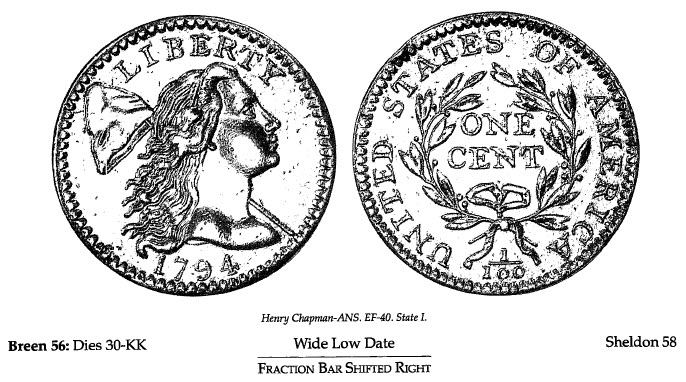
Obverse 30. Coarse hair as on the last few dies, but the upper locks are longer and the top curl point is very far from its neighbor. The lowest lock is thick and stubby but less so than on obverse 28. The shoulder loop is thin and narrow. Pole joins a dentil, point to point. Wide date, placed to the left with 1 midway between the curl point and 7. Base of the 7 practically touches the border. In LIBERTY, LIB are widely spaced with LI leaning left and R high. Dentils are long and unusually broad.
Reverse KK. Right stem end is close to the ribbon and almost parallel to it. The right ribbon end is narrow. Six berries left and seven right with four inside each branch. In the denominator, 1 is above the final 0 and nearly touches the fraction bar, which is shifted to the right, beginning above the center of 1 but ending above the right curve of the final O. AT are close and ES are high.
Die states: I. Perfect dies.
II. Faint crack from the rim through the top center of (I)T, continuing through the left pendant to the adjacent 1. Faint clash marks from hair in the left branch.
III. Heavy additional clash marks. The crack now extends through UNI later becoming increasingly heavy. John Wright calls it a "retained cud."
IV. The crack has become a heavy rim break or "cud." Very rare and usually in low grades.
Equivalents: Maris 40. Frossard 7.2. Doughty 60. Hays 16. McGirk 4A. Ross 10-J. Chapman 39. Sheldon 58. EAC 48. Encyclopedia 1668.
Rarity 3.
Remarks: Discovered by Dr. Edward Maris, circa 1870. Some of these blanks run slightly heavy. Chapman gave the weight as 206 grains (13.35 grams). Three in the ANS weigh 208.79, 214.99, and 216.10 grains (13.53, 13.93, and 14.00 grams).
This number probably formed a minority of the November 12 delivery.
Dan Trollan reported an example with the edge blundered ONE HUNDRED A DOLLAR. (Penny-Wise, no. 184, 1/15/1998, P: 11.) John D. Wright has an example off-center at K-12. See "Oops!" chapter.
Probably the majority of 21,000 delivered November 12 were this variety.
Condition Census:
MS-63 Major Sir Rowland Denys Guy Winn, M. c., 4th Baron St. Oswald • Christie, Manson & Woods, Ltd. (London) 10/1964: 153 $1,736 • A. H. Baldwin & Sons, Ltd. (London) • Dorothy Paschal • Dr. William H. Sheldon, 4/19/1972 • R. E. Naftzger, Jr., 2/23/1992 • Eric Streiner • Jay Parrino (The Mint), 4/16/1996 • W. M. "Jack" Wadlington. Obverse and reverse illustrated in Noyes.
MS-63 Major Sir Rowland Denys Guy Winn, M. c., 4th Baron St. Oswald • Christie, Manson & Woods, Ltd. (London) 10/1964: 154 $2,660 • Lester Merkin • Dorothy Paschal • C. Douglas Smith • Dr. Robert J. Shalowitz • Del Bland • Dr. Robert J. Shalowitz • David Berg • William Freeman • John W. Adams • Bowers and Ruddy Galleries FPL, 1982: 54 $22,500 • Bertram Cohen. State IV.
MS-60 George F. Seavey • William H. Strobridge, 1873 • Lorin G. Parmelee • New York Coin & Stamp Co. 6/1890: 685 $19 • J. F. Anger • Col. James W. Ellsworth, 3/1923 •• Wayte Raymond - Charles E. Clapp, Sr., 12/1924 • George H. Clapp • ANS • Dr. William H. Sheldon, 1964 • Dorothy Paschal, 1968 • R. E. Naftzger, Jr. • New Netherlands Coin Co. 11/1973: 380 $4,800 • Obverse and reverse illustrated in Early American Cents and in Penny Whimsy.
AU-55 Herbert A. Dietz • Stack's 4/1962: 271 $650 • unknown • Stack's 10/1966: 46 $1,150 • Gilbert Steinberg • 1976 ANA (Stack's): 232 $2,000 • Del Bland, 5/13/ 1986 • Herman Halpern • Stack's 3/1988: 80 $12,650 • R. E. Naftzger, Jr. • Early American Coppers 5/1990: 27 $13,000 • Thomas D. Reynolds.