Walter Breen's Encyclopedia of Early United States Cents
Walter Breen
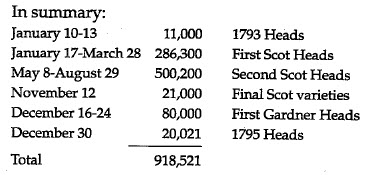
From quantitative rarity figures (at variety descriptions below), over 500 Heads of '93 survive-just under 5% of 11,000. The First Gardner Head varieties total about 3,000, or roughly 3.7% of the 80,000 of December 16-24. About 700 survive of number 65, the Head of 95, or about 3.5% of the 20,021 of December 30. (Number 64 came between earlier and later states of 65; the few survivors could hardly represent a large enough mintage to disturb the statistics.) These figures agree closely enough to make reasonable an estimate that about 3.5% of 1794s survive across the board, enabling us to deduce ballpark mintage figures for each individual variety (surviving population divided by 0.035). Experimentally doing so has yielded convincing results.
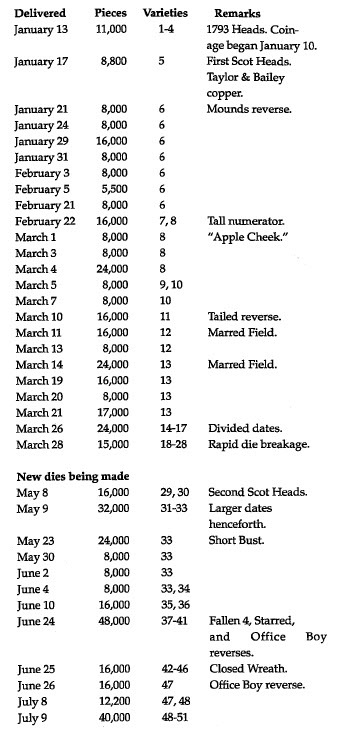
The above tabulation, correlating dates and daily delivery quantities with the emission sequence deduced below, is based on all available evidence: die states, die linkage, punch linkage, engraving style (grouping the most similar dies together wherever possible), and planchets. Arguments in favor of the present sequence (most of all where it disagrees with Sheldon's sequence) will be found below at the individual varieties or groups of varieties.
According to 1794 pay records, Frederick Riche assisted Scot in the Engraving Department for 18 days at $1 per day through June 17, "making dies," before being let go. (Stewart, p. 126.) This fits the above chronology: the four "Office Boy" reverses and the "Fallen 4" obverse of number 37 are too crudely lettered to be Scot's work. The above tabulation was assembled without taking this into account; the timing constitutes independent confirmation.
Collectors have cherished the cents of 1794 for their extreme diversity. Yet this very diversity has proven a major source of difficulty, for dealers, for cataloguers, and perhaps most of all for cherrypickers. There are too many variables to remember, especially if one has to decide in a hurry whether an unattributed coin is overpriced or is a variety in enough demand to make it worthwhile.
Varieties instantly recognizable even by non specialists have always commanded a premium beyond their actual rarity level. The classic instance is clearly the "Starred Reverse" variety, number 38, with those 94 tiny five-pointed stars between dentils-and the smallest letters in the series. Nearly as famous are the Missing Fraction Bar, number 50, and the Fallen 4, number 37.
Some varieties have bizarre or extreme die breaks, enabling recognition "across the room." A list of these follows:
Mint Director Rittenhouse interrupted cent Coinage at the end of August. Because Cox and Voigt had finally managed to locate co-signers for their surety bonds, silver coinage could legally proceed, and local banks began depositing bullion for the purpose. Rollers and blank-cutters had to be diverted to making blanks for half dollars and dollars. Scot had to sink six matrices (two each for dollars, half dollars, and half dismes), raise six device punches from them, and sink working dies: one pair for dollars, six pairs for half dollars, and three pairs for half dismes (though the latter did not go to press until March 1795). The first silver deliveries followed: half dollars (5,300 on December 1, 1794) and silver dollars (1,758 on October 15, 1794). For federal public relations purposes, silver was far more important than copper, and there were already complaints about the lack of federal silver issues-including, but not limited to, the bullion depositors who resented having their precious metal locked for weeks or months in the bowels of the Mint. With expanding production, the Engraving Department would require additional personnel; accordingly, in November Rittenhouse hired John Smith Gardner, of whom much more follows below. The "Final Scot varieties" (wider dates and lower relief heads than former dies) add up to about 800 survivors or almost 4% of 21,000, fitting their assignment to the 21,000 of November 12.