Walter Breen's Encyclopedia of Early United States Cents
Walter Breen
VF-35 Howard R. Newcomb • J. C. Morgenthau & Co. #458, 2/1945: 64 $15 • Dr. William H. Sheldon • Homer K. Downing • 1952 ANA (New Netherlands Coin Co. #38): 1691 $45 • Dr. William H. Sheldon • Dorothy Paschal • Robinson S. Brown, Jr. • Superior Galleries 9/1986: 62$1,650 • Del Bland, 11/1986 • G. Lee Kuntz • Superior Galleries 10/1991: 53 $2,750 • Tom Morley • Superior Galleries 5/1992: 200 $1,980. State V. Obverse and reverse illustrated in Penny Whimsy. Obverse illustrated in Morley.
VF-35 Bowers and Merena 6/1996: 60 $2,860 • W. M. "Jack" Wadlington.
VF-35 With a very small planchet clip. Sharpness of AU-50 but edge dents and nicks. J. C. Morgenthau & Co. #405, 10/1939: 567 $18 • George H. Clapp • ANS.
VF-35 Barney Bluestone #70, 6/1942: 760 $33 • Judge Thomas L. Gaskill • New Netherlands Coin Co., privately 11/1956 • Dorothy Paschal • New Netherlands Coin Co. #50, 12/1957: 945 $55 • Allen E. McDowell.
VF-30 Ed. Frossard Collection • Ed. Frossard #37,10/1884: 892 • T. Harrison Garrett • Robert Garrett, 1919 • John Work Garrett • Johns Hopkins University • Bowers and Ruddy Galleries 11/1979: 66 $1,000 • Tom Morley • Paul Padget • Wes A. Rasmussen.
VF-30 Henry Phelps, 1901 • Chas. Steigerwalt • unknown • Harry H. Trackman • Stack's 12/1984: 1033 $1,650 • Joel Spingarn, 4/23/1993 • Dr. Willard J. Carmel, Jr.
VF-30 Henry C. Hines • Dr. William H. Sheldon, 1948 • Judge Thomas L. Gaskill • New Netherlands Coin Co., privately 11/1956 • Dorothy Paschal • C. Douglas Smith, 1965 • Alfred Bonard.
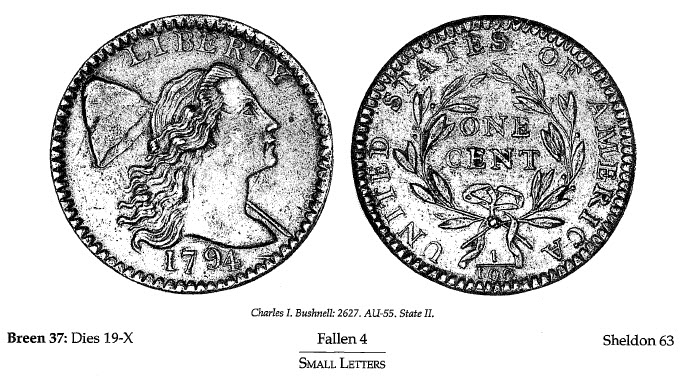
Obverse 19. Hair is in coarser strands than on previous obverses, with several internal gaps or hollows, though given finishing touches with the same needle pointed burin as the last few obverses. A small button is on the lower corner of the cap. Shoulder loop is thin and hollow. LIBERTY almost touches the border with B too low, far from I, and almost touching E. "Fallen 4": in the date, 179 slopes up to the right with the 4 much too low and too close to the high 9. All digits are repunched; Dentils are crude with a double dentil above the space between LI, many joined above LIBERTY and right of the neck, some with long spines or spurs extending into the field.
Reverse X. Small letters with a long straight tail to R. Right ribbon comes not from the knot but from the lower part of the right bow. Its end is short and squared off, joining the long fraction bar. Six berries left and five right with the two at left of the bow minute, often hardly visible. Lowest right leaf is thin and edgewise.
Die states: 1. Perfect dies. No clash marks.
II. Clash marks from leaves between the ear and temple, and before the throat. Shoulder loop fades. Defects at ERI.
Equivalents: Maris 20, "Fallen 4." Frossard 12.
Doughty 41. Hays 32. McGirk 2B. Ross 20- V. Chapman 38. Sheldon 63. EAC 35.
Encyclopedia 1665.
Low Rarity 3.
Remarks: According to Sheldon, (Early American Cents and Penny Whimsy, p. 123) George H. Clapp used to call this the "Drunken Diecutter's Obverse." The contrast between the head and the lettering suggests that an apprentice lettered this die, so poorly that he must have been removed from this assignment and probably from the engraving department. In 1954 I suggested that the circumstances justified attributing this die (and the hand cut reverses in this group: those of numbers 39, 41-48) to Frederick Riche, who worked under Scot for 18 days at $1 per day, and was paid in June 1794. (Stewart, History of the First United States Mint, p.126 )
Probably delivered June 24.
At least two are known with the edge blundered ONE HUNDRED A DOLLAR.: 1) C. E. Clapp, George H. Clapp, ANS;2) Adam Butcher. (Penny-Wise, no. 4, 1/15/1968, pp. 21-22.) Dan Trollan reported another with the word FOR doubled. (Letter to Mark Borckardt, April 28, 1997.)
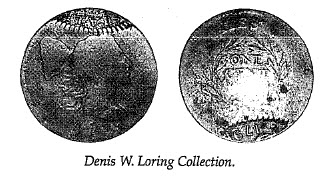
Paul-Carter (Penny- Wise, no. 23, 3/15/1971, pp. 102-104, "Dealt a Double Hand for Penny Whist.") describes a 1795 number 4b showing a purported impression of this variety, with STATE above the head and 1794 below the wreath. This coin is on a thin planchet with plain edge, is not out of round, and retains a minute thin raised rim (of the 1795) around the "1794" impressions. Dr. Sheldon supposedly claimed that he had seen several other similar impressions from the same 1794 and 1795 die and that the 1795 came first. As Sheldon never mentioned any such coin while wewere working on Penny Whimsy, nor while I was still in New York before moving to Berkeley, presumably he saw them all after October 1960. I have no clue to the whereabouts of the others Sheldon saw-if any. I saw the original at the 1989 Early American Coppers convention (Paul Carter, Anthony Terra-nova, March 17, 1988 to R. E. Naftzger, Jr., to Denis W. Loring). Its inconsistencies create doubts. If the 1794 impression came first, why is it on a blank made in early 1796? If the 1795 impression came first, why were the 1794 dies still together in spring 1796 and put into a cent press set to accommodate thin planchet coins? If the piece was made as it purports to be, why is it not out of round? Why has it any rim, no matter how slight, around the outer margin of the 1794 impression? (Genuine off center double strikes of other dates are normally out of round at the off center impression, affecting rims of the centered impressions). The only explanation that makes any sense to me is that false "1794" partial dies were stamped on a genuine 1795 cent. (Editor's Note: Denis Loring, the current owner of this coin, states that there is universal agreement that the 1794 impression exactly matches the dies of this variety. Further, he suggests that old dies were pulled out and a fantasy was created at the coiner's whim.)