Silver Dollars & Trade Dollars of the United States - A Complete Encyclopedia
Q. David Bowers
Centering may be irregular, but only slightly so. For example, a coin may be perfectly centered on the reverse, but have the obverse very slightly off center to the top (making the denticles very prominent at the bottom of the obverse, and weak at the top); or, conversely, a specimen may be well centered on the obverse, but have the reverse very slightly off center to the top (making the denticles very prominent at the bottom of the obverse, and weak at the top).
• NOTABLE SPECIMENS:
Eastern Specimen. MS-60 •• Specimen in a private eastern collection, MS-60 (reported by Douglas Winter).
Newcomer Specimen. AU-55 .• Waldo C. Newcomer • Col. E.H.R. Green .• James G. Macallister .• T. James Clarke Collection, New Netherlands 48th Sale, 1956: 616. "AU-55, only a shade from Mint State. Struck a bit off-center, with pink, blue, lavender and gold patina."
Carter Specimen. AU-50 .• Amon Carter, Jr. Collection, Stack's, 1984: 214 .. "AU and a beauty with some prooflike surface. Lovely pale russet toning with iridescence about the edges."
GENA Convention Specimen. AU-50 •• Kagin's, GENA Convention Sale, 1979: 367. "With lovely blue lustre. Sharp strike with center points of stars visible."
Hollinbeck-Kagin Specimen. AU-50 • Hollinbeck-Kagin Sale, June 1970: 599. "Nearly Uncirculated."
Metropolitan Washington Convention Specimen. EF-45 . • Kagin's Metropolitan Washington Convention Sale, 1975: 535. "Choice EF, sharp strike with deep dentilation around both edges, glittering bluish golden patina, traces of original lustre."
ANA Convention Sale Specimen. EF-40 • Steve Ivy, ANA Convention Sale, 1982: 710. "Gently cleaned at one time now retoned a natural steel gray."
CSNS Convention Sale Specimen. EF-40 .• Kagin's CSNS Convention Sale, 1979: 358. "EF-40, nice strike and original golden grayish color."
DeCoppet Specimen. EF-40 • Andre DeCoppet Collection,James F. Kelly, 1955 .• AJ. Ostheimer, 3rd Collection, Lester Merkin, 1968: 238. "EF, central areas weakly and unevenly struck, obverse full of adjustment marks; mint lustre with much iridescent gray and blue toning."
Newcomb Specimen. EF-40 .• Howard R. Newcomb Collection .• Dr. Charles Green Collection, B. Max Mehl, 1949: 1978 .• Harold Bareford Collection, Stack's, 1981: 407. "EF with some prooflike surface. Struck slightly off center at 6:00. Deep iridescent toning."
The Autumn Sale Specimen. EF-40 .• Stack's Autumn Sale, 1986: 4898. "Somewhat softly struck, with plenty of detail. A few old scratches near reverse rim just to right of bow. Surfaces still retain some mint 'flash' and exhibit attractive antique grayish violet toning."
Ullmer Specimen. EF-40 •• Ullmer Sale, Stack's, 1974: 226 .• March Sale, Stack's, 1983: 926, "EF and a superb specimen. Pale russet-gray toning. Sharply struck, with the slightest wear on the bust and leg of the eagle." Gross Specimen. EF-40 .• Yolanda Gross Collection. Purchased from JJ. Teaparty in June 1985.
• POPULATION DISTRIBUTION:
Approximate population MS-65 or better: 0 (URS-0)
Approximate population MS-64: 0 (URS-0)
Approximate population MS-63: 0 (URS-0)
Approximate population MS-60 to 62: 1 or 2 (URS-1)
Approximate population AU-50 to 58: 10 to 15 (URS-5)
Approximate population VF-20 to EF-45: 120 to 190 (URS-8)
Approximate population G-4 to F-15: 50 to 100 (URS-7)
Approximate population for all grades combined: 175 to 300 (URS-9)
• CONDITION CENSUS: 60-55-55-55-50 (multiples)
1796 Small Date, Large Letters. BB-64.
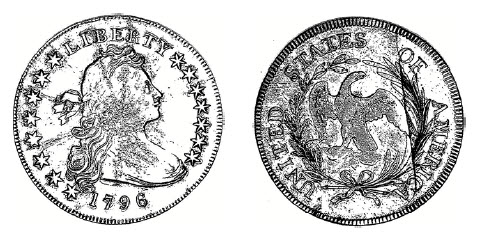
(B-6.)
• OBVERSE 2: See description under 1796 BB-63. Small, wide date.
Obverse die used to strike 1796 BB-63 (earlier use) and BE-64 (later use).
• REVERSE C: Large letters. This variety has a reverse, unknown to Bolender, not found on any other dollar of the era. Four berries inside wreath, four berries outside. Lowest outside berry is between the N and I in UNITED. Berry under right foot of A in STATES.
The two specimens known are each in a reverse die state quickly identifiable by a massive vertical die crack from the rim, through the left side of 0 in OF, through palm branch, wing. tip, palm branch again, C, then turning to the left and continuing to border. This crack strongly affects the right side of the reverse. A smaller crack goes from the bow knot, to the right, through left foot of A, bottom of C, to join larger crack. Usually, the area to the left of the crack is weakly struck. Probably, the die failed almost immediately.
Discovered by Walter H. Breen in the summer of 1957.
Reverse die used to strike 1796 BB-64 only.