Silver Dollars & Trade Dollars of the United States - A Complete Encyclopedia
Q. David Bowers
1800 Silver Dollars
Mintage (all varieties)
Calendar year, Mint report: 220,920
Coins bearing date; author's estimate: 100,000
Coinage Context
Large mintage: The government mintage figure of 220,920 marks the last time the production of early silver dollars crossed the 100,000 mark. By this time, dollars were being exported in quantity, and it was considered futile to coin large quantities.
Die making: Working dies for 1800 dollars were prepared in the same manner as were 1799-dated dollars, to which refer. Varieties are best distinguished by noting the spatial relationships of certain features to each other.
Obverse: The bust of Miss Liberty was punched into the die, after which the letters of LIBERTY, the stars, and the digits in 1800 were all added with individual punches.
Reverse: Punched into the master die were the letters in E PLURIBUS UNUM, Which can vary slightly in their placement or size (1800 BB-184 has smaller letters). The master die with the eagle punch contained the eagle, clouds, arrows; upper part of the olive branch, and inscribed ribbon. Added separately to the working die were the letters of UNITED STATES OF AMERICA, the stars above the eagle, end of the olive branch, and berries. In 1800, workmanship continued to improve at the Mint, and individual die differences become increasingly difficult to differentiate .
Die use: During the year 1800, die relapping was practiced very little. The dies were used while they were in excellent condition; after which most were discarded, even though according to standards in place a year or two before, they could have struck many more coins. Obverse and reverse dies tended to mate for the duration of their mutual lives, without ever being paired with another. Of 12 different obverse dies known for 1800, only three had more than one mate. Likewise, of 11 different reverse dies, only four had more than one partner. Because of this, the die linkages that can be constructed effectively for earlier dates do not have such an extensive counterpart here.
Quality considerations: In general, dollars of 1800 have fewer adjustment marks, planchet defects, or evidence of weak striking than do their ancestors. Quality controls must have been in place at the Mint, at least more so than previously.
Numismatic Information
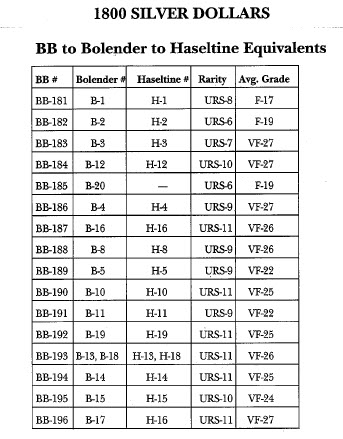
Commentary: 16 die combinations are known of 1800-dated dollars, most of which do not constitute major differences, although varieties with just 12 arrows or just 10 arrows are listed in the Guide Book in addition to the standard with 13 arrows. The AMERICAI variety is simply a standard design with a stray mark from a punch (called a die break or crack by many cataloguers) following the last letter in AMERICA, giving it a fanciful resemblance to an 1. It has been suggested that this may be a remnant of an A letter in the wrong place, but I believe it is either a stray mark or was caused by a piece of foreign matter when the die was made. The AMERICAI issue, not particularly rare, has been popular over the years.
The large number of dies made vs. the number of coins produced may indicate problems with die steel or with some other aspect of the minting process.
Striking periods: There do not seem to be early and late styles of 1800 silver dollars. Thus, while striking periods can be theorized, it is not possible to place them in chronological order. Further study of edge lettering may help to determine a specific chronology.
STRIKING PERIOD 1.
1800 BB-181.
1800 BB-182.
1800 BB-183.
1800 BB-184.
STRIKING PERIOD 2.
1800 BB-185.
1800 BB-186.
1800 BB-187.
STRIKING PERIOD 3.
1800 BB-188.
1800 BB-189.
1800 BB-190.
1800 BB-191.
1800 BB-192.
STRIKING PERIOD 4.
1800 BB-193.
STRIKING PERIOD 5.
1800 BB-194.
STRIKING PERIOD 6.
1800 BB-195.
STRIKING PERIOD 7.
1800 BB-196.