Silver Dollars & Trade Dollars of the United States - A Complete Encyclopedia
Q. David Bowers
1800. BB-186.
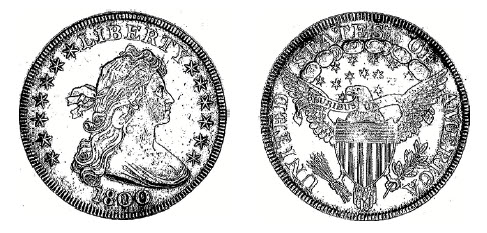
(B-4. H-4.)
• OBVERSE 4: 1 in date dose to curl, and 8 tipped too much to right at top. Liberty's mouth open. 7th, 8th, and 13th stars are all equidistant from L, Y and bust, and are near. Star 1 about 2.5 mm. distant from hair.
Obverse die used to strike 1800 BB-186 only.
• REVERSE D: See description under BB-185. Reverse die used to strike 1800 BB-185, BB-186, and BB-187, possibly in that order.
• DIE STATES:
Die State I: Perfect dies of BB-186 without obverse crack. Apparently, unknown to Bolender in 1950. Very rare. One of these is 1975 ANA Convention Sale (Superior): 973, described as "Bolender-4b," perfect dies, just one of four known; a second piece was in the same sale; both were catalogued as VF-20.
Die State II: Obverse shows slight die crack from border below 1 of date, through base of 1, upward through 8 to first O. Another fine crack from border under first 0 through base of second 0 to bust. The usually seen die state of BB-186.
Die State III: Bolender-4a. Now with extensive die cracks on obverse. Die crack from border up through entire 1 of date and bust to 12th star. Another crack through first star to curl under ribbon. Another crack between IB touching left lower part of B down through hair. Crack along inner points of 10th to 12th stars. Always found weakly struck. Considerably scarcer than the preceding.
• AUCTION POPULATION SURVEY: Very Good: 2, Fine: 5, Very Fine: 23, Extremely Fine: 6, About Uncirculated: 8. Total: 44. Average grade: VF-27.
• COLLECTING NOTES: 1800 BB-186 is one of the scarcer varieties of a year which has quite a few elusive die combinations. I estimate that only 150 to 275 are known. Quite a few of these are in grades such as EF and AU, in contrast to, for example, BB-182, which is mostly known in lower grades.
In his pioneering study in 1881, Capt. J.W. Haseltine considered it to be very rare. By Bolender's publication date, 1950, many dozens of coins had been located.
• NOTABLE SPECIMENS:
MacFarland Specimen. AU-55 .• Bowers and Ruddy Galleries, 1981: 1577. "AU-55. Original mint brilliance intact, traces of dirt on breast, and a small weak area on reverse at far right cloud. Intermediate die state with all of the obverse cracks listed for Bolender-4, plus the arc crack from rim to rim passing through 1, shoulder, neck and 12th star (as listed for Bolender-4a). But with no signs of the other Bolender-4a cracks (between IB or along 10th to 12th stars, or through the 1st star to ribbon)."
Rarcoa Auction '86 Specimen. AU-55 .• Rarcoa, Auction '86, 1986: 733. "Lovely choice AU, well struck with most of the original mint lustre intact."
Ebsen Specimen. AU-55. . Superior Galleries, Buddy Ebsen Collection, 1987: 1912. "Proof1ike surfaces and all is magnificently toned. Boldly struck with full hair detail, complete diagonal lines within all the stars and is well centered on a perfect problem-free planchet. Some light handling marks which are scattered about. Lustrous surfaces are overlaid with a beautiful blending of antique tones, shades of gray and violet mixed with golden iridescence."
Akers Auction '88 Specimen. AU-55 .• David Akers, 1988: 629. "Sharply struck, off a little to the right. Excellent lustre under attractive medium iridescent gold, russet and blue toning. Very clean surfaces; just a trace of friction on the highest points."
F.U.N. Specimen. AU-55 .• Mid American, Florida United Numismatists Sale, 1989: 608. "AU-55. Light lilac toning appears on the high points on this attractive, high-grade example. Traces of original mint lustre still remain! Intermediate state of the dies, showing a number of fine die cracks on the obverse."
Dillard Specimen. AU-53 .• Heritage, Dillard Sale, 1990: 540. "AU (53/53). Considerable amounts of lustre and lovely pale pearl-gray color which becomes slightly deeper at the edges. Excellent detail and minimal actual wear on the high spots."
New England Museum Specimen. AU-50 .• Stack's, New England Museum Collection, 1988: 582. "AU, marvelous golden pink toning with a hint of iridescence."
New England Museum Specimen (another). AU-50 .• Stack's, New England Museum Collection, 1988: 1970. "The obverse with massive cracks and quite naturally, the reverse showing weakness in the corresponding areas. AU, frosty lustre."
• POPULATION DISTRIBUTION:
Approximate population MS-65 or better: 0 (URS-0)
Approximate population MS-64: 0 (URS-0)
Approximate population MS-63: 0 (URS-0)
Approximate population MS-60 to 62: 0 (URS-0)
Approximate population AU-50 to 58: 10 to 20 (URS-5)
Approximate population VF-20 to EF-45: 120 to 220 (URS-8)
Approximate population G-4 to F-15: 20 to 35 (URS-6)
Approximate population for all grades combined: 150 to 275 (URS-9)
• CONDITION CENSUS: 58-55-55-55-50 (multiples)