Silver Dollars & Trade Dollars of the United States - A Complete Encyclopedia
Q. David Bowers
1803. BB-252.
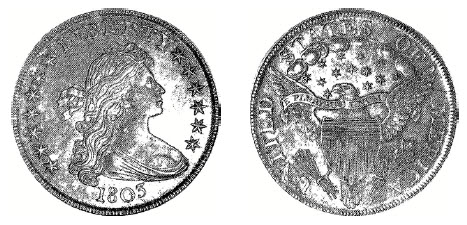
Small 3 in date. (B-5. H-5.)
• OBVERSE 2: Thin top to 3, the 3 too high. Figures of date all close. Stars 8 and 13 are about equidistant from Y and bust, and much closer than stars 1 and 7 are from hair and L. On the left, star pairs 2-3 and 5-6 are closest, while stars 6-7 are noticeably wider than any of the others. On the right, stars 10-11 and 12-13 are wider apart than any others, but not by much. The 3 almost touches bust, and 1 is near curl.
Obverse die used to strike 1803 BB-252 only.
• REVERSE A: Described under 1801 BB-214, repeated under 1803 BB-251, above .
In 1803 BB-252, the reverse is found with a spur on the outside lower right of the curve of the D in UNITED. Often found weakly struck at the centers. Some strikings show heavily bifurcated letters and were considered to be a separate die state (B-5a) by Bolender.
Reverse die used to strike 1801 BB-214 (typically with crack from border toward cloud 6); 1802/1 BB-233 (perfect; first use of the die), BB-234 (die relapped, cloud 6 mostly missing, some arrowheads disconnected; some with clash mark from cloud 5 to border above 0), and BB-235; 1802 BB-242 (spur on D from no won); 1803 BB-251 (relapped, struck before BB-252) and BB-252 (relapped, struck after BB-251 ).
• DIE STATES:
Die State I: With perfect obverse die. Reverse as described above. Some strikings have bifurcated letters on the reverse and are, called Bolender-ba by Bolender, but I do not consider these to be a separate die state.
• AUCTION POPULATION SURVEY: Good: 1, Very Good: 13, Fine: 18, Very Fine: 29, Extremely Fine: 14, About Uncirculated: 6, Mint State-60 or better: 9. Total: 90. Average grade: VF-25.
• COLLECTING NOTES: With an estimated population of 500 to 950 coins, 1803 BB-252 is the second most plentiful variety of-this year. Examples are known in all major grade categories. Most are in lower grades up through VF and EF. AU examples are rare, but are seen mote often than most other varieties of the date. Several high-quality Mint State coins exist. In fact, in Mint State, the BB-252 is the most populous variety of the year.
• NOTABLE SPECIMENS:
Schenkel Specimen. MS-63 (NGC). • Bowers and Merena, 1990: 369. "MS-63 (NGC). Attractive light gray and lilac toning over silver surfaces on obverse. Well struck and well detailed. Reverse toned a medium gray over lilac surfaces and likewise well detailed." .' Bowers and Merena Galleries, ANA Centennial Convention Sale, 1991: 445. MS-63 (NGC). (Description repeated.)
Adams Specimen. MS-63 (NGC). • Superior Galleries, Adams Collection, 1992: 2123. MS-63 (NGC). "Razor-sharp. Pristine fields and immaculate; surfaces have acquired light to medium gray toning with golden undertones on obverse, while the reverse is uniformly darker, approaching iridescent steel in its tone." (Same coin as preceding?)
Alto Specimen. MS-60 .• Stack's, Alto Collection, 1970: 1068. "Brilliant Unc., boldly struck, full mint bloom. Iridescent toning further enhances the beauty of this coin."
San Diego Specimen. MS-60 •• Mid-American, 1989:719. "MS-60. Obverse nearly fully prooflike with mirrorlike reflectiveness below rich antique gray-gold and rose color; reverse tends more toward frostiness and has similar color. Excellent strike, as is centering."
May Sale Specimen. MS-60 •• Stack's, 1991: 593. "Brilliant Unc., full frosted surfaces. The central portion slightly soft in strike."
DeCoppet Specimen. AU-55. • James Kelly, Andre DeCoppet Collection, 1955. "Practically Unc."
Hollinbeck-Kagin Specimen, AU-55 •• Hollinbeck-Kagin Sale, June 1970: 643. "Near Unc."
Bolender Specimen. EF-40 • M.H. Bolender. • Lester Merkin, AJ. Ostheimer, 3rd Collection, 1968): 326. "EF, rainbow tone, obverse stronger than reverse. Tiny obverse rim nick above R, smaller border nicks near 2nd star. Finer than Fairbanks:575 or the piece in New Netherlands , 54th sale.":
• POPULATION DISTRIBUTION:
Approximate; population MS-65' or better: 0 (URS-0) '"
Approximate population MS-64: 0 (URS-0)
Approximate population MS-63: 2 or 3 (URS-2)
Approximate population MS-60 to 62: 5 to 8 (URS-4)
Approximate population AU-50 to 58: 10 to 20 (URS-6)
Approximate population VF-20 to EF-45: 275 to 550 (URS-10)
Approximate population G-4 to F-15: 200 to 350 (URS-9)
Approximate population for all grades combined: 500 to 950 (URS-11)
• CONDITION CENSUS: 63-63-60 (multiples)