Silver Dollars & Trade Dollars of the United States - A Complete Encyclopedia
Q. David Bowers
1799. BB-154.
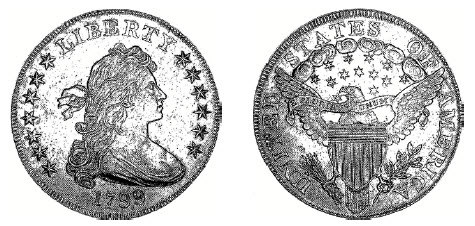
(B-18. H-18.)
• OBVERSE 3: Star 8 farther from Y than the first star from curl, or the star 7 from L, or the last star from bust. Highest curl on top of head is centered under right edge of E and space between E and R, the farthest right of any 1799 obverse. Same die used for BB-155. The first three obverse stars show light repunching (visible on high-grade specimens). On the left, stars 2 and 3 are much closer than are any other stars to each other; stars 4-5 and 6-7 have the widest spacing. On the right, stars 8-9 and 9-10 are more closely spaced than are the other star pairs.
Obverse die used to strike 1799 BB-154 (early use) and BB-155 (later use).
• REVERSE F: Heavy die crack between E and D through left wing, to top of shield, the best aid to identifying the variety (if Die State II; see Die States below). Lighter cracks usually through TATES 0, from lower part of F to top of A, from border above R, top of I, through CA, stem end, tail, up through NIT. Small point at stem end. A does not touch feathers. Leaf points below left side of upright of I in AMERICA. Point of star touches lower point of eagle's beak. The U and the T in UNITED are repunched. Far right edge of A is over cloud 3. Usually weakly struck at reverse center. A few pieces are known with reverse die misalignment.
Reverse die used to strike 1799 BB-154 only.
• DIE STATES:
Die State I: Perfect dies. Unknown to Bolender; Haseltine called it H-20, but this was eliminated by Bolender as non-existent. From 1 to 3 are known today (reported by Douglas Winter). EF-45 reported by Warren Miller.
Die State II: Die cracks less advanced than on State III. Cf. Gilhousen (Superior, 1973), VF, called "one of the half dozen finest, exceeded by three EFs and tied or minutely exceeded by a couple of others not quite reaching EF."
Die State III: Dies as described by Bolender, above. EF-45 reported by Warren Miller.
Die State IV: Later die state, now with a heavy crack below the left wing tip through STATES and the 0 in OF to the rim below; a second crack begins at the rim over the E in STATES and it then meets the crack through ED as described by Bolender.
• AUCTION POPULATION SURVEY: Good: 2, Very Good: 4, Fine: 2, Very Fine: 12, Extremely Fine: 4, About Uncirculated: 4, Mint State-60 or better: 5. Total: 33. Average grade: VF-29.
• COLLECTING NOTES: 1799 BB-154 is the second rarest die variety of 1799, and is exceeded only by BB-151. I estimate that only 60 to 100 are known. Nearly all of these are in well-worn grades. A few coins described as Uncirculated came on the market years ago, but it is probable that most would grade less today. The BB-154 is an ideal example of a coin that the cherrypicker can hope to buy for a "type" price. There may come a day when most early dollars on the market are attributed to BB numbers, but until then there is always the possibility of finding something quite rare for a nominal sum.
• NOTABLE SPECIMENS:
Hirt and Bolt Collections Specimen. MS-60 .. Pine Tree, 1975: 764. "Rainbow toned Unc., weakly struck in centers that it was graded 'AU' at its earlier auction appearances. First three stars obviously repunched; U and T of UNITED recut. Heavy break from rim between ED to shield; all cracks listed by Bolender, second extended through S to wing tip."
Hollinbeck-Kagin Specimen. MS-60 .• Hollinbeck-Kagin Sale, June 1970: 629. "Unc, bluish golden, struck from dished dies resulting in curl below ear and eagle's head (opposite side) not being fully struck up."
Terrell Specimen. AU-58 .. Bowers and Ruddy Galleries, Terrell Collection, 1973 • Bowers and Ruddy Galleries, Austin Collection, 1974: 27. "Unc. Lovely light iridescent toning, some very minor rubbing."
Fairfield Specimen. AU-58. • Bowers and Ruddy Galleries, Fairfield Collection, 1977: 1035. "Borderline Unc., lightly struck at centers. Deep lilac and iridescent toning."
Brooks Specimen. AU-55 .• Bowers and Merena, Brooks Collection, 1989: 246. "A rare early die state lacking the 'heavy die break' described by M.H. Bolender between E and D in UNITED. Lilac and golden toning with vestiges of satiny lustre around the design elements."
DeCoppet Specimen. AU-55 •• James Kelly, Andre DeCoppet Collection, 1955. "Well centered, sharply struck. Practically Unc."
• POPULATION DISTRIBUTION:
Approximate population: MS-65 or better: 0 (URS-0)
Approximate population MS-64: 0 (URS-0)
Approximate population MS-63: 0 (URS-0)
Approximate population MS-60 to 62: 1 or 2 (URS-1)
Approximate population AU-50 to 58: 4 to 8 (URS-3)
Approximate population VF-20 to EF-45: 40 to 65 (URS-0)
Approximate population G-4 to F-15: 15 to 25 (URS-5)
Approximate population for all grades combined: 60 to 100 (URS-7)
• CONDITION CENSUS: 60-58-55-50-50-45 (multiples)