Silver Dollars & Trade Dollars of the United States - A Complete Encyclopedia
Q. David Bowers
1800. BB-188.
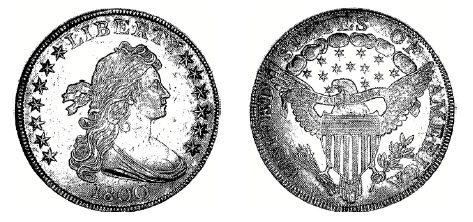
(B-8. H-8.)
• OBVERSE 6: Bolender said this: "Look for the die 'dot' inside lower part of R, near the left upright, in LIBERTY." This easily distinguishes this die, which was also used for BB-189. Left base of E slightly high in relation to bottom of B (this same characteristic is true of the different obverse used to strike BB-193). Mouth of Liberty closed. Star 7 is closer to L, by a tiny amount, than star 8 is to Y, and star 13 is separated from the bust even farther, and the hair from star 1 farther yet. On the left, stars 1-2 and 2-3 are closer together than are any other stars. On the right, stars 10-11 and 12-13 are wider apart than are any other stars. Stars 2-3 and 11-12 are slightly misaligned in relation to each other.
Obverse die used to strike 1800 BB-188 (earlier use) and BB-189 (later use).
• REVERSE E: Three upper stars on right on reverse do not touch clouds. Three upper stars on left on reverse each have one point touching clouds. Leaf points slightly left of center of I in AMERICA. Star enters eagle's mouth, upper part of beak closing down on side of star point. Letter A just touches 3rd and 4th feathers. AME do not join each other. Very large berries. A over clouds 2 and 3. Tip of arrowhead under center of U in UNITED.
Reverse die used to strike 1800 BB-188 only.
• DIE STATES:
Die State I: Obverse and reverse dies without crack. The die state usually seen.
Die State II: Obverse die without cracks. Reverse with crack through AMER.
Die State III: As preceding, but reverse crack forms a tiny blob at upper right of R, and continues to border at that point.
Die State IV: As above, but with additional crack from right side of R to top of I to border above C. Crack through AMER now extends to the left through wing and F.
• AUCTION POPULATION SURVEY: Good: 4, Very Good: 2, Fine: 6, Very Fine: 15, Extremely Fine: 6, About Uncirculated: 3, Mint State-60 or better: 4. Total: 40. Average grade: VF-26.
• COLLECTING NOTES: The 1800 BB-188 dollar is on the scarce side. Perhaps 150 to 275 survive in all grades combined. This population is far higher than the number of specialists seeking them. Thus, there will be no problem acquiring one for a "type" price.
• NOTABLE SPECIMENS:
Boyd Specimen. MS-60 .• Numismatic Gallery, World's Greatest Collection, F.C.C. Boyd, 1945: 95. "A very handsome Unc, coin, though with slightest edge nick."
Superior Auction '88 Specimen. MS-60. • Superior Galleries, 1988: 212. MS-60. "Extremely well struck with most of obverse hair strands individually defined; just a touch of weakness is' noted at the innermost part of the eagle's Wings. Not quite perfectly centered with the denticles at the left obverse narrow while wide at the right obverse. The surfaces are completely lustrous and display superb natural medium gold toning with splashes of iridescence at the obverse and reverse borders plus some bright golden orange in the protected areas of the reverse. One small mint-made reverse flaw which runs from the IE of PLURIBUS through the ST in STATES to the rim; otherwise, the surfaces are virtually pristine."
DeCoppet Specimen. AU-55. • James Kelly, Andre DeCoppet Collection, 1955. "Practically Unc. A beautiful, well-struck coin."
Ebsen Specimen. AU-50. • Superior Galleries, Buddy Ebsen Collection, 1987: 1913. "Die dot inside lower part of R in LIBERTY; very large berries. AU-50+. Boldly struck with nice wide denticles, and is well centered on a perfect planchet. A blending of grayish violet, pale blue and greenish golden iridescence."
Higgins Specimen. AU-50 •• Bowers and Merena; Lloyd Higgins, M.D. Collection, 1988: 2222. "AU-50 (ANACS), outstanding. Sharply struck, virtually full central obverse detail. The majority of Liberty's hair strands are sharp and separate. The stars are sharply struck as are the letters in LIBERTY and the numerals of the date. Similarly well struck reverse, slightly soft in the center given the sinking of the die at this point. The coin is highly lustrous, particularly on the reverse. The reverse is lightly toned in a delicate golden brown shade. One small darker area is noticeable on the reverse."
Four Landmark Collections Specimen. AU-50. Bowers and Merena.Four LandmarkCollections, 1989: 1972. "AU-50, prooflike. Bright and reflective surfaces. The obverse and reverse peripheries are lightly toned in pale blue and iridescent golden-brown shades." • Yolanda Gross Collection.
• POPULATION DISTRIBUTION:
Approximate population MS-65 or better: 0 (URS-0)
Approximate population MS-64: 0 (URS-0)
Approximate population MS-63: 0 (URS-0)
Approximate population MS-60 to 62: 2 to 4 (URS-2)
Approximate population AU-50 to 58: 3 to 5 (URS-3)
Approximate population VF-20 to EF-45: 100 to 190 (URS-8)
Approximate population G-4 to F-15: 40 to 75 (URS-7)
Approximate population for all grades com-bined: 150 to 275 (URS-9)
• CONDITION CENSUS: 60-60-60-55 (multiples)