Silver Dollars & Trade Dollars of the United States - A Complete Encyclopedia
Q. David Bowers
1800. BB-185.
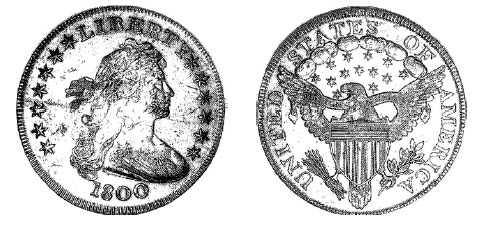
(B-20.)
• OBVERSE 3: The upper right star is in position similar to the obverse of the 1804 dollars, with two points almost touching Y. Therefore, as Bolender related, this variety has been used at least twice in idle fabrication of an 1804, by altering the last figure of date. The upper point of star 8 nearly touches Y at a point below its top, as in the 1804 dollars. Star 7 is about as near L as star 13 is from bust. Star 1 is distant, over 3 mm., from hair. On the left, star 1 is below the arc line of stars 2-7.
This obverse was not known to Haseltine when he compiled his Type-Table in 1881.
Obverse die used to strike BB-185 only.
• REVERSE D: Die flaws show at top and to right of ES, easily identifying this die which was also used for BB-186 and BB-187. Lower right serif of F is extremely close to or touches cloud 8; the only reverse of 1800 with this characteristic. The eagle's beak closes down on extreme point of a star. Leaf points slightly right of center of I in AMERICA. First A in AMERICA rests on wing. Letter T in UNITED is double-punched. A over clouds 2 and 3. Tip of arrowhead under right side of right upright of U in UNITED.
Reverse die used to strike 1800 BB-185, BB-186, and BB-187, possibly in that order.
• DIE STATES:
Die State I: Early state of obverse without bulging. Very rare, if, indeed, it exists at all.
Die State II: Bulge begins at center of obverse, especially in the left field. Die crack links stars 9 to 13. The usual state seen.
Die State III: Bulge becomes very prominent. The Spies Collection coin is VG-8.
• AUCTION POPULATION SURVEY: Less than Good: 1, Very Good: 1, Fine: 3, Very Fine: 4, Extremely Fine: 2. Total: 11. Average grade: F-19.
• COLLECTING NOTES: Only about 20 to 40 are known of the 1800 BB-185, believed to be the rarest variety of the year. Bolender knew of only a single undamaged specimen of this variety, stating it was "as rare as an 1804." Since that time, other examples have come to light. None is known in a grade of AU or higher.
• NOTABLE SPECIMENS:
Bolender Specimen. EF-40. • M.H. Bolender Collection, 1952: 162. "EF, sharp even impressions, well-toned." • W. G. Baldenhofer to Stack's, Farish-Baldenhofer Sale, 1955 .• AJ. Ostheimer, 3rd Collection • Superior Galleries, ANA Convention Sale, 1975: 1003. "EF-45, lovely blue-gray iridescence, and a choice impression. Trifle central weakness and a faint scratch is under LI of LIBERTY toward the sixth star; otherwise, virtually perfect. Discovery specimen;"
Willasch Specimen. VF-20. • Superior Galleries, H. Roland Willasch Collection, 1990: 577. "VF-25. Even gray but cleaned long ago with the faint hairlines in the field. A small planchet defect is visible between third and fourth stars on the obverse and corresponding area on the reverse, only affecting the dentils. Weakly struck on Liberty's neck and surrounding curls, probably from buckling of the die. Early die state before the reverse broke at the E of AMERICA. Pedigree: Unknown, likely purchased by Mr. H. Roland Willasch as it does not appear to have come from any of the recent large Bust dollar sales."
Boyd Specimen. VF-20 •• Numismatic Gallery, World's Greatest Collection, F.C.C. Boyd, 1945: 108, (Haseltine-20), Not in Haseltine. Struck off center, 00 in dale high, with last O closer to bust. Die break through E in AMERICA. VF. Helfenstein Specimen. VF-20. Lester Merkin, 1968: 281. "VF, lustrous, golden russet, blue and brown toning. Borderline R-8. Obverse die has caved in, producing a bulge left of curls and below ribbon, accounting for immediate discard of this obverse."
Polis Specimen. VF·20. • Bowers and Merena Galleries, George N. Polis, M.D. Collection, 1991: 2227. "VF-20. Attractive, pleasing combination of pale and darker gray. The central devices nicely offset against darker fields.
Hollinbeck Specimen. F-12 .• Hollinbeck Coin Co. (January 1955), "Fine, with an X-shaped rubber-band 'burn' on the obverse." • Lester Merkin, AJ. Ostheimer, 3rd Collection, 1968: 311. "Fine; obverse planchet flaws forming a cross." • Stack's, W. Earl Spies Collection, 1974: 208. "Obverse new and unknown to Haseltine, .starting to bulge at center but the central hair is still fairly strong. Reverse from Bolender-4 die with the die flaws not too prominent. Fine, with a rubberband (?) 'burn' in the shape of an X across obverse. R-7." Spies Specimen, VG-8 •• Stack's; W.Earl Spies Collection, 1974: 209. "Advanced die state with the obverse bulge very prominent, making the central portion very weak. VG."
Note: At least two more have been damaged by altering the last date digit to 4, to read "1804" (per M.H. Bolender).
• POPULATION DISTRIBUTION:
Approximate population MS·65 or better: 0 (URS-0)
Approximate population MS-64: 0 (URS-0)
Approximate population MS-63: 0 (URS-0)
Approximate population MS-60 to 62: 0 (URS-0)
Approximate population AU-50 to 58: 0 (URS-0)
Approximate population VF-20 to EF-45: 12 to 25 (URS-5)
Approximate population G-4 to F-15: 8 to 15 (URS-4)
Approximate population for all grades combined: 20 to 40 (URS-6)
• CONDITION CENSUS: 45-35-30-20 (multiples)