Silver Dollars & Trade Dollars of the United States - A Complete Encyclopedia
Q. David Bowers
1801. BB-212.
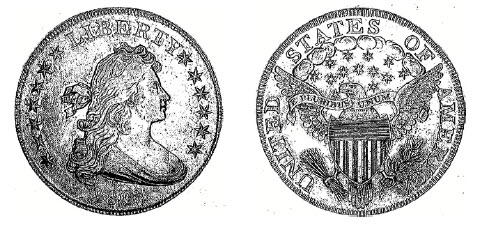
(B-2. H-2.)
• OBVERSE 1: See description under 1801 BB-211. Now with die clash marks around date. Often struck lightly at the upper. obverse.
Obverse die used to strike 1801 BB-211 (earliest use),BB-212.(intermediate use), and BB-213 (latest use).
• REVERSE B: the point (the leftmost arrowhead is under the left edge of the left serif of N in UNITED. The point of upper part of eagle's beak touches down on a point of a star slightly back from extreme star point. Only 12 arrows show plainly (13th faintly shows, but is difficult to find). First A in AMERICA touches third feather, and is connected by die crack to 4th feather. Leaf points more towards left corner of base of I in AMERICA.
The same hub used to produce this reverse was also employed to make Reverse X and Reverse Y for the 1801-2-3-4 novodel series (see Chapter 6). It had 12 arrows, instead of the correct 13. Whenever this hub was used, the 13th arrow was added by hand, always with a light impression front a separate punch.
Reverse die used to strike 1801 (intermediate state) BB-212; 1802/1 BB-231 (early state) and BB-232 (early state); 1802 BB-241 (slightly advanced intermediate state); and 1803 BB-253 (if it exists) and BB-254 (slightly advanced intermediate state), and BB-255 (terminal state).
Note: Die progression study reveals that 1801 BB-212 was struck after 1802/1 BB-231 and BB-232, but before 1803 BB-254 and 1803 BB-255; thus it was not struck before 1802.
• DIE STATES:
Die State I: Perfect dies without clash marks on obverse or reverse. Scarce.
Die State II: 'The obverse has dash marks as follows: At top of bus rare double clash marks, from two clashes, slightly misaligned between strikes; the impressions (from top of eagle's wing by UNUM on reverse) .appear as a -. double "collar." Incusations from clouds can be seen at the date, and other incusations extend left to' star 3. On the reverse, a tiny crack can be seen from the eagle's second feather to the left rim. A very light. clash mark (not a die crack) from the drapery can be seen through OF. LIBERTY is often lightly struck, as is the eagle's tail, on this and Die State III (perhaps the clashing caused some misalignment of the die faces)
Die State III: Obverse. die lightly relapped, removing-one of the "collar" marks (how it is.a single "collar"), most of the incusation marks at date and to the left, and reducing the size of a raised die line to the left of the 1 (that has appeared since its first use on 1891 BB-211). Reverse as preceding. This is the die state most often seen.
• AUCTION POPULATION SURVEY: Less than Good: 1, Very Good: 7, Fine: 16, Very Fine: 37,Extremely Fine: 18, About Uncirculated: 8, Mint State-60 or better: 4. Total: 91. Average grade: VF-26.
• COLLECTING NOTES: The. population of 1801 BB-212 is about 500 to 900, or about the same as 1801 BB-211. These two varieties are the two most populous of the year. However, of the four business strike varieties of the date, none is a rarity.
Examples are quite rare AU or finer, I know of no Uncirculated specimen coming on the market in recent decades. Perhaps some coins listed in that grade many years ago will resurface to be graded by today's interpretations, and some future edition of this book will list them. The Winsor-Mills coin probably does qualify, and in the Condition Census I arbitrarily assign the grade of MS-63 to it.
• NOTABLE SPECIMENS:
Winsor Specimen. MS-63. • Richard Winsor Collection (1895) .• Mills Collection (Chapman brothers, 1904).
Boyd Specimen. AU-58 .• Numismatic Gallery, World's Greatest Collection, F.C.C. Boyd, 1945: 110. "A splendid coin, Unc., though with cabinet friction on high spots. Brilliant."
Brooks Specimen. AU-58. • Bowers and Merena Galleries, 1989: 269. "AU-58/MS-60. The obverse field has a pleasing satiny texture. The reverse is prooflike; even the stripes within the eagle's shield exhibit a mirrorlike finish. Both surfaces are attractively toned in appealing pastel hues of gold, blue, and rose."
DeCoppet Specimen. AU-55. • James Kelly, Andre DeCoppet Collection, 1955. "Practically Unc., beautifully toned."
Hollinbeck-Kagin Specimen. AU-55 .• Hollinbeck-Kagin Sale,June 1970: 636. "Bolender-2a. Light die break through o in OF, very close indeed to Unc. with only the barest of rubbing in center, sharp stars, lovely bluish golden patina."
Gross Specimen. AU-55 .• Paramount International Coin Corporation, 1973. "AU, choice." • Yolanda Gross Collection.
New Netherlands Specimen. AU-50 .• New Netherlands Coin Company's 57th Sale, 1963, AD.
Hollinbeck-Kagin Specimen. AU-50 .• Hollinbeck-Kagin Sale, August 1970: 1097. "Near Unc., attractive patina."
Newport Specimen. AU-50 .• Bowers and Ruddy, Newport Collection, 1975: 388. "Very beautiful AU, with much original mint lustre still in evidence. A tiny ding on the reverse rim above D of UNITED must be mentioned for accuracy."
CSNS Specimen. AU-50 .. Kagin's, CSNS Convention Sale, 1980: 946. "Choice AU-50+, lovely gray bluish toning, traces of original lustre. Strong strike, sharp stars, nice overall clear surfaces."
Ebsen Specimen. AU-50 .• Superior Galleries, Buddy Ebsen Collection, 1987: 1919. "Die chip right of foot of! in AMERICA. AU-50+. Nice even strike, a bit shallow through the central areas of Liberty, but all the details are easily discernible. Well centered on a perfect planchet. The stars are fully struck up nice and bold and the reverse is particularly sharp. The surfaces are lustrous and frosty, with an attractive natural mixture of warm sunset tones."
DSCE Sale Specimen. AU-50.• Heritage, DSCE Sale, June 1988: 712. "AU (50/50). Choice steel gray surfaces with ample lustre remaining. Free from mentionable flaws and a fine candidate for a high-grade type set."
Casterline Specimen. AU-50. • Superior Galleries, Fred Casterline Collection, 1989: 3215. "AU-50. Untoned and exceptionally frosty. Some very light wear on the high spots of the obverse and, to a lesser degree. The strike is extremely sharp, just a few small marks strewn about the fields."
Aspen Specimen. AU-50. • Bowers and Merena, Dr. Nelson Page Aspen Collection, 1989: 400. "AU-50. Clean and attractive with ample mint lustre still surviving in the protected areas. Blushes of light golden toning enhance the surfaces."
Spring Quartette Sale Specimen. AU-50. • Bowers and Merena Galleries, Spring Quartette Sale, 1992: 2319. "AU-50. Generous amounts of mint lustre are retained in the recessed areas,"
• POPULATION DISTRIBUTION:
Approximate population MS-65 or better: 0 (URS-0)
Approximate population MS-64: 0 (URS-0)
Approximate population MS-63: 1 or 2 (URS-1)
Approximate population MS-60 to 62: 0 (URS-0)
Approximate population AU-50 to 58: 15 to 30 (URS-5)
Approximate population VF-20 to EF-45: 325 to 625 (URS-10)
Approximate population G-4 to F-15: 150 to 250 (URS-9)
Approximate population for all grades combined: 500 to 900 (URS-11)
• CONDITION CENSUS: 63-58-58-55 (multiples)