Silver Dollars & Trade Dollars of the United States - A Complete Encyclopedia
Q. David Bowers
1799. BB-153.
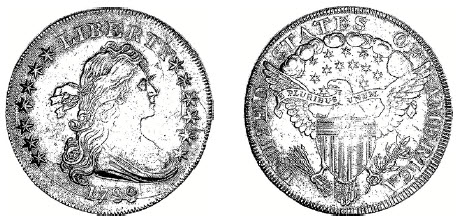
15 stars on reverse
(B-4. H-4.)
• OBVERSE 2: Irregular date. See description under BB-151.
Obverse die used to strike 1799 BB-151 (first use), BB-152 (intermediate use), and BB-153 (final use).
REVERSE A: See description under 1799 BB-141. 15 stars; the two extra stars are identifiable only by points emanating from the bottom of clouds. Clouds 1 and 8 are oversized to hide the blunder. The stars are arranged in arcs as 5-6-2, rather than 6-5-2. Far right edge of A is over cloud 3.
Reverse die used to strike 1799 BB-141 (later use) and BB-153 (earlier use).
DIE STATES:
Die State I: Obverse die with these cracks, mostly inherited from.its earlier use to coin BB-152:.Hairline crack from left side of 1 in date through stars 14 to border opposite star 5. Hairline crack from Center of star 4 through star 7. Separate hairline crack from center of star 7 through LIBE. Crack from right side of R, through bottom of T, below Y; to field. Crack from Y through stars 8, 9, and 10 to bust. Now also with hairline crack from star 1 to second curl from bottom. Reverse die without cracks (but with some raised die flaws, as made, near D of UNITED). Scarcer die state than the following.
Die Stale II: Obverse now with incusation marks-from reverse denticles, at obverse denticles at border from star 1 through 6, slightly toward star 7. Earlier crack from Y now extends to left to border; Crack in field opposite stars 10 and 11 begins at earlier crack, is closer to neck, and goes to bust. Crack from star 10 to border opposite star 11 (on slightly later die progression, crack extends toward field from star 10 and joins earlier crack). Crack extends from earlier crack through top of star 12 to border. The obverse die failure is responsible for usual light striking at the center of the reverse. The die could not have lasted much beyond this point. This is the die state usually seen. '.' .:
• AUCTION POPULATION SURVEY: Very Good: 9, Fine: 13, Very Fine: 23, Extremely Fine: g, About Uncirculated: 3, Mint State-60 or better: 2. Total: 59. Average grade: VF-22.
• COLLECTING NOTES: I estimate that 350 to 600 examples of 1799 BB-153 are extant today, placing it in the medium range of availability within varieties of this year. Most survivors' are in grades up through VF, although EF examples come on the market at intervals. In AU or Mint State, BB-153 is a great rarity. The blundered reverse die feature lends interest and value.
• NOTABLE SPECIMENS:
Kagin Specimen. AU-50+ • Ragin's, CSNS Convention Sale, 1979: 365. "Borderline Unc-50+. Lovely golden gray lustre, only barest friction. Full stars, collar lines and top hair strands but center hair strands back of ear not fully struck up:'
Dallas Specimen. AU-50+ •• Heritage, Dallas Auction, 1989: 458. "AU (50/50+). Gorgeous, with lots of original lustre still remaining on both sides. Some very shallow adjustment marks crisscross the shield on the reverse. Attractive, golden-gray color."
Ruby Specimen. AU-50 •• Superior Galleries, Ruby Collection Sale, Part I, 1974: Lot 1467. "Shattered obverse die, possibly later even than Gilhousen 1249. AU, a really brilliant coin with a little too many areas of cabinet friction on face and curls. Delicate gold tone starting. One minute nick in top reverse field, otherwise just about flawless."
Austin Specimen. AU-50; • K.P: Austin Collection > Lester Merkin, AJ. Ostheimer, 3rd Collection, 1968: 275. "Shattered obverse. Choice Unc., weak in centers but with splendid lustre and prooflike surface; irregular toning and tarnish, natural streakiness and almost no bagmarks." • Superior Galleries, Gilhousen Collection, 1973: 1249. "Irregularly toned, prooflike Unc., weakly struck in centers out much better struck elsewhere. Advanced obverse cracks!" • Superior Galleries, ANA Convention Sale, 1975: 914. "Obverse die cracks, as usual. EF-45 or better, but very weakly struck up in the center portions. Irregularly toned and has prooflike.surfaces." [Author's note: We have arbitrarily assigned the grade of AU-50 to this specimen. In 1968 it was described as ChoiceUnc; in 1973 as prooflike Unc. and in 1975 as EF-45 or better. We have not examined this coin to determine our 1993 grade opinion.]
Austin Specimen (another). EF-45 .• K.P. Austin A.J. Ostheimer, 3rd Collection • Superior 'Galleries, ANA Convention Sale, 1975: 915. "Much more advanced state of the obverse dies, EF-45, cleaned, but lustrous and beS1nning to tone. Light handling marks visible to the naked eye." (numerous other, EF coins could be cited) .
• POPULATION DISTRIBUTION:
Approximate population MS-65 or better: 0 (URS-0)
Approximate population MS-64: 0 (URS-0)
Approximate population MS-63: 1 (URS-1)
Approximate population MS-60 to 62: 1 or 2 (URS-1)
Approximate population AU-50 to 58: 5 to 10 (URS-4)
Approximate population VF-20 to EF-45: 225 to 400 (URS-9)
Approximate population G4to F-15: 125 to 200 (URS-9)
Approximate population for all grades combined: 350 to 600 (URS-10)
• CONDITION CENSUS: 63-60-60-50-50-45 (multiples)