Silver Dollars & Trade Dollars of the United States - A Complete Encyclopedia
Q. David Bowers
The identical specimen appeared 16 years later as Lot 24 of the W. Earl Spies Collection (Stack's, 1974). The cataloguer noted the following:
1796 B-3 [BB-62]. Small Date, Small Letters. The letters not bifurcated., and the curl at the top of the head imperfect. One of only very few known. Probably a high Rarity-6 or perhaps 7. Very Fine to Extremely Fine. From our Straus Sale in 1959. [Realized $950.]
The preceding descriptions, particularly that in the Straus Collection sale, indicate that the cataloguer for Stack's was quite certain at one time that a BB-62 existed, and was examined by a specialist.
In recent decades, such notable silver dollar variety collection sales as Ostheimer (1968), Gilhousen (1973), 1975 ANA, and Willasch (1990) have lacked an example of this variety. It is worth noting that Bolender's own collection, auctioned in 1952, was missing the 1796 BB-62.
• NOTABLE SPECIMENS:
Straus Specimen. VF-30. • Straus Collection, Stack's, 1959 .• Spies Collection, Stack's, 1974: 24. Letters not bifurcated, and the curl on top of the head imperfect. VF to EF.
The following are of unknown status:
Note: With the exception of the Straus-Spies coin, all "Bolender-3" 1796 dollars listed in our survey fall into one of two categories: 1. The coin was mis-attributed based on plate examination. 2. The coin was not plated in the catalog making verification impossible.
Boyd Specimen. VF-20.• World's Greatest Collection, F.C.C. Boyd, Numismatic Gallery, 1945: 20. Haseltine-3. VF and very scarce. Not plated.
Blauvelt Specimen. VG-10 .• Bowers and Ruddy, 1977: 492, About Fine. Some marks on obverse. Not plated.
Aaron Specimen. VF-20 .• Steve Ivy, 1982: 1070. Not plated.
Phoenix Specimen. VF-25 .• Steve Ivy, 1982: 998. Die dot in field above 1 in date. Tear-drop die flaws below stars 11 and 13. Non-bifurcated letters in LIBERTY. Even gray surfaces which are very lightly granular. Not plated.
Hatie Specimen. VG-8 .• Bowers and Merena, 1983: 908, VG-8 or fairly close to it. Some traces of adjustment marks on 'obverse right field. Light gray coloration. Not plated.
• POPULATION DISTRIBUTION:
Approximate population MS-65 or better: 0 (URS-0)
Approximate population MS-64: 0 (URS-0)
Approximate population MS-63: 0 (URS-0)
Approximate population MS-60 to 62: 0 (URS-0)
Approximate population AU-50 to 58: 0 (URS-0)
Approximate population VF-20 to EF-45: 1 to 3 (URS-1)
Approximate population G-4 to F-15: 1 or 2 (URS-1)
Approximate population for all grades combined: 2 to 5 (URS-2)
• CONDITION CENSUS: 30-? (information incomplete)
1796 Small Date, Small Letters. BB-63.
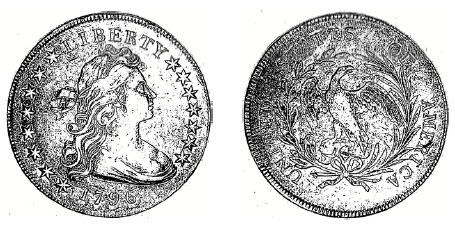
(B-2. H-2.)
• OBVERSE 2: Small wide date; all of the figures of date evenly spaced wide apart. 6 leans to the left. Highest wave of hair under serif at left bottom of E; second highest wave under upright of R. End of hair tress touches only one (the innermost) point of star 1. The curly lock closest to the date barely misses the star point to the right of the innermost point of star 1 (magnification may be necessary to tell this: on BB-66, the curly lock touches not only the tip of the innermost point of star 1, but also the point to the right of it). On BB-63, star 1 points to the space between two denticles (on BB-66 it points to a denticle). A point of star. 15 points to the middle of the drapery folds (on BB-66 it points to a spot high on the drapery folds). This obverse bears a close resemblance to the obverse of BB-66, and specimens sh6hld be compared to it. The R in LIBERTY shows beginning signs of failure at the lower right tip. Of the four 1796 obverses, this die was cut next to the last.
Obverse die used to strike 1796 BB-63 (earlier use) and BB-64 (later use).
• REVERSE B: Described under 1795 BB-51, herewith repeated: Small Eagle. Small Letters in legend. Eagle stands on clouds. Wreath is composed of a palm branch (right) and olive branch (left), the latter with seven berries. A short, prominent die scratch extends up to left from tip of right, inside leaf below (observer's) left wing. Berry under A of STATES; a quick way to identify this reverse. Weakly detailed at center.
Reverse die used to strike 1795 BB-51; 1796 BB-62, BB-63, and BB-66 (now relapped); 1797 BB-72; and 1798 BB-81.
• DIE STATES:
Die State I: Perfect dies. Reverse die state the same as used on 1795 BB-51; no lapping yet (compare to die states of 1796 BB-66) .. This is the only die state seen by the author. This is the same reverse die state as used to coin 1796 BB-62.
Die State II: Reverse die relapped, removing. some details of the shallowest (lowest) folds in the wreath ribbon and removing about 50% of the lowest left leaf on the wreath Gust below the U of UNITED). This die state was also. used to coin 1797 BB-72 and 1798 BB-82. May not exist with 1796 BB-63.
• AUCTION POPULATION SURVEY: Very Good: 2, Fine: 7, Very Fine: 16, Extremely Fine: 7, About Uncirculated: 3, Mint State-60 or better: 1. Total: 36.
• COLLECTING NOTES: An estimated 175 to 300 specimens exist of 1796 BB-63, another variety that is usually seen in lower grades. Above VF, acquisition becomes a challenge. Specimens are scarce if EF and very rare if AU. The typical example of 1796 BB-63 is not as well struck as 1796 BB-66, and is apt to show weakness at the lower center of the reverse at the eagle's tail and feet.