Silver Dollars & Trade Dollars of the United States - A Complete Encyclopedia
Q. David Bowers
1802. BB-242.
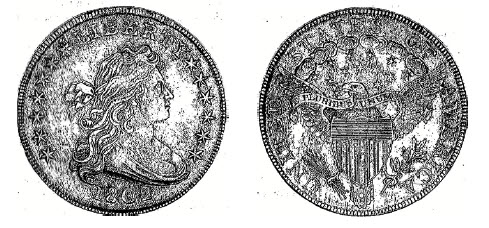
(B-5. H-5.)
OBVERSE 7: Normal date. Base of T in LIBERTY perfect. These two characteristics, used together, are diagnostic for the variety. Star 1 over 2.5 mm. from hair curl. Star 7 close to base of L; star 8 closer to base of Y, and star 13 even closet to bust. On the left, stars 3 and 4 as well as stars 5 and 6 are closer than the other star pairs. Stars 8 and 9 on the right are closer than the others; stars 12 and 13 are wider than the others. Distance of tip of 1 to curl is 0.2 mm. 1 and 8 in date more widely spaced than the other digits. The left base of 2 is very minutely repunched.
Obverse die used to strike 1802 BB-242 only.
REVERSE B: See description under 1801 BB-214, repeated under 1802/1 BB-233. Kagin's 313th Sale: 707 described a reverse with a perfect T in UNITED; this has not been verified by the author; all others seen of this reverse have a defective T.
Reverse die used to strike 1801 BB-214 (typically with crack from border toward cloud 6); 1802/1 BB-233 (perfect; first use of the die), BB-234 (die relapped, cloud 6 mostly missing, some arrowheads disconnected; some with clash mark from cloud 5 to border above 0), and BB-235; 1802 BB-242 (spur on D from now on); 1803 BB-251 (relapped, struck before BB-252) and BB-252 (relapped, struck after BB-251).
• DIE STATES:
Die State I: Perfect obverse die. Reverse in state as described above.
• AUCTION POPULATION SURVEY: Good: 1, Very Good: 2, Fine: 6, Very Fine: 9, Extremely Fine: 8, About Uncirculated: 2, Mint State-60 or better: 2. Total: 30. Average grade: VF-27.
• COLLECTING NOTES: With an estimated population of only 75 to 140 specimens, 1802 BB-242 is at once the rarest (by far) non-overdated 1802, and the second rarest (after 1802/1 BB-235) variety of the year. In 1881, this was the only variety of 1802 that Haseltine designated as rare.
• NOTABLE SPECIMENS:
Hollinbeck-Kagin Specimen. MS-60 .• Hollinbeck-Kagin Sale, June 1970: 539. "Unc, golden."
DeCoppet Specimen. AU-55 •• James Kelly, Andre DeCoppet Collection, 1955. "Practically Unc."
Lee and Shaffer Collections Specimen. AU-50. • Superior Galleries, Lee and Shaffer Collections, 1988: 3164. "Sharpness of AU-55, but unfortunately, retoned. Very sharply struck with what appears to be virtual full mint lustre below toning."
Seller Specimen. EF-45. • Bowers and Ruddy Galleries, 1980: 3278, "Choice EF-45, golden gray, with adjustment marks on reverse at bottom; no other defects. R-6." • James Matthews Collection. (Coin illustrated in the present book.)
Bolender Specimen. EF-45 .• M.H. Bolender Collection, 1952 .• Dr. Charles Ruby Collection, Gilhousen Sale, Part III, Superior. • Superior's California Collection Sale: 1335 .• Superior Galleries, February 1981: 665. "EF-45/ AU-50. some original prooflike surfaces, warm light iridescent tone. Reverse with full breast feathers." • Paramount, Auction '86: 1802.
Bebee's. EF-40 .• Numismatist advertisement, 1953. EF. Howe Specimen. EF-40 .• The Bolender Collection coin from the Howe Collection, called "EF sharp" by Bolender, later appeared in Superior's Ruby, Gilhousen III (1973): 1280 (EF+), 1975 ANA: 1022 (EF-40), and February 1981 (EF/ AU), then as Rarcoa's Auction '86: 736; the obverse is plated in the Bolender book; once called the second finest known.
Herdegen Specimen. EF-40. • Herdegen Collection (Hans M.F. Schulman 1973), EF.
• POPULATION DISTRIBUTION:
Approximate population MS-65 or better: 0 (URS-0)
Approximate population MS-64: 0 (URS-0)
Approximate population MS-63: 0 (URS-0)
Approximate population MS-60 to 62: 0 or 1 (URS-1)
Approximate population AU-50 to 58: 2 to 4 (URS-2)
Approximate population VF-20 to EF-45: 50 to 95 (URS-7)
Approximate population G-4 to F-15: 25 to 45 (URS-6)
Approximate population for all grades combined: 75 to 140 (URS-8)
• CONDITION CENSUS: 60-55-50-45 (multiples)