Silver Dollars & Trade Dollars of the United States - A Complete Encyclopedia
Q. David Bowers
1799/8 Overdate. BB-143
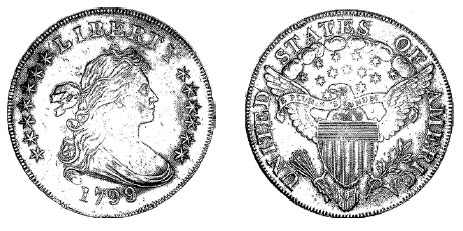
(B-2. H-2.)
• OBVERSE 1: See description under 1799/8 BB-141; overdate die. Die flaws as on BB-141, plus some new die flaws in and around the date and between star seven and the L in LIBERTY extending to the hair above the ribbon.
Obverse die used to strike BB-141 (1st use), BB-142 (2nd usej.and BB-143 (relapped; 3rd use).
• REVERSE C: 13 stars above eagle. Die crack from border' down through curved part of D and showing atbase. Leaf point is below left side of upright of I in AMERICA. Star touches lower part of eagle's beak and just enters the mouth; ray points to right side of left upright of U in PLURIBUS. A in AMERICA touches 4th feathery-but not the 3rd. Readily distinguishable from BB-142 by its reverse crack through the curve of the D in UNITED. There is a bar, on the reverse, in the clouds below the E in STATES which may be the remnants of a mispunched letter I) ie flaw between left base of N and arrowhead, next to arrowhead. Far right edge of A is over junction of clouds 3 and 4.
Reverse die used to strike 1799 BB-143 (late state) and BB-155 (early state)." ,
• DIE STATES:
DieState I: Obverse die relapped in effort to remove flaws. Lowest curl (to left of 1 in date) now partly missing and with open center. Just a trace of second curl remains as two tiny, isolated curved lines in field. Flaws below E and RT, and in field behind head are now larger than on BB-142. Reverse with crack from rim to right side of D in UNITED. Additional hairline crack from S through OF to top of wing. Die roughness at ER in AMERICA. (Slightly advanced from last die state described under 1799 BB-155.)"
Die State II: Obverse as preceding. Reverse with hairline crack expanded, now through ATES, OF, wing, and top part of AME; crack becomes multiple between wing and A.
• AUCTION POPULATION SURVEY: Less than Good: 1, Good: 5, Very Good: 9, Fine: 11, Very Fine: 9, Extremely Fine: 3, About Uncirculated: 4, Mint State-60 or better: 4. Total: 46. Average grade: VF-21.
• COLLECTING NOTES: 1799/8 BB-143 is the scarcest of the three overdate die varieties of the year. I believe that 250 to 450 of this variety exist. This estimate, if accurate, makes BB-143 at least twice as elusive as BB-142 and about three times harder to find than BB-141. Equally important, unlike BB-142, the 1799/8 BB-143 variety is usually seen in lower grades. Most are VF or less. Why this is so is a mystery. As is the case with BB-141 and BB-142, the demand for this variety is increased by the overdate feature.
• NOTABLE SPECIMENS:
Fairfield Specimen. MS-63. • Bowers and Ruddy, Fairfield Collection, 1977: 1032. "Choice Unc. with attractive gray and light golden toning."
Einstein Specimen. MS-63. • Bowers and Merena, Harry Einstein Collection, 1986: 1730 "MS-63. Sharply struck, with all stars on the obverse except star one having full centers. Light smoky gray iridescence blends with pale gold and lilac. Upon reflection in the light. Only a few contact marks on the obverse."
Miles Specimen. MS-60 •• RL. Miles, Jr. (Stack's, 1969): 1544. "Brilliant Uncirculated."
Scanlon Specimen. MS-60 •• Scanlon Collection, Stack's: 1719. "Brilliant Uncirculated." Stack's April 1974 Sale.
Green Specimen. AV-50 •• Col. KH.R Green Collection. • K.P. Austin Collection. ·AJ. Ostheimer, 3rd Collection Superior, ANA Convention Sale, 1975: 910. "AU-50 or so, the reverse nicer than the obverse and with a fully lustrous cartwheel effect. Obverse rubbed on forelock and has many small handling marks,"
Aspen Specimen. AU-50. • Bowers and Morena, Dr, Nelson Page Aspen Collection, 1989: 370 "AU-50. Brilliant in the central areas with tinges of faint golden coloration at the peripheries. Wisps of frosty mint lustre can be seen at the borders and around the design elements. The surfaces p.ppear to be entirely free of adjustment marks."
Heifetz Specimen. AU-50 • Superior Galleries, jascha Heifetz Collection, 1989: 2395. "AU-50, Superb iridescent toning throughout with hints of green and gold when tilted in the light. The only area of weakness is on the left wing of the eagle but this is minor."
Clarke Specimen. EF45 •• New Netherlands 48th Sale, T. james Clarke Collection, 1956: 628,."Reversedie breakthrough D, plus several.other light crackscAbout EF and choice. Weak towards the center of the reverse; small edge dent above T A of STATES." • Lester Merkin, AJ. Ostheimer, 3rdQpllection, 1968: 273. "Unpublished advanced die cracks. AU, uneven and rather indefinite strike, frosty pale gold tone." ,
Herdegen Specimen. EF-45 •• Hans M. F. Schulman, RT. Herdegen Collection, 1973. "Highly lustrous, choice EF condition, Reverse close to Unc, Nicely toned."
Green Specimen. EF-45. • Bowers and Merena, Green Collection, 1985: 1378. "Choice EF-45. Pleasing surfaces and light toning. Well struck overall."
• POPULATION DISTRIBUTION:
Approximate population MS-65 or better: 0 (URS-0)
Approximate population MS-64: 0 (URS-0)
Approximate population MS-63: 2 to 4 (URS-2)
Approximate population MS-60 to 62: 3 to 5 (URS-3)
Approximate population AU-50 to 58: 5 to 10 (URS-4)
Approximate population VF-20 to EF-45: 75 to 125 (URS-8)
Approximate population G-4 to F-15: 175 to 310 (URS-9)
Approximate population for all grades combined: 250 to 450 (URS-10)
• CONDITION CENSUS: 63-63-60-60-60-55 (multiples)