Silver Dollars & Trade Dollars of the United States - A Complete Encyclopedia
Q. David Bowers
1802/1 Overdate. BB-232.
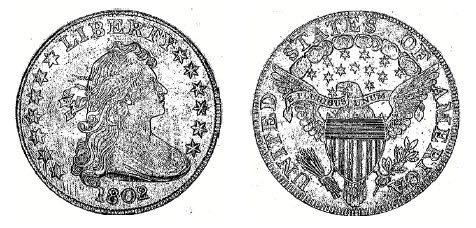
(B-4. H-4.)
• OBVERSE 2: Close date, the 1 firmly touching curl. The 8 is tipped slightly to right. Star 13 almost touches bust near junction of drapery with bosom. Star 1 near hair, star 8 near Y, and star 7 distant from L. Base of B in LIBERTY is below base of E. On the left, star pairs 3-4 and 6-7 are farther apart than are any others. On the right, stars 8-9 are closer together (but only by a small margin) than are any others.
Obverse die used to strike 1802/1 BB-232 only.
• REVERSE A: Described under 1801 BB-212 (repeated under 1802/1 BB-231). .
Reverse die used to strike 1801 (intermediate state) BB-212; 1802/1 BB-231 (early state) and BB-232 (early state); 1802 BB-241 (slightly advanced intermediate state); and 1803
BB-253 (if it exists) and BE-254 (slightly advanced intermediate state), and BB-255 (terminal state).
• DIE STATES:
Die State I: With perfect obverse die. Reverse die in early state. Scarcer than the following.
Die State II: Obverse now with a crack through the right side of the bust to near star 13. Reverse die in early state. The die state usually seen.
Die State III: Obverse with crack extending to the left to drapery. Second crack, short in length, approximately parallel and slightly below the first, develops at bosom. Reverse now with a tiny crack connecting the base of the first A in AMERICA to the third feather. Rare.
• AUCTION POPULATION SURVEY: Good: 1, Very Good: 5, Fine: 13, Very Fine: 31, Extremely Fine: 14, About Uncirculated: 5, Mint State-60 or better: 5. Total: 74. Average grade: VF-26.
• COLLECTING NOTES: It is believed that about 400 to 750 specimens of 1802/1 BB-232 dollars exist, about the same number as estimated for BB-234. Most examples are in lower grades, although a few AU and Mint State coins have been reported.
• NOTABLE SPECIMENS:
Generales Specimen. MS-63 .• Stack's, Generales Collection, 1984: 1254. "Choice Brilliant Unc., Wholly prooflike, has the appearance of a restrike! Some faint planchet adjustment marks."
1949 ANA Sale Specimen. MS-60 .• 1949 ANA, 207, (incorrectly attributed as H-1), Numismatic Gallery, August 1949 .. Stack's, Harold Bareford Collection, 1981: 421. "Brilliant Unc., even steel, russet, and iridescent toning. Sharply struck even though the obverse is starting to 'mound.
Davis Specimen. MS-60 .• Stack's, Davis-Graves (James Davis) Collection, 1954: 1326. "Lustrous and nicely toned, but struck weakly on left side. Unlisted die breaks on obverse make this coin so much the rarer. Left side of 8 recut. Reverse has prooflike surface. Not quite in the 'gem' class. Unc."
Smith Specimen. MS-60 .. Elliot Smith Collection, sold by J.G. Morgenthau & Co .. New Netherlands 48th Sale, T. James Clarke Collection, 1956: 647. "Strictly Unc. Evenly centered, narrow thin border on obverse. Sharp, uniform impressions, boldly struck throughout. Faint indications of mint adjustment marks towards the upper left obverse border. Splendid blue and pinkish gold iridescence."
Carter Specimen. AU-58 (PCGS) .• Stack's, Amon Carter, Jr. Collection, 1984: 233. "Brilliant Unc., full blazing lustre with splendid satiny surfaces. Exquisite golden russet toning." • Heritage, Dillard Sale, 1990: 970. "AU-58. Overdate not distinguished on PCGS holder. Satiny lustre, handsomely framed in golden-russet toning, with traces of iridescent blue along rims." Recently regraded MS-61 (PCGS).
Lee and Shaffer Specimen. AU-58 .• Superior Galleries, Lee and Shaffer Collections, 1988: 972. "AU (58/58). R-5. Lustrous, attractive light golden toning on both sides. Extremely well struck and defect-free."
• POPULATION DISTRIBUTION:
Approximate population MS-65 or better: 0 (URS-0)
Approximate population MS-64: 0 (URS-0)
Approximate population MS-63: 1 or 2 (URS-1)
Approximate population MS-60 to 62: 2 to 4 (URS-2)
Approximate population AU-50 to 58: 5 to 10 (URS-4)
Approximate population VF-20 to EF-45: 275 to 500 (URS-10)
Approximate population G-4 to F-15: 125 to 225 (URS-9)
Approximate population for all grades combined: 400 to 750 (URS-10)
• CONDITION CENSUS: 63-60-60-60-58 (multiples)