Silver Dollars & Trade Dollars of the United States - A Complete Encyclopedia
Q. David Bowers
Varieties
1794. BB-1.
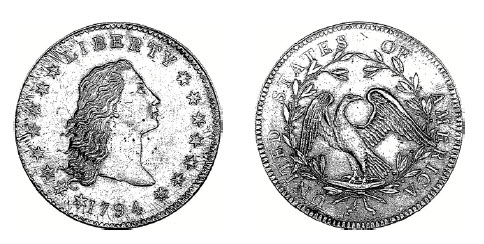
(Bolender-I, Haseltine-I).
Dollars bearing the 1794 date were struck from a single pair of dies. Nearly all seen by the author are lightly struck at the lower left of the obverse and corresponding part of the reverse. Some few pieces display a well-balanced strike and are exceedingly rare. Perhaps because there was just one variety of the year, Bolender did not assign a number to it in his 1950 book. However, specialists since then have called it Bolender-I. Bolender was following the tradition of Haseltine (1881), who omitted a description of the dies, simply noting this: "There is but one die known of the 1794 dollar."
• OBVERSE I: Flowing Hair design with six curls, the third curl weak. First star close to 1 in date. Second star near first curl, but does not touch it. The head of Miss Liberty in the 1794 dollar has a fuller cheek and more pronounced jaw line than does any of 1795, and admits of consanguinity with some of the finely-detailed heads seen on large cents made early in the year 1794. Blunt tip to neck point.
No head on a 1795 dollar is exactly like this head, although three obverse dies of 1795, one used to coin BB-11 , 12, and 13; another to produce BB-14; and a third to strike BB-16, 17, and 18, each have a blunt tip to neck point and are more like the 1794 head than any others. If any 1795 obverses are worthy of the "Head of '94" appellation, these three are. In the 1795 Flowing Hair dollar study, below, I designate these "Head of '94" coins as Portrait I (PI) issues.
A curious fact is that while the eight stars on the left of the 1794 silver dollar are each oriented with a point toward the denticles (as standard), the seven stars on the right are each positioned differently, unique to 1794 in the early dollar series, with two points toward the denticles (see plate). (Illustrated as such in the 1893 Scott catalogue. Described by George Rice in The Numismatist, August 1895.)
• REVERSE A: Eagle perched on a rock within a wreath; 21 leaves on each branch. The wreath has 19 berries, 10 on the left branch, 9 on the right. A leaf is joined to second T in STATES, and another almost touches the right corner of F in OF. "Lobster claw" leaf pair under second T of STATES and first A of AMERICA. Eagle's wing touches R in AMERICA. Ribbons below wreath thinner and much closer together, and branch ends thinner and straighter, than on any 1795 reverse. Ribbon (not a knot) around junction of the two wreath stems.' Seven feathers in eagle's tail. Rock under eagle's feet extends much farther to the left than on any 1795 die. This die was retired after the 1794-dated coinage and was not used in 1795.