Silver Dollars & Trade Dollars of the United States - A Complete Encyclopedia
Q. David Bowers
Newman Specimen. MS-60 • Attractive surfaces with mottled blue and pale gold peripheral toning. Early state of the dies, equivalent to Die State I, above .
Newcomer Specimen. MS-60 • Waldo C. Newcomer Collection. • Col. E.H.R. Green Collection. • James G. Macallister .• T. James Clarke Collection, New Netherlands 48th Sale, 1956: 617. "Choice Uncirculated. Nicely centered and struck; slightly flat upon high points of eagle's head, breast, wings and legs. Pale blue toning with extensive golden lustre."
Alto Specimen. MS-60 • Stack's, Alto Collection Sale, 1970: 1062, Brilliant Uncirculated. Full frosty mint bloom. The coin is well struck, having some light adjustment marks across the eagle's breast, and a thin tarnish streak on cheek.
Kagin's Tercentenary Sale Specimen. MS-60 • Kagin's Tercentenary Sale, 1974: 605. "Bluish Uncirculated, sharper struck than most seen with only a few of the feathers not complete. A glass reveals microscopic handling marks."
Long Beach Sale Specimen. MS-60. • Heritage, Long Beach Sale, 1989: 791. "Cleaned. Dullish silvery-gray surfaces which deepen to a charcoal and pinkish gold color about the devices. Nearly void of adjustment marks or noticeable distractions, with only minor weakness on eagle's breast and leg."
• POPULATION DISTRIBUTION:
Approximate population MS-65 or better: 0 (URS-0)
Approximate population MS-64: 0 (URS-0)
Approximate population MS-63: 1 or 2 (URS-1)
Approximate population MS-60 to 62: 6 to 10 (URS-4)
Approximate population AU-50 to 58: 15 to 30 (URS-5)
Approximate population VF-20 to EF-45: 800 to 1,300 (URS-11)
Approximate population G-4 to F-15: 400 to 700
Approximate population for all grades combined: 1,250 to 2,000 (URS-12)
• CONDITION CENSUS: 63-60 (multiples)
1796 Small Date, Small Letters. BB-62.
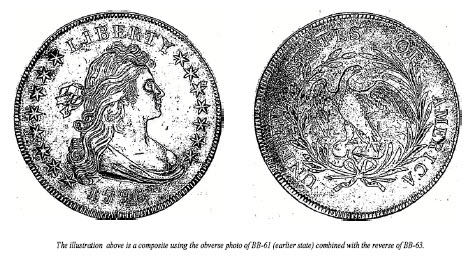
(B-3. H-3.),
• OBVERSE 1: Die State III of 1796 BB-61, to which refer. The stars are small and the last two or three are spidery. Curl on top of the head defective.
This is; a later state, equal to Die State III of 1796 BB-61 as noted, with relapping removing part of Miss Liberty's top curl, and some of the part of the stars in lower relief, making them appear smaller.
Obverse die used to strike 1796 BB-61 (early state) and BB- 62 (late state).
• REVERSE B: Described under 1795 BB-51, herewith repeated: Small Eagle. Small Letters in legend. Eagle stands on clouds. Wreath is composed of a palm branch (right) and olive branch (left); the latter with seven berries. A short, prominent die scratch extends up to left from tip of right, inside leaf below (observer's) left wing. Berry under A of STATES; a quick way to identify this reverse.
Bolender reported that some letters were bifurcated on examples he had seen of 1796 B-3 [BB-62], and thought this meant that the die had been "touched up" (however, bifurcation is an idiosyncrasy of striking, and has nothing to do with the die variety Of state).
Reverse die used to strike 1795 BB-51; 1796 BB-62, BB-63, and BB-66 (now relapped); 1797 BB-72; and 1798 BB-81.
• DIE STATES:
Die State II: Perfect dies. May not exist. Reverse die not relapped.
Die State I: Obverse die relapped; curl at top of head now defective, some stars appear smaller. Reverse die not relapped. This is the die state usually seen. Obverse die state equivalent to Die State III of 1796 BB-61. Reverse die state equivalent to 1796 BB-63. 1796 BB-62 was struck before 1796 BB-66 (which I believe to have been struck in 1798). 1796 BB-61 was struck before 1796 BB-62.
AUCTION POPULATION SURVEY: Very Good: 2, Very Fine: 5, About Uncirculated: 1. Total: 8. The yellow flag of caution is out on these listings, as BB-62 has been misattributed many times in die past. Probably, only one, two, or three 1796 BB-62 dollars are actually represented.
• COLLECTING NOTES: Bolender wrote this in 1950: "While many 1796 dollars have been listed as [B-3; BB-62], this has been erroneously done. I have purchased a dozen or more [B-3; BB-62], every one of. them wrongly attributed. Only three specimens are known to me.
The rarity of 1796 BB-62 approaches legendary proportions. In fact, it has kept out of sight so well that many specialists have never seen an example. The fifth revised edition (1988) of Bolender's The United States Silver Dollars noted the following: "Most experts now question whether this variety actually exists."
In a conversation; Jules Reiver related that over the years a dozen or more 1796 "Bolender-3" dollars have been offered to him, but without exception they were all misattributed.' "I don't believe that B-3 [BB-62] exists," he concluded.
Not having seen a specimen in the flesh, I cannot say whether or not it exists. However, a specimen is listed and clearly illustrated as Lot 2065 of the Philip G. Straus Collection (Stack's, 1959). The cataloguer, probably Norman Stack, described it as follows:
1796 B-3 [BB-62]. Small Date, Small Letters. Has diagnostic flaw in hair curl. On reverse, berry centered directly below A of STATES. An excessively rare variety, and only three known according to Bolender. Very Fine to Extremely Fine. After checking some of the outstanding collections of silver dollars, we learned that none have this variety represented. One specialist commented that "This is the only B-3 [BB-62] I have ever seen. Nobody I know has one." Considering the rarity of the coin, we would not be surprised to see it bring a "runaway price." [The coin brought $500.]