Silver Dollars & Trade Dollars of the United States - A Complete Encyclopedia
Q. David Bowers
1801 BB-214
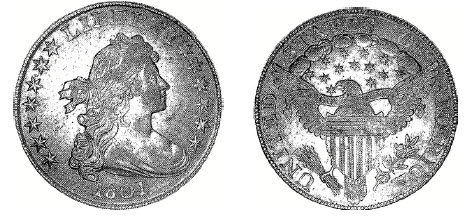
(B-4. H-4.)
OBVERSE 2: The distance from 1 in date to curl is a tiny fraction of the distance from star 8 to upper right serif of Y. So-called Close Date, figures evenly spaced. The first 1 is very close to curl, the last 1 in date distant from bust. The 8th star is about as near to Y as last star is from bust, slightly under 1 mm. Star 7 is about 1.5 mm. distant from L, and star 1 is about the same distance from curl. Right serif of I is lower than left serif of B (on BB-211 through BB-214, the serifs are level).
Obverse die used to strike 1801 BB-214 only.
REVERSE D: The point of the leftmost arrowhead is under the center of the left upright of the N in UNITED. There is a "spur" on the curved part of D. Leaf points under center of! in AMERICA. Point of a star touches the outside of upper part of eagle's beak slightly above beak's point. This long-lived die was mated with obverses dated 1801, 1802, and 1803. Letters T in UNITED and STATES have lower right serif partially broken. Apparently, this die was made immediately before the die used to coin the reverse of 1801 BB-213, which has the lower right serif completely missing. Die progression evidence indicates that 1801 BB-214 was struck no earlier than 1802.
Reverse die used to strike 1801 BB-214 (typically with crack from border toward cloud 6); 1802/1 BB-233 (perfect; first use of the die), BB-234 (die relapped, cloud 6 mostly missing, some arrowheads disconnected; some with clash mark from cloud 5 to border above 0), and BB-235; 1802 BB-242 (spur on D from now on); 1803 BB-251 (relapped, struck before BB-252) and BB-252 (relapped, struck after BB-251).
DIE STATES
Die State I: Perfect obverse and reverse dies without cracks.
Die State II: As above, except a tiny vertical crack begins to develop between arrows and eagle's leg feathers, closer to eagle's leg (this crack advances slightly with use of the die with other obverses). The die state usually seen.
Die State III: Tiny die crack extends diagonally to the left from border to neat cloud 6. At least five to 10 times scarcer than the preceding.
AUCTION POPULATION SURVEY: Very Good: 8, Fine: 19, Very Fine: 26, Extremely Fine: 9, About Uncirculated: 6, Mint State-60 or better: 4. Total: 72. Average grade: VF-24.
COLLECTING NOTES: About 400 to 750 specimens are known of 1801 BB-214, slightly edging BB-213 for the title of scarcest issue of the year. However, in an absolute sense, enough exist that every numismatist who wants-one-can have one.
Most specimens exist in lower grade levels. However, the Carter is notable, quite possibly the finest known, at MS-60.
NOTABLE SPECIMENS:
Carter Specimen. MS-60 .• Stack's, Arnon Carter, Jr. C.oIlection, 1984: 232. "Gem Brilliant Unc., wholly prooflike. Prooflike surface. There is a circular area in the center of the obverse which is frosty. Russet and iridescent toning." • Superior Galleries, Buddy Ebsen Collection, 1987; 1921. "MS-60. Well struck, full center detail. Some stars below clouds are a bit softly struck. Semiprooflike surfaces on both sides. Some light drift marks appear faintly across the obverse, Beautiful natural toning consisting of' medium violet and electric blue with some areas of untoned chrome-like lustre peeking through."
Hollinbeck-Kagin Specimen. AU-58 •• Hollinbeck-Kagin Sale, June 1970: 637. "Close date, brilliant slightly golden Unc., sharp strike!"
Shore Specimen. AU-58 •• Superior, A. Bernard Shore Collection, 1988: 2226, Close Date. Bolender-4a. "Spur on D of UNITED. Faint reverse crack from the denticle to the right of the second S in STATES. AU-58. Somewhat weakly struck, lustrous, toned in original rich gray and lavender hues."
Davis Specimen. AU-50- Stack's, Davis-Graves Games Davis) Collection, 1954: 1324. AU, showing only slight rubbing on bust and light scratches in hair.
Dupont Specimen. AU-50. • Stack's, Anderson Dupont Collection, 1954: 2506. "AU, almost full mint surface, but minor friction on head, arid nick above shield."
NASC Convention Sale Specimen. AU-50. • Kagin's, 1979: 539. "AU-50, with some portions AU-55, sharply struck with lovely blue, golden gray lustre. R-5:"
First National Bank of Denver Specimen. AU-50 •• Bowers and Merena Galleries, 1987: 427. "AU-50. Highly reflective surface stoned in shades of medium gray, iridescent green, and pale orange. A few trivial rim bumps on obverse are noted." "
Bebe'e Specimen AU-50 •• Bowers and Merena Calleries, Aubrey and Adeline Bebee Collection, 1987: 414, AU-50. "Mostly brilliant surfaces, with some light toning. A generous amount of original mint lustre still survives in the fields and other areas., particularly among the devices and other protected spots. Nicely centered."
Four Landmark Collections Specimen. AU-50 Bowers and Merena, 1989: 1980, AU-50. "Brilliant and untoned. There is pleasing mint lustre that can be seen on both sides, creating partial cartwheel effects."
POPULATION DISTRIBUTION:
Approximate population MS-65 or better: 0 (URS-0)
Approximate population MS-64: 0 (URS-0)
Approximate population M8-63: 0 (URS-0)
Approximate population MS-60 to 62: 1 or 2 (URS-1)
Approximate population AU-50 to 58: 8 to 15 (URS-4)
Approximate population VF-20 to EF-45: 210 to 400 (URS-9)
Approximate population G-4 to F-15: 175 to 325 (URS-9)
Approximate population for all grades combined: 400 to 750 (URS-10)
CONDITION CENSUS: 60-58-58-58-55 (multiples)