Silver Dollars & Trade Dollars of the United States - A Complete Encyclopedia
Q. David Bowers
1803. BB-256.
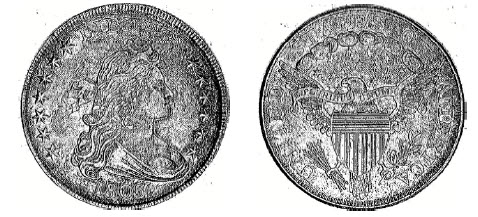
Small 3 in date. (B-3. H-3.)
• OBVERSE 6: Thin top to 3, position of 3 similar to 1803 BB-251, but star 8 is more distant from y. Close date. On the left, stars 1 and 2 are more widely separated than are any others.
Obverse die used to strike 1803 BB-256 only.
• REVERSE C: AM touch at base. Point of star touches point of lower part of eagle's beak. Very short stem in claw. Right edge of right foot of A over edge of cloud 4 (the only such instance for a dollar of 1803).
Reverse die used to strike 1803 BB-256 only.
Note: As 1803 BB-256 stands alone without die linkage to any other 1803 dollars, it is not possible to determine the striking sequence within the year.
• DIE STATES:
Die State I: Perfect dies. Bolender noted that this variety is always weak at the center of the reverse.
• AUCTION POPULATION SURVEY: Good: 1, Fine: 3, Very Fine: 5, Extremely Fine: 2, About Uncirculated: 1, Mint State: 1. Total: 13. Average grade: VF-25.
• COLLECTING NOTES: The 1803 BB-256 is the second rarest die variety of the year (after BB-253, if BB-253 exists). I estimate that 30 to 60 are known. Examples seldom surface on the market. This issue is one that the specialist would be well advised to acquire in any condition, using leisure time to upgrade if the opportunity is presented.
In his 1881 Type-Table, J.W. Haseltine called this variety extremely rare, but did not inform the reader whether an extremely rare coin was more or less populous than an excessively rare one.
• NOTABLE SPECIMENS:
Newcomer Specimen. MS-60 .• Waldo C. Newcomer. Col. E.H.R. Green .• James G. Macallister. • New Netherlands 48th Sale, T.James Clarke Collection, 1956: 651. "Unc., a gorgeous first-strike. Slightly off-center; deeply struck at borders, enhancing the mirrorlike 'Proof lustre. Two small rim bruises at bottom of obverse, and possibly a few other, less important edge imperfections. Lustrous, attractive purple toning, much iridescence."
Herdegen Specimen. AU-50 .• Hans M. F. Schulman, R.T. Herdegen Collection, 1973. "AU showing faint wear on rather weakly struck center. A beautiful coin with prooflike surface, but very likely a first strike."
Cohen Specimen. EF-45. . Bowers and Merena, Milton Cohen Collection, 1985: 530. "Choice EF-45, semiprooflike. Light gold toning."
Newport Specimen. EF-40 .. Bowers and Ruddy Galleries, Newport Collection, 1975: 503. EF.
Blevins Specimen. VF-35 .• Superior, H. W. Blevins Collection, 1988: 3802. "VF-35. Light gray with splashes of attractive rich orange-gold coloring on both sides. Extremely well struck with the centers and borders both showing good definition. A considerable amount of mint lustre."
Frontenac Specimen. VF-30. • Bowers and Merena Galleries, 1991: 1276. "VF-30, light gray surfaces."
Stirling Specimen. VF-20 net. (VF-30, cleaned) .• Frank M. Stirling Collection, Heritage, February 1986: VF-30, "lightly cleaned surfaces, prooflike."
Spies Specimen. F-15 .• Stack's, W. Earl Spies Collection, 1974: 232. "A strong Fine."
Werner Specimen. F-15 .• Thomas Werner, April 1954 .• K.P. Austin .• A.J. Ostheimer, 3rd Collection .• Superior Galleries, ANA Convention Sale, 1975: 1030. "Not quite VF- 20 and a flat impression on the high points as usual. Uneven tarnish mixed with faint original lustre around the devices. Some reverse edge bruises and nicks, the most serious at 7:00."
Ostheimer Specimen. F-15. • Lester Merkin, A.J. Ostheimer, 3rd Collection, 1968: 3234. 'Just about VF, flat impressions in the usual places, some areas of EF sharpness."
Willasch Specimen. F-15 .• Superior Galleries, H. Roland Willasch Collection, 1990: 598. "F-15+. Broad, flat rims protected the delicate engravings. Well balanced coin with ample detail remaining and most importantly, rarest variety of the year. Minor cleaning lines in the fields, sprinklings of toning. Early die state as are all seen of this variety."
• POPULATION DISTRIBUTION:
Approximate population MS-65 or better: 0 (URS-0)
Approximate population MS-64: 0 (URS-0)
Approximate population MS-63: 0 (URS-0)
Approximate population MS-60 to 62: 1 or 2 (URS-1)
Approximate population AU-50 to 58: 1 or 2 (URS-1)
Approximate population VF-20 to EF-45: 17 to 35 (URS-6)
Approximate population G-4 to F-15: 10 to 20 (URS-5)
Approximate population for all grades combined: 30 to 60 (URS-6)
• CONDITION CENSUS: 60-50-45-45-40-40