Silver Dollars & Trade Dollars of the United States - A Complete Encyclopedia
Q. David Bowers
1803. BB-255.
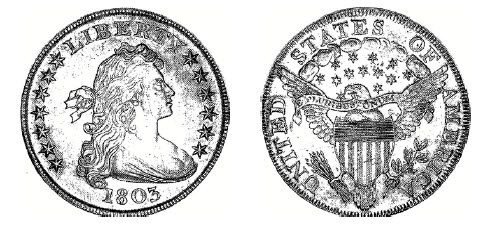
Large 3 in date. (B-6.)
• OBVERSE 5: Thick top to 3 in date. Star 13 close to bust. Star 1 distant from hair, about 2.3 mm. On the left, stars 1-2 and 5-6 are closer than any others, while stars 4-5 are the most widely separated. On the right, the stars are remarkably evenly spaced. The 180 wide, and 3 a trifle low at base. The 3 is lightly double punched at its base and has a spur at its bottom.
Obverse die used to strike 1803 BB-255 only.
• REVERSE B: See description under 1801 BB-212 (description repeated under 1803 BB-253). Reverse die used to strike 1801 (intermediate state) BB-212; 1802/1 BB-231 (early state) and BB-232 (early state); 1802 BB-241 (slightly advanced intermediate state); and 1803 BB-253 (if it exists) and BB-254 (slightly advanced intermediate state), and BB-255 (terminal state).
• DIE STATES:
Die State I: Perfect obverse die. Reverse as described above. The die state usually seen.
Die State II: Obverse with hairline crack, hardly discernible, connecting stars 10 and 11. This progresses (in intermediate states) to connect with star 9, then 12. About 20% to 30% of BB-255 dollars are of this die state.
Die State III: Obverse hairline crack connects all stars on the right. Scarcer than the preceding.
• AUCTION POPULATION SURVEY: Good: 4, Very Good: 25, Fine: 49, Very Fine: 85, Extremely Fine: 42, About Uncirculated: 13, Mint State-60 or better: 11. Total: 229. Average grade: VF-24.
• COLLECTING NOTES: I estimate that about 1,250 to 2,000 specimens are known of 1803 BB-255. The 1803 BB-255 is about as plentiful as 1802 BB-241, and, like it, the 1803 BB-255 dominates its year-accounting for more coins than all other die varieties of 1803 combined. Notwithstanding all of this, in Mint State it is not the most often seen 1803 variety. That distinction goes to BB-252, for reasons not understood today.
• NOTABLE SPECIMENS:
New England Rare Coin Galleries Specimen. MS-60, prooflike .. New England Rare Coin Auction's sale of April 10, 1980. 705 .• New England Rare Coin Auction's sale of June 4, 1981. 1311, accompanied by the text of a letter from Walter Breen in which he expressed his belief that the coin was a special presentation striking .• Stack's, Auction '89: 1780, Bolender-6a. "Brilliant Unc. and fully prooflike, struck from polished dies on a polished planchet. A few light hairlines under russet gold toning, deepening to a tan gray at the peripheries. Unusually sharp strike for this variety. The dies were refinished and polished in the Mint at a time when they were in a late state and had rusted slightly."
Brand Specimen. MS-60 • Virgil M. Brand Collection. • M.H. Bolender Collection, 1952: 181. "Sharp Unc., beautiful mint lustre, and some Proof surface. Strong sharp impressions. Pedigree: from the Brand Collection."
Gable Specimen. MS-60 •• Gable Collection, 1914 .• M.H. Bolender Collection, 1952: 183. "Bolender-6b. Shows obverse die crack faintly through stars on right. Unc., with Proof surface."
Hollinbeek-Kagin Specimen. MS-60 •• Hollinbeck-Kagin Sale, June 1970: 644. "Brilliant Unc. gem with some prooflike surface. "
MANA Specimen. MS-60 •• Kagin's, 21st MANA Convention Sale, 1973: 1304. "Glittering golden Unc., with raised edge and shimmering lustre."
Smith Specimen. MS-60. • Elliot Smith Collection. • Stack's, Harold Bareford Collection, 1981: 423. "Brilliant Unc., sharply struck, with lustrous, satiny surface. Splendid glistening iridescent toning."
Baldenhofer Specimen. AU-58 •• W.·C. Baldenhofer to Stack's, Farish-Baldenhofer Sale, 1955 .• AJ.Ostheimer, 3rd Collection Superior Galleries, ANA Convention Sale, 1975: 1035, Bolender-6a. "Later state: fine die crack connects all of the stars on the right. Virtually MS-60, dark iridescent toning, and fully lustrous with a sparkling cartwheel effect. Minor signs of handling, a few microscopic obverse rim nicks, and not fully struck up on high points."
Clarke Specimen. AU-58 •• New Netherlands 48th Sale, T. James Clarke Collection, 1956: 652, Bolender-6a. "Unc., but not pristine. Evenly struck, the borders a bit imperfect upon the obverse at 1. Liberty mostly bold, alight scratch on her cheek. A tiny reverse edge nick at bottom, and the usual quota of minor handling marks. Attractive toned, a touch or so of tarnish or carbon streaking."
DeCoppet Specimen. AU-55 •• James Kelly, Andre DeCoppet Collection, 1955. "Well struck and practically Unc. Prooflike surface."
Hollinbeck-Kagin Specimen. AU-50 • Hollinbeck-Kagin Sale, August 1970: 1101. "Near Unc., toned."
DeCoppet Specimen. AU-50. • DeCoppet Collection Games F. Kelly, 1955). "AU, prooflike."
Carter Specimen. AU-50 • Amon Carter, Jr. Collection (Stack's, 1974), AU.
• POPULATION DISTRIBUTION:
Approximate population MS-65 or better: 0 (URS-0)
Approximate population MS-64: 0 (URS-0)
Approximate population MS-63: 0 (URS-0)
Approximate population MS-60 to 62: 5 to 10 (URS-4)
Approximate population AU-50 to 58: 20 to 40 (URS-6)
Approximate population VF-20 to EF-45: 700 to 1,100 (URS-11)
Approximate population G-4 to F-15: 525 to 850 (URS-11)
Approximate population for all grades combined: 1,250 to 2,000 (URS-12)
• CONDITION CENSUS: 60 (multiples)