Silver Dollars & Trade Dollars of the United States - A Complete Encyclopedia
Q. David Bowers
1801 Heraldic Eagle
Varieties
1801. BB-211
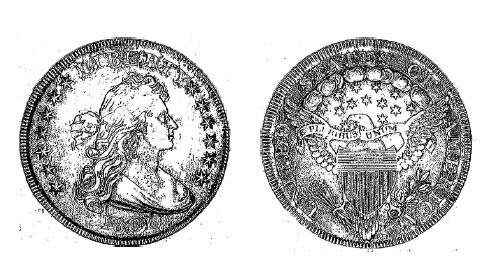
(B-1. H-1)
• OBVERSE 1: The distance from 1 in date to curl is about the same as the distance from star 8 to upper right serif of Y. The so-called Wide Date, most space between 180, the 01 closest; this traditional nomenclature is only useful if you have a Close Date (BB-214) on hand with which to compare it. The first 1 not very close to curl. The last 1 about as far from bust as first 1 is from curl. Star 8 close to Y. Other three key stars-7, 1, and 13-are distant from L, hair, and bust. Small dot to left of center dot. Right serif of I is level with left serif of B (on BB-214, the serif of B is higher).
Obverse die used to strike 1801 BB-211 (earliest use), BB-212 (intermediate use), and BB-213 (latest use).
• REVERSE A: Arrowhead under U of UNITED. Point of star almost touches point of lower part of eagle's beak. 13 arrows. Ray of star points to lift side of U in PLURIBUS (the only 1801 for which this is true). A in AMERICA touches 3rd and 4th feathers. Leaf point is under left side of upright of in AMERICA.
Reverse die used to strike 1801 BB-211 only.
Note: As the other three varieties of 1801 dollars-1801 BB-212, 213, and 214-were all struck in 1802 or later (see descriptions under their respective categories), this leaves 1801 BB-211 as the only candidate for a variety that might have been actually struck in 180l.
• DIE STATES:
Die State I: Perfect dies. About 10% or so are of this die state.
Die State II: As preceding, except for a tiny hairline die crack on obverse to left of 1 in date, slanting down toward the border.
Die State III: With reverse clash marks at TED and eagle's wing, showing on high-grade coins the distinct incuse impressions of obverse stars, probably stars 1 and 2, plus traces of others, as well as incusation marks from obverse denticles. This injury may have precipitated a die crack which extends through STA down through the clouds on the right, extending (in several intermediate states) to the first A in AMERICA. On worn specimens, the clash marks and crack are not easily seen. This is the usual die state encountered.
Die State IV: With reverse cracks from the rim through STA to the right wing to the first A in AMERICA to M and E to the rim. Cf. Sotheby's December 8-9,1992: 499 (one of two pieces in the lot). Rare. Not seen.
Die State V: The latest state, of which there are several progressive stages, shows a crack from the clouds to the right wing and, finally, a large bulge at AMER. Cf. Sotheby's December 8-9, 1992: 499 (one of two pieces in the lot) was described as: "more advanced state of the die with the die crack through OF, and struck from clashed dies." Rare. Not seen.
• AUCTION POPULATION SURVEY: Less than Good: 1, Good: 3, Very Good: 7, Fine: 20, Very Fine: 26, Extremely Fine: 20, About Uncirculated: 11, Mint State-60 or better: 2. Total: 90. Average grade: VF-26.
• COLLECTING NOTES: I estimate that about 500 to 900 exist of 1801 BB-211, ranking it with BB-212 as one of the most plentiful varieties of the year. However, as a date, 1801 dollars are measurably more elusive than are those of the earlier years of the Heraldic Eagle type, up to this point in time. The BB-211 is about as available as BB-212 if all grades combined are totaled, but in higher ranges, the BB-211 is the scarcer of the two.
Quite a few AU specimens of BB-211 have crossed the auction block over the years, but at the Uncirculated level, appearances fall off sharply. In fact, I am not aware of any Mint State coins sold in the past two decades, nor do I know if those sold earlier would qualify for this grade now.
• NOTABLE SPECIMENS:
Hollinbeck-Kagin Specimen. AU-58 .• Hollinbeck-Kagin Sale, June 1970: 635. Bolender-1a. "Die breaks on reverse with die starting to buckle at right, Unc, golden, top hair strands not struck up as sharply as balance. Sharp stars."
New Netherlands Specimen. AU-55 .• New Netherlands 57th Sale, 1963: 1092, Bolender-1a. "Unlisted die state. Star point about touches lower prong of beak. Weakly and unevenly struck, but very near, indeed to Unc. Highly lustrous and some iridescent toning."
Howe Specimen. AU-50. . Howe Collection. • M.H. Bolender Collection, 1952: 163. "Perfect Dies. Sharp stars, well-filled. Only slight signs of circulation, strong impressions, mint lustre."
Holmes Specimen. AU-50 .• Stack's, Milton A. Holmes Collection, 1960: 2259. "Nicely centered, sharply struck except in center no doubt due to the buckling of the dies. Brilliant, AD. Full mint lustre."
Green Specimen. AU-50 .. Col. E.H.R. Green .. M.H. Bolender. . Lester Merkin, AJ. Ostheimer, 3rd Collection, 1968): 312, Bolender-1b. AU.
Spies Specimen. AU-50 .. Stack's, W. Earl Spies Collection, 1974: 213. "Bolender-1c, AU, lustrous with pale steel toning." • Stack's, March 1983: Lot 937. (Description repeated from preceding.)
Superior Auction '88 Specimen. AU-50 .• Superior Galleries, Auction '88, 1988: 213. "AU-50. Superb original toning. The strike is about as sharp as one could hope for. Excellent centering, full denticles plainly visible on both the obverse and reverse. Lovely deep rose gray color with underlying bursts of electric blue on the obverse and rich russet gold on the reverse."
November Specimen. AU-50 .• Heritage, November Sale, 1989: 460. "AU (53/53). Deeply and uniformly toned in rich, steel, lavender and golden color. The piece is absolutely original and shows little trace of actual wear."
Chalkley Specimen. AU-50 .• Superior Galleries, Chalkley Collection, 1990: 2891. "AU-50. Cleaned with whispers of hairlines in the fields, but plenty of lustre still remaining. Sharp strike."
Willasch Specimen. AU-50. • Superior Galleries, H. Roland Willasch Collection, 1990: 578. Bolender-1a. "AU-50. Bright and lustrous, glowing lustre. Hint of golden toning further offsets devices. Exceptional strike." • Yolanda Gross Collection.
October Sale Specimen. AU-50. • Superior Galleries, October Sale, 1990: 1214. "AU-50. Vibrant lustre dances about the fields, high rim boldly impressed into the planchet, saving devices from wear. Middle die state with a crack through STA of STATES on reverse."
Brilliant and Sieck Specimen. AU-50. • Bowers and Merena, Brilliant and Sieck Collections, 1992: 1634. "AU-50. Sharply struck. Mottled light silver, lilac and gray toning."
• POPULATION DISTRIBUTION:
Approximate population MS-65 or better: 0 (URS-0)
Approximate population MS-64: 0 (URS-0)
Approximate population MS-63: 0 (URS-0)
Approximate population MS-60 to 62: 0 (URS-0)
Approximate population AU-50 to 58: 25 to 50 (URS-6)
Approximate population VF-20 to EF-45: 350 to 650 (URS-10)
Approximate population G-4 to F-15: 125 to 200 (URS-9)
Approximate population for all grades combined: 500 to 900 (URS-11)
• CONDITION CENSUS: 58-58-55 (multiples)