Silver Dollars & Trade Dollars of the United States - A Complete Encyclopedia
Q. David Bowers
1800. BB-193.
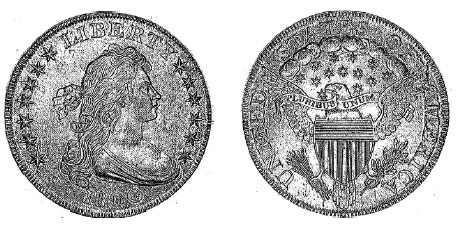
(B-13, formerly B-18. H-13.)
• OBVERSE 9: Star 13 slightly closer to bust than Star 8 is from Y Star 7 is much farther from L, and the star 1 is the farthest from hair, 2.75 mm. Left base of E slightly high in relation to bottom of B (this same characteristic is true of the different obverse used to strike BB-188 and BB-189). On the left, stars 4, 5 and 5, 6 are more closely spaced than are the others. On the right, stars 9, 10 are the most closely spaced and stars 10-11 ate the most widely spaced.
Obverse die used to strike 1800 BB-193 only.
• REVERSE H: Similar to BB-188, but A and M touch, and A in STATES is in different position; A over cloud 3 (mostly) and area between clouds 3 and 4. Tip of arrowhead under and just slightly right of center of U in UNITED.
Reverse die used to strike 1800 BB-193 only.
• DIE STATES:
Die State I: Perfect dies. Obverse without cracks. Reverse without clash marks or cracks. This is the regular BB-193 variety. Three or more times scarcer than Die State III.
Die State II: First clashing. Obverse with clash marks at left side of date and stars 1 and 2, incuse impressions of clouds on reverse. No die cracks. Reverse with light clash marks at F, clouds 7 and 8, and below cloud 7, incuse impression of drapery folds. As additional strikings occur, the obverse clash marks fade aways lightly. Scarce.
Die State III: (Bolender-18) Second clashing. Obverse with faded clash marks from first clashing. No die cracks. Reverse with massive injury from second clashing. Now with raised lines through F and clouds 7 and 8 to stars below those clouds; clash marks in same position as Die State II, but now much bolder and more extensive. Die crack along top of AMERICA, extending about halfway beyond final A along the border toward eagle's tail. This "variety," actually a die state, used to be called Bolender-18, and is very common. In nearly all strikings, the 8 of tile date appears "pinched" and the last two numerals appear somewhat heavier toward the bottom, undoubtedly the result of metal flow during striking.
Die State IV: Bolender-18a. Obverse die fails at stars 2 and 3, which bulge outward. An arc-like crack connects star 1 with star 4, and curves through the field just beyond stars 2 and 3. On the reverse, the metal displacement caused by the obverse bulge causes weakness at RI of AMERICA. Scarce die state.
• AUCTION POPULATION SURVEY:
These were catalogued as BB-193: Very Good: 1, Fine: 3, Very Fine: 14, Extremely Fine: 1, About Uncirculated: 3, Mint State-60 or better: 1. Total: 23.
These were catalogued as Bolender-18: Less than Good: 1, Good: 2, Very Good: 7, Fine: 9, Very Fine: 39, Extremely Fine: 13, About Uncirculated: 8, Mint State-60 or better: 7. Total: 86. Average grade for all listings: VF-26.
• COLLECTING NOTES: 1800 BB-193, as we know the variety today, is one of the most plentiful dollars of the year, and is about tied with BB-187 as the most common. An estimated 700 to 1,200 are known. In the present text, the population of BB-193 includes what used to be called Bolender-18, from the same dies, but a later state with clashing. Today, specialists recognize Bolender-18 as simply a later die state of BB-193.
For many years, Bolender-13 was considered to be one of the rarer varieties of 1800, while Bolender-18 was one of the more common issues. Auction data suggest that "old" B-13 coins were about three and one-half times rarer than "old" B-18 coins. As might be expected "old" B-13 coins were considered to be great rarities in high grades. The Mint State 1975 ANA Convention Sale (Superior) coin, earlier in the W.G. Baldenhofer Collection, was considered the finest known. Now come more than a half dozen records of Mint State "old" B-18 coins to dilute the desirability of the "old" B-13.
My feeling is that as time goes on, the "old" B-18 will be forgotten, and will be considered for what it really is: a die state of BB-193 [B-13]. Values will settle at the lowest common denominator, which means that Die State I of BB-193 (equal to the "old" B-13 in its entirely) may be worth slightly more than Die State III (equal to the "old" B-18), but not much more. Time will tell.
• NOTABLE SPECIMENS:
Fairfield Specimen. MS-64. . Bowers and Ruddy Galleries, Fairfield Collection, 1977: 1037, Bolender-18a. "Gem Unc. Full lustre under lovely lilac, sea green, and iridescent toning. Virtually flawless. Except for the gorgeous natural toning this coin is in the same condition as it was when it left the dies nearly two centuries ago."
Four Landmark Collections Specimen. MS-63. " Bowers and Merena, 1989: 1976. "MS-63 to 64. A lovely, lustrous example. Both the obverse and reverse are toned in delicate silver gray with faint rosy highlights. The mint lustre on both sides full and unbroken cartwheels! The obverse strike is very sharp, with all stars showing full central detail and Liberty's hair strands completely struck up. On the reverse, the eagle's breast feathers may be seen without the aid of magnification. Fairly late state of the reverse die, with a 'spray' of breaks arising from the tip of the eagle's right wing (as seen), arching down to the fourth and fifth stars above the eagle's head. Other, subsidiary, breaks may be seen elsewhere on the die."
Baldenhofer Specimen. MS-60 .• W. G. Baldenhofer to Stack's, Farish-Baldenhofer Sale, 1955 .• AJ. Ostheimer, 3rd Collection Superior Galleries, ANA Convention Sale, 1975: 993. "Clashed die reverse. MS-60, fully lustrous and iridescently toned, Very choice despite a small edge nick above the left upright of U of UNITED on the reverse. A trifle flat at Liberty's brow; otherwise, superb."
Johnson Specimen. MS-60 .• B.G. Johnson .• Numismatic Gallery, World's Greatest Collection, F.C.C. Boyd, 1945: 105. "H-18A. Not in Haseltine, Similar to H-18, but obverse die cracks. Unc." . Lester Merkin, AJ. Ostheimer, 3rd Collection, 1968): 309. Bolender-18b. "Brilliant Unc., peripheral tone, part of cheek and adjacent hair not up, some other localized weaknesses from advanced die failures. With obverse cracks in stars, this die state rarer still."
New Netherlands Specimen. AU-55 .. New Netherlands 52nd Sale, 1958: 620. "Die cracked through tops of AMERICA to tail (intermediate between Bolender-18 and Bolender-18a). Marked 'Br Unc.,' this frosty and highly lustrous example is just a rub away from full Mint State, though evidently cleaned years ago-not badly."
Davenport Specimen. AU-55. . Superior Galleries, Davenport Collection, 1977: 482. "AU-55, fully lustrous and iridescently toned. Several minor rim nicks and some light handling marks."
Garrett Specimen. AU-55 .• Bowers and Ruddy, Garrett Collection, 1980: 693. "Choice AU-55, with many claims to full Unc. status. Nearly perfect strike, no adjustment marks, obverse displaying nearly complete mint frost, missing only the highest areas of Miss Liberty. The slight friction there may well be attributable to coin-to-coin contact in a mint bag shortly after it was struck. Reverse is fully frosty."
Hollinbeck-Kagin Specimen. AU-55 .• Hollinbeck-Kagin Sale, June 1970: 634. "Comet variety, spray of die breaks through clouds. Near Unc." Bebee's. AU-50 .• Numismatist advertisement, 1953. AU. DeCoppet Specimen. AU-50. . James Kelly, Andre DeCoppet Collection, 1955. "Well struck and practically Unc."
Pradeau Specimen. AU-50. . Superior Galleries, A. Pradeau Collection, 1970: 461. "A beautiful type coin. Choice toned AU."
Four Landmark Collections Specimen (another). AU-50. • Bowers and Merena, 1989: 1977, AU-50. "About the same die state as [the other specimen]. Both obverse and reverse have a beautiful, pale purple, golden brown, and silver gray toning scheme. The surfaces and rims are problem-free for the grade."
F.U.N. Convention Specimen. AU-50 (PCGS) .. Mid American, Florida United Numismatists Convention Sale, 1991: 916, AU-50 (PCGS). "Deep, even olive-gray color can be seen on the obverse and on the reverse both sides show very sharp detail and the surfaces appear to be quite lightly marked below the aforementioned coloration."
Dillard Specimen. EF-40 .• Heritage, Dillard Sale; 1990: 539. "EF (40/40). Bolender-13a. (Formerly Bolender-18). R-3. Late Die State; struck from clashed and worn dies. Untoned with much lustre on both sides. A small, thin scratch can be Seen to the left of the first Star on the obverse. ANACS certificate for grade and authenticity."
• POPULATION DISTRIBUTION:
Approximate population MS-65 or better: 0 (URS-0)
Approximate Population MS-64: 1 or 2 (URS-1)
Approximate population MS-63: 2 to 4 (URS-2)
Approximate population MS-60 to 62: 5 to 10 (URS-4)
Approximate population AU-50 to 58: 25 to 50 (URS-6)
Approximate population VF-20 to EF-45: 525 to 900 (URS-11)
Approximate population G-4 to F-15: 150 to 250 (URS-9)
Approximate population for all grades combined: 700 to 1,200 (URS-11)
• CONDITION CENSUS: 64-63-63-58-58-55 (multiples)