Silver Dollars & Trade Dollars of the United States - A Complete Encyclopedia
Q. David Bowers
1800. BB-183.
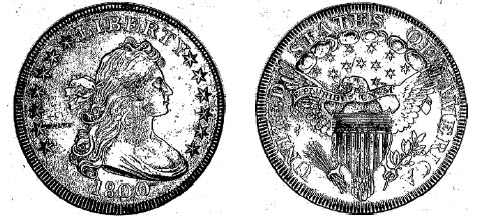
(B-3. H-3.)
• OBVERSE 2: See description under 1800 BB-182.
Obverse die used to strike 1800 BB-182, BB-183, and BB-184.
• REVERSE B: Leaf touches center of lower stand of I in AMERICA (compare to reverse of 1800 BB-181, which touches lower right of the same letter). The two upper stars on the right do not touch the clouds; the other stars each have one point touching. Point of star enters eagle's mouth, not touching lower part of beak. End of branch curves toward eagle's tail. AME close but do not join. A touches both 3rd and 4th feathers. Center of A over cloud 3. Tip of arrowhead under center of U in UNITED.
Reverse die used to strike 1800 BB-183 only.
• DIE STATES:
Die State I: Perfect dies.
• AUCTION POPULATION SURVEY: Good: 1, Very Good: 1, Fine: 1, Very Fine: 7, Extremely Fine: 4, About Uncirculated: 3, Mint State-60 or better: 1. Total: 18. Average grade: VF-27.
• COLLECTING NOTES: The 1800 BB-183 dollar is rare in all grades. Only 40 to 70 are believed to exist.
The record for 1800 BB-183 is quite interesting inasmuch as until recent decades it was considered to be a prime rarity. In 1881, J.W. Haseltine knew of but a single specimen, in Very Fair condition, perhaps equal to what we would call Good or VG today. By 1950, M.H. Bolender had seen just one, a coin which he noted (in the 1952 catalogue of his personal collection) as being "excessively rare, the finest known, and not found by me until 1949. Formerly in 'World's Greatest Collection.' VF, obverse edge nick at top."
Since then, others have been found, but today in the early 1990s 1800 BB-183 remains quite rare. Several dozen or so are known. Why weren't these known earlier? The answer is that by 1950, when Bolender wrote his book, only a few dealers bothered to attribute early dollars in their inventories or auction listings. Nearly all 1800 H-3 (later, BB-183) dollars were bought and sold as having no special consequence. Even today, the leading grading services-NGC and PCGS-do not attribute the early dollars that pass through their hands. Who knows, among the numerous they have certified of this date may be a few of the BB-183 variety. In his 1881 Type-Table, J.W. Haseltine called this variety "excessively rare."
As time goes on, the evaluation of rarity ratings will become more scientific and less empirical. My feeling is that the next decade or two will see a great interest in early dollars, and that this will bring with it a new series of studies, just as has happened in the later dollars series such as the Liberty Seated and Morgan issues.
• NOTABLE SPECIMENS:
European Specimen. MS-60 •• New Netherlands 48th Sale, 1956: 640. "Full Mint State. Highly lustrous, a very few light and insignificant nicks. Originally discovered in Europe, currently the property of a New York dealer."
Baldenhofer Specimen. AU-50• W. G. Baldenhofer to Stack's, Farish-Baldcnhofer Sale, 1955 .• AJ. Ostheimer, 3rd Collection .• Superior Galleries, ANA Convention Sale, 1975: 972. "AU-50, well toned, struck, and has highly polished surfaces. Not perfectly centered, but bold detail with sharp denticles. A few minor edge nicks, mostly above CA of AMERICA.". Superior Galleries, February, 1981: 658, AU-50. "Well toned, struck, and has highly polished surfaces. Not perfectly centered, but bold detail with sharp denticles. A few minor edge nicks.". Auction '86, Rarcoa, 1986: 732. "AU, with nice lustre. Well struck and beautiful."
Holmes Specimen. EF-45.. Stack's, Milton A. Holmes Collection, 1960: 2255. "Lustrous, sharply struck and superbly toned. Full denticles. EF, choice." • Stack's, Don Corrado Romano Collection, 1987: 756. "EF and choice. Lustrous, sharply struck and superbly toned. Full denticles. Glorious gold and pastel iridescent toning."
Boyd Specimen. EF-40• Numismatic Gallery, World's Greatest Collection, F.C.C. Boyd, 1945: 90. "EF with some wear on high spots."
Spies Specimen. EF-40 •• Stack's, W. Earl Spies Collection, 1974: 175. "EF, with mint lustre, some mottled iridescent toning."
• POPULATION DISTRIBUTION:
Approximate population MS-65 or better: 0 (URS-0)
Approximate population MS-64: 0 (URS-0)
Approximate population MS-63: 0 (URS-0)
Approximate population MS-60 to 62: 1 (URS-1)
Approximate population AU-50 to 58: 5 to 8 (URS-4)
Approximate population VF-20 to EF-45: 30 to 55 (URS-6)
Approximate population G-4 to F-15: 5 to 8 (URS-4)
Approximate population for all grades combined: 40 to 70 (URS-7)
• CONDITION CENSUS: 60-55-50 (multiples)